We are competitive library employees who are using this blog for our reading contest against each other and Missouri libraries up to the challenge.
Tuesday, March 24, 2026
The Score
Wednesday, November 26, 2025
A selection of November graphic novels
Briar Vol. 1: Sleep No More by Christopher Cantwell with art by German Garcia (2023) 128 pages
Reading for #hooplachallenge "Beyond the Storybook" theme this month. Clearly leads right into volume 2, but I didn't love it enough to continue. Maybe later. Chapter one "Nothing Sharp in Sight" has the lovely transition from soft storybook telling of Sleeping Beauty leading to dystopian fantasy future. We even get a rodent of unusual size! The beginning of Briar Rose's journey is handled well. Bloody and scatological, Cantwell's use of language is stilted. Chapter two "The Witch Which Witches Not" reveals the evil that pursues Briar Rose and her growing band of misfits. Chapter three "Of Villainous, Cruel Gnomes" starts with a flashback for a new character and continues with the same sort of dark adventure. Chapter four "Adra Adrata Adracta" brings the threads together pretty well and reveals a surprise that makes sense going back to the beginning. I like the band of misfits and visually I like the series. I do want to find out what happens next, so I probably will pick up volume 2 at some point.
Ruins by Peter Kuper (2015) 328 pages
"Samantha and George are a couple heading towards a sabbatical year in the quaint Mexican town of Oaxaca. For Samantha, it is the opportunity to revisit her past. For George, it is an unsettling step into the unknown." I loved seeing the butterfly's journey. I loved getting to know the city of Oaxaca (wah-ha-ka) and surrounding areas of Mexico. Many layers to the relationship story, but a troubled one.
Lackadaisy: Volume 1 by Tracy J. Butler (2009) 96 pages
Tracy J. Butler is a local St. Louis artist. This is set in St. Louis in 1927. Prohibition has sparked the engine of organized crime. The story is full of 1920s slang and references. Good sense of humor. Good character development of anthropomorphized cats in spiffy outfits.
Once Upon a Time Machine edited by Andrew Carl, written and illustrated by many artists (2012) 431 pages
Anthology of many international comic artists adapting fairy tales from around the world into futuristic tales. There seems to be a large number of artists from Philadelphia invited to contribute. It is a mix of more or less successful adaptations. Some artists have provided just a single page illustration, but it is the other short adaptations that make it worth your while. I'll highlight a few that I thought were clever and unique, but you may be more strongly drawn to others. I thought "Pinocchio or The Stars Are Not Wanted Now" had a nice twist on the lesson of telling the truth or telling lies. "The Puppet-Show Man or No Strings" is based on a story I'm not familiar with, but it drew me in with its grungy art and 'be careful what you wish' lesson. "The Shepherd and the Weaver Girl" feels epic and mythical. This adaptation of the Chinese myth has a clever way of drawing on the old and imagining it in the future. I also liked the nanotechnology dreamed up in the adaptation of "Rikki-Tikki-Tavi." The adaptation of "The Ugly Duckling or The Ugly Part" changes the ingredients of the story quite a bit, but achieves a better moral in the end. I really enjoyed "Vasilissa the Beautiful" based on a Slavic Baba Yaga tale. And "The Gold Piece or A Destiny Earned" was sweet and meaningful.
Washington's Gay General: The Legends and Loves of Baron von Steuben by Josh Trujillo with art by Levi Hastings (2023) 192 pages
"A graphic novel biography of Baron von Steuben, the soldier, immigrant, and flamboyant homosexual who influenced the course of US history during the Revolutionary War despite being omitted from our textbooks." I love learning about history and a person's life in this way. Well illustrated and moves along fairly quickly. Some memoir scenes and other brief introductions of queer people in history are sprinkled in too.
Ash's Cabin by Jen Wang (2024) 320 pages
I grew up enjoying Illustrated Classics versions of Swiss Family Robinson and Robinson Crusoe. I also loved imagining the survival stories in Island of the Blue Dolphins and Incident at Hawk's Hill. I loved this story of nonbinary Ash challenging themselves to find their grandpa's hidden cabin in a National Forest in California. It feels very real as Ash studies and prepares. This is not a spur of the moment decision. Learning to survive with their dog, Chase, is an experience in which they learn from their mistakes and find what is most important in their life. Great art and structured like a journal.
The Stoneshore Register by G. Willow Wilson with art by M.K. Perker (2025) 128 pages
I like the lead character, Fadumo, a refugee and stranger to this Pacific Northwest town. The townspeople are fairly well drawn too, but we don't get to know them very deeply. I like the exploration of the uncanny and weird. I didn't enjoy chapter 4 as much. Chapter 5 nails the real message of the graphic novel when the immigration agents come looking for Fadumo. G. Willow Wilson's writing continues to be enjoyable.
Aristotle: A Graphic Biography by Tassos Apostolidis with art by Alecos Papadatos (2024) 216 pages
Nice framing device with a colleague of Aristotle teaching his students about Aristotle's life and thoughts. I like the basic color scheme. Some lengthy text for historical exposition is mixed with occasional humor and fairly detailed summaries of Aristotle's major philosophical concepts. I like the peek into daily life around Greece of the time and how Aristotle's relationships with family and friends is portrayed. The book does a good job of making him more than just the figure behind these abstract ethical/scientific concepts. He was real and enjoyed life.
Wednesday, June 11, 2025
Meditations for Mortals
Mediations for Mortals: Four Weeks to Embrace Your Limitations and Make Time for What Counts, by Olive Burkeman, © 2025, 208 pgs.
I'm a sucker for the occasional self-help book but about 90% of the time they tend to be very tedious reading or not really well-written and I end up putting them back on the shelf. This one was a great surprise and one that demanded to be read--it feels less like reading and more like having a nice chat with a good friend. Burkeman is quick to point out that this is not a "how-to" book--there is no list to follow in order to achieve instant life-changing nirvana--those books rarely work. This is a down-to-earth guide on learning to use what we have, let go of what we don't need and doing things that really matter to you in the brief amount of time we all have on this Earth. Instead of being a cheerleading kind of book, the author reminds us that our time is infinite and true happiness comes from learning how to use the time we have in order to get the most out of our lives and ourselves. The book is separated into short chapters and is meant to be read a chapter per day, allowing you to finish the book in four weeks at a leisurely pace that also allows time for the reader to engage in thoughtful reflection. Of particular note is a chapter on staying sane when the world's a mess--useful advice in some troubling times.
Tuesday, May 13, 2025
A selection of May graphic novels
The Contract with God Trilogy: Life on Dropsie Avenue by Will Eisner (2005) 498 pages
The original publications of the three books in this set were in 1978, 1987, and 1995. Not a fan of the first three short stories in A Contract with God, even though they each have good moments. Loved "Cookalein" with its strong literary characterizations and bringing multiple threads with adult themes together in a satisfying way. Eisner explains in his preface that Cookalein is a Yiddish-English word that means "cook alone." Instead of bed and breakfasts, farms in upstate New York offered summer holiday stays with bed and kitchen. Multiple families had access to the kitchen so the mothers could cook for their own families. The second novel in this graphic novel trilogy, A Life Force, is excellent! It starts in the Great Depression and explores the meaning of life through Jacob Shtarkah's family and neighbors as well as his observations of a cockroach. Again Eisner is brilliant at probing the depth of characters. He brings the novel to graphic novel with many subplots on the side and real history affecting the characters at the center. All of these stories take place around the fictional Dropsie Avenue in the Bronx, NY. The third novel, Dropsie Avenue, traces the history of this neighborhood beginning in 1870 when this part of New York was still farmland. The story moves quickly through all the changes of ethnicities that call this neighborhood home throughout the century. It is an immigrant story and a microcosm standing in for many small towns that turned into big cities. The story is full of tearing down and building up, politics and business deals, tragedy and celebration, biases and prejudices. Year after year, decade after decade, with certain characters getting older, Eisner again illustrates our very real world.
Advocate: A Graphic Memoir of Family, Community, and the Fight for Environmental Justice by Eddie Ahn (2024) 208 pages
This memoir covers a lot as indicated by the subtitle. The author/artist strangely is a bit distant in revealing his personality. It comes through in certain moments, but in describing the facts of day to day work and repeatedly trying to explain his career to his parents, who do not understand, Eddie remains elusive. I liked the realistic art, which is like a photo album. The different color tints help distinguish different times and places. I wish the book went even more in depth about environmental justice efforts.
Orbiter by Warren Ellis with art by Colleen Doran (2003) 104 pages
Short and intriguing. Perhaps too short to let you really get to know the characters. Set in a dystopian near future that imagines NASA's space program ended after shuttle Venture burned up on launch. Inspired by the loss of Challenger. But 10 years later the shuttle reenters the atmosphere and crash lands near the Kennedy Space Center. Scientists whose careers ended are put on the case by the military to solve the mystery. There is a lot of science-y speculation to explain the condition of the shuttle and the one surviving astronaut. Pretty fun adventure like a Michael Crichton thriller. Somewhat dark and gritty art.
And Mankind Created the Gods: A Graphic Novel Adaptation of Pascal Boyer's Religion Explained by Joseph Behe (2024) 368 pages
This is dense with a lot of complex ideas. Fascinating to think about. It is based on Pascal Boyer's book Religion Explained. Pascal appears in the graphic novel leading a philosophical dialogue. Picture Plato exchanging ideas with a group of people. For visual learners the black and white illustrations of the dinner party conversation, world cultures, and the workings of our minds are very helpful. It is difficult to sum up. You just have to dive in and explore with Pascal's dinner guests yourself.
Tuesday, September 24, 2024
Sophie's World
This novel is about a high schooler in Norway, named Sophie, who begins receiving mysterious letters offering a course on Philosophy. I've had it on my reading list since before I used Goodreads. It was a nice review of the Intro to Philosophy course I took in college. About half way through you find out an officer working for the United Nations in Lebanon has written this work of fiction and has sent it home to his daughter Hilde, who is the same age as the fictional Sophie, for her birthday. By this point, I had become invested in the story of Sophie and her Philosophy teacher, so it was a bit frustrating that Sophie's story becomes more and more fantastic, and Hilde's story is about her reading what we have just read. My college course ended with Kant, so I was interested in an overview beyond that period of philosophic thought. The Philosophy teacher in the story begins pulling in other sciences with discussion of Darwin and Freud. More and more mythical and fairy-tale characters strangely pop up in Sophie's world as well. It really leans in to the dual worlds of grounded reality and mysterious fantasy, but I don't think the author mixes them particularly well.
Thursday, May 30, 2024
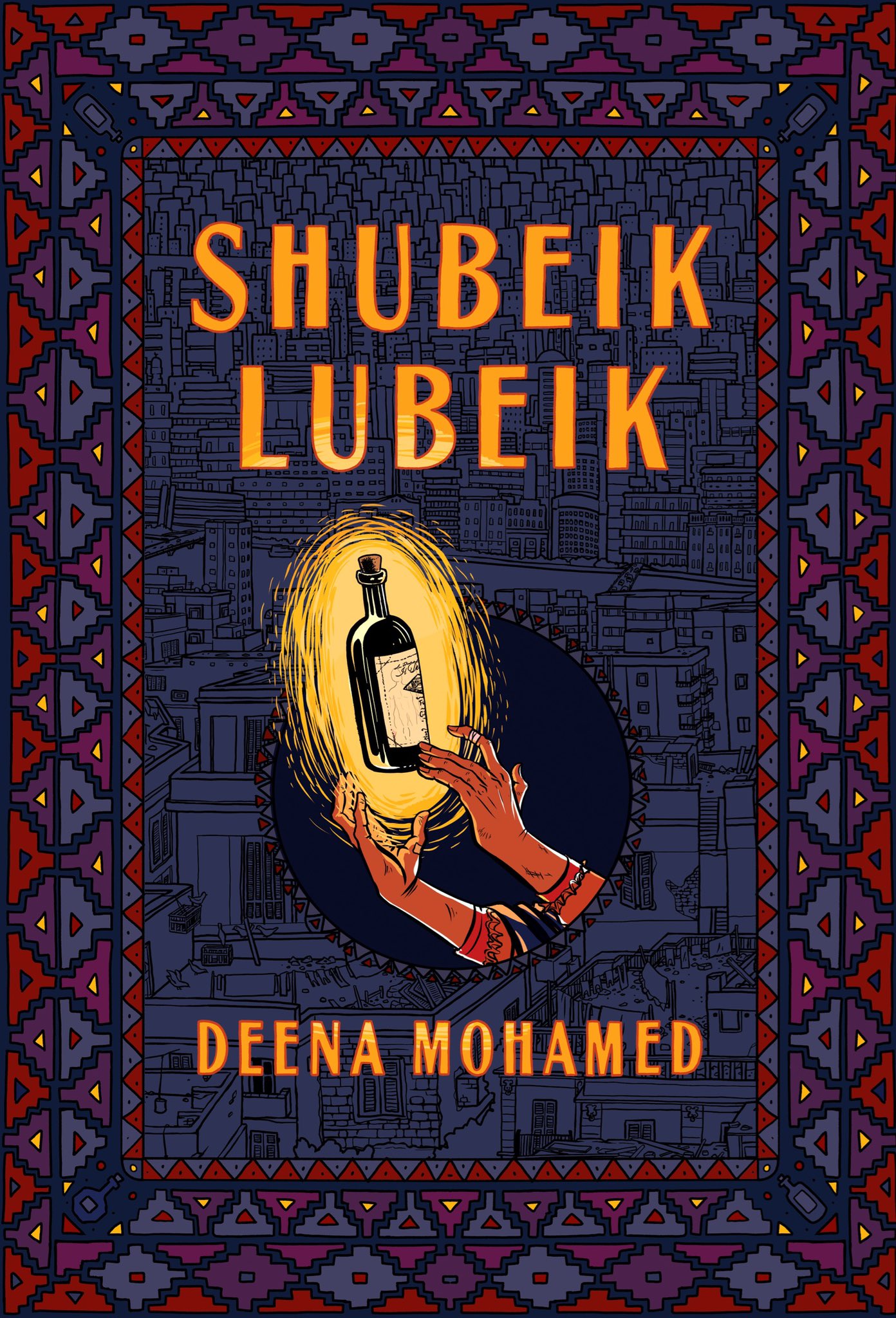
Shubeik Lubeik
Regan and Kara previously reviewed this on the blog.
"Your wish is my command." We've all heard a genie say that. If your wish is to be told many stories, this graphic novel is for you. It was originally three volumes in Arabic. I loved the art work and adapted pretty quickly to reading right to left. With multiple flashbacks there are more than just three stories about how three first-class wishes sold at Shokry's kiosk are used. There are two parts to Aziza's story, when she is young and when she is middle aged. Mostly it is about the lack of justice for the poor in the Egyptian justice system. There is one really in depth story about college student Nour's mental health (with a brief tangent about the talking donkey) in part two. Part three is so good! We get a history lesson from the perspective of Abu Shokry, Shokry's father, covering 1954 to 1980, then with Shokry carrying on to 2020. Shokry, the kiosk owner, is a giving person and wants to help others. His father's generation taught him that devout Muslims do not use wishes, so he really agonizes over the last first-class wish that hasn't sold. Hagga Shawqia is a regular at Shokry's kiosk, and we learn much more about her from her friends and family as she nears the end of her life. There is tragedy and triumph. She is such a fascinating character, a "gutsy gal." We check in with Aziza and Nour. The book subverts the traditional end with a darkly hilarious bow on the talking donkey story too. This was such a fun read.
Thursday, December 21, 2023
Pedagogy of the Oppressed
Pedagogy of the Oppressed by Paulo Freire (1968) 183 Pages
Originally published in Portuguese, Freire writes what is now known to be one of the foundational texts for critical pedagogy. In the work, Freire proposes a new relationship between teacher, student, and society. Pedagogy refers simply to the theory and practice of teaching and learning. Freire dedicates this text to the oppressed, especially those he has had close contact with in Brazil, teaching students to read and write. In this text, Freire applies a Marxist class analysis to the relationship between the colonizer and the colonized. This is especially true for Brazil, a country which has been colonized heavily by Europeans for over a century. Paulo explains that the current model of pedagogy treats the learner as something to be filled with knowledge and argues that a better model for the learner includes that person as a "co-creator" of knowledge. Like most Latin American countries, Brazil was involved in a regime change or coup led and backed by the US, during which time Freire was exiled from his home for 16 years. Because of his experiences during exile, Freire was able to get a better understanding of relationships between social classes and the ways in which lower classes are taught. One of the main themes he wrestles with is humankind's main problem of affirming their identity as human. He states that everyone strives to attain this affirmation but oppression prevents many from achieving this.
Thursday, December 7, 2023
Too Like the Lightning
Too Like the Lightning by Ada Palmer, 432 pages
The year is 2454, and in the somewhat-utopian world that has replaced our version of society, most criminals are sentenced to dedicate their lives to serving others, something that is tracked by the aptly named tracker that all humans must wear 24/7. That's exactly what our narrator, Mycroft Canner, must do. But in the course of his work, he has discovered a young boy without a tracker, but with an amazing ability to bring life to the inanimate, and Mycroft is determined to protect this child at all costs. Meanwhile, a tracker-tricking device that society has linked to Mycroft has been used to steal an influential list of global leaders — kind of like the Time Person of the Year or People's Sexiest Man Alive, but with the ability to set off a political chain reaction that could upset the world order. Because of his old association with the device, Mycroft is pulled into that investigation by a cabal of world leaders, which makes protecting the child (and Mycroft's own secrets) even more difficult.
The plot and premise of this book is intriguing, and Palmer's worldbuilding is incredible. However, Mycroft's obsession with 18th Century philosophers (and the ensuing philosophical deep dives) is at odds with the setting, making the first half of the book in particular a tough read. There are plenty of confusing bits (Mycroft's gendering of characters in a theoretically genderless society, the handful of names each world leader goes by), enough that I'm really debating reading the second book in this quartet, even though this one ends on a bit of a cliffhanger. Should make for an interesting Orcs & Aliens discussion in any case!
Tuesday, February 28, 2023
Rationality
Rationality: What It Is, Why It Seems Scares, Why It Matters by Steven Pinker, 412 pages
Thursday, January 12, 2023
Self-Confidence: A Philosophy
I am a bit of an introvert and side-musician dealing with more anxiety issues as I get older, especially in crowds or playing music, so I was looking for texts that could speak to basic strategies on gaining more self-confidence in those areas. While this book was not as procedural as I imagined it would be, it was actually very aspirational, and reminded me of my time in undergrad reading transcendentalist authors, like Emerson and Thoreau. Much of the book is written in an uplifting, inspirational manner, which I generally sort of despise, but this doesn't feel sappy. The book abounds with analogies and metaphors intended to get the reader to reflect on their own experiences with confidence, while referring to famous quotes throughout the ages. There's a bit of philosophy, a lot of straight talk that is very down to earth and serves as a good reminder to what's important in life. The book first breaks down what confidence is, or rather the concept of confidence--what we tend to think of it. It then begins to investigate how self-confidence works and provides useful examples both historical and modern. It was an interesting concept to think of achieving self-confidence as something you cannot do on your own, paradoxically. According to the author, confidence is derived by others in our life, who help to make us feel confident--people who help us increase our feelings of competence--and then we begin to (or should) move forward in the direction of trusting ourselves, our intuition, of building a natural resistance to fear of the unknown and developing a categorical mistrust of life as a whole. We must become brave and learn to navigate uncertainty, to listen to ourselves and trust our rational minds. That is the only way to true self-confidence. Personally, this is less of a self help book and more of an agnostic, inspirational text, I definitely enjoyed it. It was a fast read and really aims to get you out of your own head. Good for adults and teens.
Thursday, November 25, 2021
Feline Philosophy
Feline Philosophy: cats and the meaning of life / John Gray 122 pgs.
I think this is trying to say that if you were a cat, you wouldn't need philosophy because the cat just lives its life. Maybe there IS something to learn here.
Tuesday, October 19, 2021
The Midnight Library
The Midnight Library by Matt Haig (2020) 288 pages
Nora has made a number of decisions in her life that have led her to feeling miserable. By halting her competitive swimming, she disappointed her father who dreamed for her to be in the Olympics. By quitting the band she was in with her brother– just as they were getting very popular–she disgusted her brother. She decided not to marry her fiancé at the last minute. The list goes on.
Feeling despair after she loses her job and her cat dies, she takes an overdose of medication. However, she unexpectedly finds herself at the Midnight Library, a place between life and death. In the Midnight Library, time stands still and and an infinite number of books give her the opportunity to make a different choice at various junctures in her life.
First Nora fights the idea of trying any of these other lives, but encouraged by the librarian, she eventually makes choices–one after another–to change something in her life to see how her life would have been. It's a fascinating idea, to see what other possibilities are possible if only one had taken a different path here or there. Nora wonders how she will know if any of the alternate lives is the right one for her. Her philosophy degree gets a bit of a workout.
This book has been circulating from our library almost non-stop, and I was so glad to finally get a chance to read it.
Saturday, May 22, 2021
36 Arguments for the Existence of God
36 Arguments for the Existence of God by Rebecca Newberger Goldstein (2010) 402 pages
In this work of fiction, Cass Seltzer, a professor at Frankfurter University in Boston has written a book titled "The Varieties of Religious Illusion," and has surprisingly (to him) garnered acclaim, with his book translated into 20+ languages. He's been interviewed numerous times and dubbed "The Atheist With a Soul" by Time magazine. He has been offered a position at Harvard after teaching several years at Frankfurter, where he obtained his doctorate.The plot weaves back and forth in time, showing his life growing up with a mother who had fled her Hasidic roots, getting his premed undergrad degree from Columbia University, and his life's course abruptly changing when he follows Professor Jonas Elijah Klapper to Frankfurter University to study in the Department of Faith, Literature and Values. He has finally gotten over his divorce and is currently in a relationship with Lucinda, a hyper-competitive expert in Game Theory who is known for "fanging" lecturers.
The characters teem with quirkiness, especially Professor Klapper, a pompous teacher who disdains the sciences; Roz, an old girlfriend who spent years studying a tribe in the Amazon; and also Azarya, a Hasid child who figured out for himself–by age 6–prime numbers. I needed to keep a dictionary handy for this novel, even on my third trip into this academic world, but it was so worth it.
Monday, August 17, 2020
Zen Pencils Vol 2
Another win from Than, this volume is a delight from start to finish. The way he uses his art to expand the words...all of which are deep and meaningful anyway, is impressive. I lingered over each and every page. My biggest problem now is that I've read everything available by the author. Looking forward to his upcoming middle grade series.
Saturday, August 1, 2020
Zen Pencils
Saturday, June 15, 2019
The Power of Myth
Every few years (or several this time around) I pick up this book and reread it. I first learned about Joseph Campbell by watching the PBS series with Bill Moyers when it was broadcast back in 1988 and I came to love his work. This book is the transcript of the series with added material that was edited from the shows. Campbell, a professor, storyteller, mythologist, and philosopher explains the connections between the mythologies of the major religions and contemporary culture. Campbell's work uses the idea of the monomyth (all mythic stories are variations of one great story), the hero's journey (explained further in his book The Hero with a Thousand Faces), and Jungian psychology. He is also standard bearer for the idea of following your bliss which is mentioned frequently in the book. At the time of his death Campbell was working on his Historical Atlas of World Mythology. That series remains unfinished and is out of print. I had copies of the volumes that were published but they were irreparably water damaged in my leaky basement. 😢
Sunday, March 24, 2019
If cats disappeared from the world
I enjoyed this philosophical book about end of life choices and the meaning of life. Our unnamed narrator is a postman with a brain tumor. He is not long for the world when the devil shows up and asks him if he wants to extend his life by allowing the devil to make something disappear from the world. On the first day, phones disappear. The next day, movies are gone, then clocks. But when the choice is cats, the narrator decides it is time to die. The reader does a great job and I appreciated hearing the Japanese names/place pronounced correctly.
Sunday, September 23, 2018
The Three Escapes of Hannah Arendt: A Tyranny of Truth
The Three Escapes of Hannah Arendt: A Tyranny of Truth, by Ken Krimstein, 233 pages.I knew absolutely nothing about Hannah Arendt before I read this book. I am not proud of that, I'm just saying. This was an absolutely fascinating introduction to the German / Jewish philosopher, writer, and thinker. Arendt was a student of Heidigger, and for a time, his lover. After her affair with Heidigger ended, and as the Nazis came to power, Arendt has to make her first escape.
Krimstein's art and story reinforce each other and strengthen the narrative, and it is quite a narrative. Arendt and her mother have to escape the Nazi's again, moving first to Paris and then on to Portugal before finally ending up in the United States. She knew many of the great thinkers of the day, from Einstein to Brecht. She taught at Princeton and penned some of the most important works of the twentieth-century including The Human Condition, The Origins of Totalitarianism, and Eichmann in Jerusalem.
A fascinating look at an extraordinary thinker. Easily my favorite piece of graphic literature of the last couple of years.
Sunday, April 29, 2018
Montaigne in barn boots
Not familiar with Montaigne, I read this book because I've liked other books by Perry. This one is pretty great, finding intersections between the life of Michel Montaigne, a 16th century French nobleman and the author, a 21st century Wisconsin writer and family man. Perry compares what he learned about and from Montaigne, with his contemporary thoughts and his personal history. The audiobook is read by the author and it is a great listen. Highly recommended.
Monday, March 21, 2016
Franny and Zooey
I read this book in high school 40 something years ago and frankly didn't remember a whole lot about it. The book is made up of a short story, "Franny" and a novella, "Zooey." Franny and Zooey are two of the Glass siblings who grew up in a family of highly intelligent kids who were featured on a genius kids radio show. Now all grown up, Franny attends college and has become obsessed with a short book The Way of the Pilgrim and the concept of praying without ceasing. A discussion of this with a boyfriend in a restaurant reveals that he is more interested in himself and getting to a football game. In the novella, Zooey, now an actor, is portrayed soaking in the bathtub, reading an old letter from his brother Buddy. His mother intrudes, demanding that Zooey try to help Franny who has suffered an emotional breakdown. There is much discussion of Buddy's reclusiveness and another brother, Seymour, who took his own life years before. Finally Zooey retreats into the bedroom once shared by Buddy and Seymour to read the philosophical quotes tacked to their door. Eventually he calls Franny for further philosophical discussion. I probably didn't remember much from my first read because I didn't understand it then. While I understand it now I am not very impressed.


