Showing posts with label psychology. Show all posts

Friday, March 28, 2025

Another selection of graphic novels read in Mar.

 Are You My Mother? A Comic Drama by Alison Bechdel (2012) 290 pages


Unfortunately, I liked this one, the third I've read by Bechdel, the least. She has a hard time deciding how to start this book about her relationship with her mother, with what memory. She spends more time describing her psycho-analysis therapy sessions than showing us memories with her mother. There are a lot of big psychology concepts about parents and children, objects and subjects, plus quoting Virginia Woolf. I could not understand it all. I enjoyed her memories of life with her mother, some of it was relatable. I think the biggest flaw was the structure. I could not find the thread of the story as she jumps around from writing Fun Home to writing this book, from going on a promotional tour for Fun Home to moving away to college memories, from teenage memories to childhood memories, from one therapist to another, from one girlfriend to another, and from her mother as a widow in recent years to back when she was newly a widow and still doing theater. Dream analysis and certain phone conversations with her mother sometimes are revealing, but too often don't connect. Oh, and the ebook of this on Hoopla had the margin cut off too high across the bottom. Some text was cut off.

Berlin by Jason Lutes (2018) 580 pages


Epic! Three books bound into one. I loved this historical fiction about the Weimar Republic, the years between WWI and WWII in the title city. The characters are so well developed. Such a wide range of perspectives like in life. Such diversity like in life. There is a trans character, so this could count if you are participating in a trans rights readathon through trans visibility day on March 31. So timely with the politics currently happening in America. The nightmare of the rise of Fascism and their efforts to eliminate dissent and diversity has happened before and we must learn from history. Jason Lutes has crafted a story and art that is incredibly full of life!


Bad Dream: A Dreamer Story by Nicole Maines with art by Rye Hickman (2024) 205 pages


My wife and I enjoyed streaming the CW's Supergirl series. When I saw that the actress who played Dreamer, Nicole Maines, was writing a comics origin story of her trans superhero character, I was excited to read it. I've also read Jadzia Axelrod's Galaxy: The Prettiest Star graphic novel with a handful of land of Oz references, and a couple characters from that crossover in this story. This is promoted as a DC YA crossover. Rye Hickman's art has a YA feel, not too gritty, brightly colored with plenty of pink and blue, and not too realistic. Nia's dreams, especially before she embraces her Dreamer powers, which includes this entire prequel adventure before the events of the TV series, are topsy-turvy and hard to interpret. While some would accuse it of woke-ness, as if that is a bad thing, there are plot points exploring the way alien refugees are treated and how families sometimes disown their queer children. T
his would also count if you are participating in a trans rights readathon through trans visibility day on March 31.

Thursday, November 21, 2024

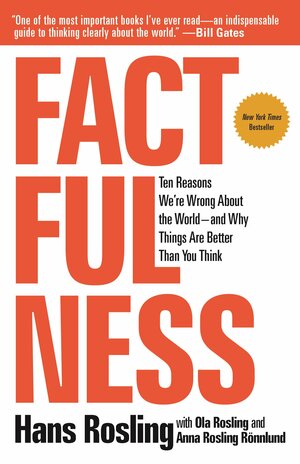
Factfulness

Factfulness: Ten Reasons We're Wrong About the World -- And Why Things Are Better Than You Think by Hans Rosling, 288 pages.

The book starts with Hans Rosling, a professor of public health and medical researcher, gathering a whole lot of data. He surveyed people in all sort of specializations, at all sorts of income levels, in countries around the world; and found that people consistently did much WORSE than they would have guessing randomly when asked about global trends. His questions had to do with things like rates of childhood vaccination, global population trends, and extreme poverty. People worldwide consistently not only overwhelmingly got the questions wrong, but usually thought things were much worse than they were. 

This book is Rosling's attempt to get at the kinds of logical fallacies and thought traps that contribute to all of this incorrect information. Each of the ten chapters is dedicated to a different one of these "instincts" he has identified, such as the "gap instinct" or the "straight-line instinct" (respectively: the tendency to want to separate things into two distinct groups, and the tendency to think rates of change are constant). Each chapters uses both a plethora of examples and data to illustrate the point, then ends with easily actionable bullet points to help reform your own thought patterns. 
I think this is a pretty useful little book! It is both easy to read and fairly actionable, and I appreciate that the author is very excited to share where he gets his information from. This is also not written as an inflammatory book at all, but rather something that's intended to be both comforting and productive. There were times that I found his reasoning to be a little simplistic and occasionally lacking in nuance, but I would still consider this to be a book worth reading, especially with the vitality of media-literacy today. 


Thursday, October 5, 2023

The Art Thief

 The Art Thief: A True Story of Love, Crime, and a Dangerous Obsession, by Michael Finkel, 221 pgs. 

Most heist films start off with a big plan, a cadre of ruffians who each bring their A-game along with the latest technology for subterfuge. The Art Thief is the opposite of all that. Starting in the late 90s, Stephane Breitwieser, alongside his girlfriend and accomplice Anne-Catherine Kleinklaus, strolled into a museum in Belgium wielding only a swiss army knife and stole a 17-century, ivory-carved statue of Adam and Eve. No trip wires. No midnight rappel from a rooftop window. He walked right in during the guards lunch hour, put the statue in his waistband, and went home. And so began his insane spiral into stealing art all across Europe.

Breitweiser spent the next decade filling his tiny apartment above his mother's house with artifacts, oil paintings, engravings, statues--anything that caught his aesthetic eye. Most of the work he nabbed was from that similar time period, and to hear his side of the story as told by the author, he was a lover of art--not a thief. To wit, he never threatened violence against anyone, never damaged museum property, and--here's the kicker--never tried to sell any of the art. Investigators believe that's what made him so hard to catch. To Stephane, there is a long history of people stealing art from other cultures and he saw himself as carrying on that legacy. Not to make money but to enjoy and become closer to the work. However, even the best criminals get sloppy.

This is an unbelievable ride of  book where you find yourself shouting at Stephane saying "how is he going to get away with this?!" And then he does, time and time again. For adults and teen art students. Highly recommended (reading the book, not stealing art). 

Friday, September 8, 2023

Thinking, Fast and Slow


Thinking, Fast and Slow by Daniel Kahneman (2011), 499 pages

Really intriguing study detailing the nuts and bolts about "how" we think. The easiest way to visualize this is to imagine that there are two systems for processing thoughts in your brain--one that works fast and one that works...not so fast. System 1 is sort of automatic and operates quickly with little or no effort and no sense of voluntary control. It's how we make intuitive decisions quickly. Think of the following problem:

5+5 = ?

You know the answer from experience and you didn't need to engage any sort of "back-end" brain functions. 

System 2 demands that your brain slows down to recall information or any steps to solving more complex or nuanced problems. Try to solve this problem in your head:

18,480 x 5,390 = ?

Your heart probably started beating faster and your eyes dilated. That's your system 2 kicking in. Your brain is recalling a whole host of steps and memories and processes for solving a problem like this. 

Both systems operate independently but tend to support each other over a range of activities, for example, emotions (system 1) are crucial in adopting logical reasoning (system 2). The main function of System 1 is to maintain and update a model of your personal world, which represents what is normal in it. System 2 focuses on choice and concentration. Kahneman also details some of the most recent research in heuristics and decision-making. A deep-dive of a book that offers an important perspective into how human being really operate and why. 


Wednesday, April 26, 2023

Atomic Habits

 Atomic Habits: An Easy and Proven Way to Build Good Habits and Break Bad Ones, by James Clear, 306 pages


This was a fast read. I usually despise  "business" self-help books like this but another author I enjoy recommended it. Ultimately, the advice here can be used for anything.

What caught my attention initially was the author's personal story in the introduction. As a young man, he's involved in a horrific baseball accident that puts him into a coma and on a ventilator. He rebounds, but his arduous recovery forces him to develop positive habits to ensure the return of his health and achieve his academic dreams. He attributes this system of habit-building to his current success. 

Bottom line: if you want to get started on a new habit, whatever it is, follow these 4 laws:

  • Make it obvious
  • Make it attractive
  • Make it easy
  • Make it satisfying
Each section of the book dives into these laws with abbreviated scientific studies, true-to-life vignettes, and tips on how to implement these laws while trying to solidify your new habit. One interesting trick is known as "habit-stacking," where you attach your newly desired habit to an already existing habit. For example:

1. After I (CURRENT HABIT), I will (HABIT I NEED). 
2. After (HABIT I NEED), I will (HABIT I WANT). 

So after you get back from lunch, you will call three new clients (need).
After you call three new client, you will check social media (want). 

For me, trying to make a new habit produce a dopamine hit seems to be the best way to add it to my schdeudle. If you can associate your desired habit with the reward center in your brain, you'll be on a surefire path to learning how to...knit? Skateboard? Juggle? Juggle your knit creations while skateboarding? Try it out and let me know how that goes. 

Recommended for adults. 

Wednesday, April 12, 2023

Flow

 Flow: The Psychology of Optimal Experience, by Mihaly Csikszentmihalyi, 303 pgs. 


At the heart of this book is a very simple idea: attention is a finite block of mental energy and in order to create positive growth in our lives, we must learn to control our consciousness--or, enter a flow state of mind. 

To do this, we must protect our awareness of the world around us and learn to control our consciousness. In doing so, we can improve our skills, our mental health, our relationships--our entire lives. "The flow experience is typically described...as lacking the sense of worry about losing control." Throughout the book, the author works to illustrate different states of flow, in work, family and our creative endeavors. 

The biggest takeaway for me was the author's description of flow activities. Typically, a person will begin some new skill, like a sport or a craft and as they begin at an easy level, they enter a flow state; it's fun, they're learning and succeeding. But eventually, the person will get bored with their current skill level and need to challenge themselves. This takes them out of the flow state. At that point, they are are learning new skills or improving on current skills, in order to return to the flow state at a higher skill level. 

This diagram illustrates the thinking behind this concept:

So whenever you're doing something and your anxiety is up and the task seems too difficult, just tell yourself you are working towards a flow state 😊

I liked this book overall, though it feels a little dated reading it in 2023 and I wonder if there are similarly-styled works on the same topic. While it is not light on scientific references, it tends to feel that way because of Csikszentmihalyi's writing style--the book reads less like a well-researched psychology text and more like a professor's ongoing lecture. As a result, occasionally it feels like Csikszentmihalyi starts to lose the book's overall message in his own descriptive language and penchant for analogies. But the overall thread remains the same throughout--"attention shapes the self, and is in turn shaped by it." 

Recommended for adults. 

Musicophilia

 Musicophilia: Tales of Music and the Brain, by Oliver Sacks, 425 pages.

Have you ever gotten the melody of a song stuck and in your head? We commonly refer to those as earworms but Oliver Sacks like to think of them as "brainworms."

This author has been on my to-read-list for a while now after seeing the 1990 Robin Williams film Awakenings, based on Sacks' work as a neuroscientist.  This is the perfect introduction to his life's work, which details some of his strangest and fascinating encounters with people who become plagued with issues of the mind--this one specifically catalogues stories of patients who suffer with (and in some cases, prosper from) uncontrolled issues of music related to the brain. This is a very empathetic and fascinating read, mostly short vignettes about interesting case studies Sacks has encountered in his storied career in the medical field. Patients who develop musical "hallucinations," concert musicians whose fingers suddenly revolt and refuse to play, a patient who constantly hears micro-tones, people with Tourette's who can only control their condition by continuously playing piano--the list seems endless. 

Many of the tales here feel unresolved, as many of these maladies are so peculiar and strange that cures and treatments are few and far between. Oftentimes, the very real people in these stories must learn to cope and live with their audio-induced ailments. Sacks flits about from one strange encounter to another, curiously musing on each case study briefly but with all the care of a trusted friend. One such heartbreaking story is of Clive Wearing, an accomplished musicologist and conductor, who contracted a herpes simplex virus that attacked his central nervous system and primarily affected his hippocampus. The resulting damage obliterated his brain's ability to make and retain new memories. New memory events for him last between 7 and 30 seconds. He couldn't remember his children's names or the last time he saw his wife (even though she continues to visit him regularly). And yet Clive was still able to play a piece of music from start to finish on the piano. Sacks muses that Clive can do that because melody is not a memory, but plays in our mind. "For those moments he was playing he seemed normal." But when the music stopped, Clive was lost to time once again. 

Fascinating, quick reading about the brain, neurology and music related trauma. Recommended for adults. 

Friday, March 3, 2023

Negotiating the Nonnegotiable

Negotiating the Nonnegotiable: How to Resolve Your Most Emotionally Charged Conflicts, by Daniel Shapiro, © 2016, 319 pages

There have been many books written recently documenting our current level of intense polarization across the United States and elsewhere, highlighting the growing increase in an ever-present state of conflict, but few books written with the sole intention of providing us with the tools needed to navigate, defuse and otherwise deescalate some of those conflicts. Negotiating the Nonnegotiable does just that. 

Daniel Shapiro, founder and director of the Harvard International Negotiating program, lays out a fundamental text for anyone interested in how to get beyond conflict, how to bridge the gap between individuals and groups, and how to think about conflict from a birds-eye perspective. And this author has the credentials. This is not some feel-good, self-help book--Shapiro has launched conflict resolution initiatives across the globe. 

He starts off by identifying what he calls "the Tribes effect," showcasing the subtle ways our identity is shaped by our surroundings and the social groups with which we become aligned. Shapiro then writes of the different ways the tribal mindset sabotages our faculties and essentially our abilities to think critically and objectively about a conflict. One of those ways I found fascinating was what he refers to as vertigo. Have you ever been so mad at another person during an argument that all you can see is the color red? That's vertigo. It's a state we find ourselves in during a conflict when we feel our identity is under threat. It affects us outside our awareness, makes us fixate on negatives, and diminishes our capacity to self reflect. Shapiro provides the reader with strategies that improve self-awareness during conflicts so that we be forward-thinking about what exactly is at stake and what our main objectives are. 

This book is not a political book but focuses on  resolving conflict between any kind of relationship--political or personal, groups or individuals, everything in-between.  If you've ever had a disagreement with a family member and you felt that there was no getting over it, this may be a good start to learning how to bridge the gap. Check out this video to get a sense of what this book is about: https://youtu.be/PBkDdWzXTO0

Recommended for adults interested in social science, psychology, conflict resolution and improving relationships. 

Tuesday, February 28, 2023

Rationality

 Rationality: What It Is, Why It Seems Scares, Why It Matters by Steven Pinker, 412 pages


If it snows, it's cold. That is a true statement, right? But think about that in reverse. If it's cold, it snows. Is that always true? No, because there are a multitude of reasons why it could be cold but also not snowing. Welcome to the wonderful world of logic! If you were in a freshman logic course, this might be the first logic puzzle you encounter. Logicians swap the nouns for letters (if A, then B) and try to turn statements like these (and longer) into a mathematical equation to be proven true or false. This is where the book Rationality gets started. 

In this text, Harvard psychologist Steven Pinker makes his case for the importance of rationality, a concept as old as Greek civilization, but no less important, especially in our modern time. Pinker discusses how rationality, more than anything else, predicates most of what we do and what we achieve as individuals and as a society. If you've felt like the world around you is descending into chaos, Rationality is a good book to offer some hope about the world while improving your own critical thinking skills. Some of the best parts of this book involve Pinker's descriptions of informal fallacies, arguments labeled as straw man, ad hoc, ad hominin, bandwagon and more. But he not only writes of rationality as a basic paradigm for better understanding, but illustrates how some of our unseen biases can hinder that understanding in ways you've never considered. 

Pinker dives into probabilities and statistics and gives a laypersons understanding of how each works and how one might apply such thinking to everyday scenarios. One such scenario that had me testing it at the dinner table involved a logic problem dubbed the Monty Hall Dilemma, which, based off an old television show called "Let's Make A Deal," indicates that a contestant should always switch doors when given the option of winning a prize (at the time this was confirmed by Marilyn vos Savant in 1990, widely considered to be the world's smartest woman due to her inclusion in the Guinness book of World Records for the highest score on an intelligence test). 


I will admit, that, at times, Pinker singles out "woke" culture, which gives me the impression that he's of an older generation railing against the youth today, but he does list some concerning instances of college culture becoming too protected and too politically correct--so much so that it conflicts with rationality as Pinker sees it. However, this book doesn't really go into a political diatribe for one side or another. Pinker's devotion is to critical thinking and furthering the main principals of the enlightenment for a new age. 

Recommended for adults interested in math, probability and critical thinking. 

Saturday, February 18, 2023

Guitar Zero: The New Musician and the Science of Learning

 Guitar Zero: The New Musician and the Science of Learning by Gary Marcus, 261 pages

A great violinist finished playing a moving piece. Afterwards, an audience member came up to him and said "I would give my life to play like that." And the violinist replied, "that's exactly what I did." As a child, the violinist woke up at 5 a.m. every day to begin working on his craft, lasting until the evening hours and he did that for most of his young life. 

While most of us listen to an accomplished, versatile musician and think to ourselves, wouldn't it be nice to be able to play like that, the reality is that we can still develop some musical capabilities during our lifetime, regardless of age or abilities. Guitar Zero is not just a book for guitar players, but a book for any readers who have an interest in what it takes to become a musician. Marcus, a professor of psychology and the director of the NYU Center for Language and Music, decides on this 40th birthday to begin following his boyhood dream of learning to play the guitar. On the way, he investigates the way musicians learn and what happens to the brains of musicians as they're learning their craft. As we follow along with him trying out lessons, signing-up for a kids band camp, and interviewing heavy hitters like Tom Morello of Rage Against the Machine and jazz phenom Pat Metheny, we learn more about the science behind becoming a musician--how learning music triggers similar parts of the brain that utilize language, the various theories that debate whether music was a byproduct of our evolution, and finally, how talent is not innate. Yes, dear reader! You too can learn an instrument today, even if you've told yourself your entire life that you have no musical talent. Marcus' book demonstrates that true musical talent is a direct by-product of countless hours of practice and dedication. And while you don't need to dedicate your life to it necessarily and wake up every morning at 5 a.m., Marcus reminds us that there are no shortcuts. You've just got to get started. By the end of his journey, Marcus has learned his instrument, can play chords easily and transition between them. He even writes a personal song for a family member who is dying of cancer. While this book does focus on guitar and how it differs from other instruments, Marcus touches base with other instrumentalists as well. This is an easy read for anyone looking to know a bit more about the science behind music education and how it can impact your life in a positive way. Older teens and adults. 

Wednesday, February 1, 2023

Conspiracy

 Conspiracy: Why the rational Believe the Irrational, by Michael Shermer, 311 pages 


        If you've haven't had a difficult conversation with someone regarding the current political climate or state of affairs, kudos to you and the beautiful island you inhabit. It's hard these days not to think that somebody out there isn't out to get you. After all, there have been conspiracies in the past that have been found to be true--not just made up in someone's imagination. There are lots of non-fiction books that have been coming out as of late regarding the topic of conspiracies and the people who propagate them, but this one should be a textbook for just about anyone interested in the subject at large. Michael Shermer is the founding publisher of Skeptic Magazine and Executive Director of the Skeptics Society, which analyzes pseudoscientific and supernatural claims and breaks them down bit by bit. His previous books tackle similar topics, but this one is laid out very well. It breaks down conspiracy thinking, how people come to believe in false things, and offers some insight into how to break down conversation barriers with people and try to break through. But this is not a political book, believe it or not. Shermer doesn't spend any time talking negatively about conspiracists and what they believe. Instead, he offers genuine reflections and questions about conspiracy thinking as a whole--how it affects different members of our society regardless of class, race, or gender, how the three different types of conspiracies work to influence each other, and he offers conspiracy detection kit to help readers tell if a conspiracy theory is true or false. To illustrate some of his findings about modern conspiracism, Shermer offers informative chapters on some of America's most enduring conspiracy theories that just don't seem to die, such as the JFK assassination, 9/11 Truthers, and any number of conspiracies that involved former president Barack Obama. Especially fascinating is Shermer's chapter on the deadliest conspiracy theory in history: the events that triggered World War I. While the rogue Serbian terrorists were not acting in tandem with the Serbian government, the Austria-Hungary empire joined forces with Germany and claimed that the Serbian government was attacking them. As more and more nations joined the fray, eventually the European world found itself in the Great War, all based on a forced conspiracy theory that was verified false at the time. Shermer asks, pointedly, "Imagine how differently the twentieth century would have unfolded without the Great War, sparing the lives of tens of millions of people. moreover, no WWI would almost certainly mean no Hitler, no Nazis, No WWII, and no Holocaust. Just imagine." This is a great scientific read into a real problem that plagues mankind to no end. Well researched and a balanced, rational take. Highly recommended.  

Friday, November 18, 2022

Seek You: A Journey Through American Loneliness


 Seek You: A Journey Through American Loneliness by Kristen Radtke (2021) 352 pages

I read this non-fiction graphic novel on the Libby app. The chapter breakdown is Listen, Watch, Click, Touch, Listen. Within these sections Radtke references various social psychology studies. She shares personal stories and probes our American cultural habits. Certain pages combine visuals and text in an especially meaningful way that I wish I could share as a meme on social media. However, the overall connection between the concepts felt disjointed. Each old generation blames new technology for breaking down how connected we are to those close to us. Radtke also shows that technology should not be the scapegoat for our sense of isolation. Loneliness is surely a complex concept to study. Ultimately this doesn't entirely succeed in tying together the different approaches to thinking about loneliness into a deeper understanding of the issue, and what to do about it, if we see it as a problem.

Saturday, May 22, 2021

36 Arguments for the Existence of God

 36 Arguments for the Existence of God by Rebecca Newberger Goldstein (2010) 402 pages

In this work of fiction, Cass Seltzer, a professor at Frankfurter University in Boston has written a book titled "The Varieties of Religious Illusion," and has surprisingly (to him) garnered acclaim, with his book translated into 20+ languages. He's been interviewed numerous times and dubbed "The Atheist With a Soul" by Time magazine. He has been offered a position at Harvard after teaching several years at Frankfurter, where he obtained his doctorate.

The plot weaves back and forth in time, showing his life growing up with a mother who had fled her Hasidic roots, getting his premed undergrad degree from Columbia University, and his life's course abruptly changing when he follows Professor Jonas Elijah Klapper to Frankfurter University to study in the Department of Faith, Literature and Values. He has finally gotten over his divorce and is currently in a relationship with Lucinda, a hyper-competitive expert in Game Theory who is known for "fanging" lecturers.

The characters teem with quirkiness, especially Professor Klapper, a pompous teacher who disdains the sciences; Roz, an old girlfriend who spent years studying a tribe in the Amazon; and also Azarya, a Hasid child who figured out for himself–by age 6–prime numbers. I needed to keep a dictionary handy for this novel, even on my third trip into this academic world, but it was so worth it.

Monday, December 28, 2020

The great indoors


The great indoors: the surprising science of how buildings shape our behavior, health and happiness / Emily Anthes, 290 pgs.

A fascinating look at how our environment shapes us. The inside environment, not "nature."  Most humans spend the bulk of their time inside and the way that space functions, how it serves us is a key component in how productive we are, how healthy we are and how happy we are. Anthes studies workplaces, hospitals, correctional facilities, school and even our future homes on Mars.  Each chapter is loaded with examples of ways we can improve our environs and why it matters.

Tuesday, May 26, 2020

Providence

Providence by Max Barry, 306 pages

Several years after first contact with aliens, humans are now in an interminable war with the hive-like species they've dubbed "salamanders." Thankfully, humankind has some very high-tech interstellar warships, run by artificial intelligence so good that a crew of just four can run a successful mission against thousands of salamander ships. But despite (or perhaps because of) the light workload, the human crew members have a difficult time dealing with the long hours in space, punctuated by short battles in which they merely monitor the ship's systems. It gives them too much time to think about what they're doing, why they're doing it, and whether the ship is really their "friend" in this war.

Barry's written quite the pageturner here, with plenty of action-packed battle sequences and a suitably creepy alien villain. But it's also a fascinating look at the psychology of war and space travel, as well as thought-provoking in regard to what is or isn't a person. It's a lot packed into a thrilling read. Highly recommended.

Sunday, May 17, 2020

The Catalyst

The catalyst: how to change anyone's mind / Jonah Berger, read by Keith Nobb, 271 pgs.

Ha, if this were only a 5 or 6 page prescription that was guaranteed to work, we would be on our way to the biggest era of change in the history of the world.  Of course it doesn't work that way.  What motivates some people does not motivate them all.  The psychology behind the motivations of people and resistance are fascinating. Although everything seems pretty simple in the examples, real life is messier and implementing these suggestions won't be simple.  Of course it is always good to learn about new possibilities and methods to improve communication and hopefully bring people along when change is necessary. I listened to part of the audio book which was fine but got bogged down in some of the details so switched to the print version.

Wednesday, November 20, 2019

Talking to strangers

Talking to strangers: what we should know about the people we don't know / Malcolm Gladwell, read by the author and a cast of others, 386 pgs.

You meet someone who is quite different from yourself.  Maybe from a different culture, maybe a different age group or ethnicity.  What could go wrong with your communications?  Plenty!  In this book, Gladwell looks into the psychology behind how we evaluate strangers, how we communicate with them and what we think we know about them.  The problem is that study after study says we are mostly wrong about what we think we know.  But not just you and I.  Police officers, judges, spy bosses, planners, even psychologist.  There are enough examples here to make you rethink a lot of your own attitudes.  If the CIA can't find double agents and they have people there whose SOLE JOB is to find double agents, what chance to the rest of us have?  There is a lot here that could/should disturb you.  The audio version is fantastic...using, whenever possible, the real voices of people Gladwell writes about.

Thursday, October 31, 2019

Think Like a Freak

Think Like a Freak: the Authors of Freakonomics Offer to Retrain Your Brain / Steven D. Levitt and Stephen J. Dubner, read by Steven Dubner, 268 p.

More great anecdotes and thought-provoking observations in the vein of the earlier works.  The title oversells things a bit; no, my brain was not retrained.  But I enjoyed listening and definitely found some things to think about.

Monday, September 23, 2019

The Psychopath Test

The Psychopath Test by Jon Ronson, 275 pages

In this 2011 book, journalist Ronson examines psychopathy by looking at everything from the DSM-IV and Scientology (the first of which doesn't count psychopathy as a mental illness and the second of which doesn't count, well, anything as a mental illness) to Bob Hare's psychopathy checklist, which is used by professionals to determine if someone is or is not a psychopath. This book is equal parts fascinating and horrifying, particularly after Ronson learns how to use Hare's checklist and begins using it on everyone from himself to the business leaders he interviews. But Ronson also does plenty of self-checking with this new "power," which is definitely necessary (and may be lacking in some of those who wield it in the field). A captivating book.

Wednesday, January 23, 2019

The Angel of Darkness

The Angel of Darkness by Caleb Carr  752 pp.

This is the sequel to Carr's book The Alienist. Dr. Lazlo Kreisler and recurring characters from the first book return to search for the kidnapped daughter of a Spanish diplomat. The story is told 20 years later by Stevie Taggert, the boy Kreisler rescued from a life of crime on the streets of New York City and takes place a year after the doctor and his assistants tracked down a serial killer. This story has the twist of the kidnapper/killer being a chameleon of a woman who worked as a nurse with a record of young patients dying suddenly and keeping company with one of the notorious criminal gangs of New York. As in the first book, there are appearances by real life figures of the time including Diamond Jim Brady and the famous lawyer Clarence Darrow. The plot is good, the characters bring the story to life, and it is, for the most part, well written. But the story goes on too long. By three quarters through I was ready for it to end even with the audiobook read by one of my favorite narrators, George Guidall. Was it necessary to include so many occasions of the investigators dining and the bumpy details of every trip by wagon/carriage on country roads? Sometimes less is more.