Showing posts with label state of the world. Show all posts

Thursday, February 26, 2026

Anxious People

Anxious People (2019) by Fredrik Backman, 336 pages.

Your palms are sweating; your heart is racing; you can't think straight. You are anxious. 
The bank robber stands in the apartment-for-sale--chest pounding, pistol in hand--and stares at the group of people ahead. These "hostages" include a young couple with a baby on the way, an older couple with a shared project, a banker with a haunting secret, an elderly woman, a real-estate agent, and a rabbit. Down on the street, assessing the situation, are two police officers working to diffuse this incident before backup from Stockholm arrives. Each of these people has plenty to be anxious about, even without the hostage situation. Each of these folks probably shares an anxiety with you. 

After reading My Friends--Fredrik Backman's most recent work, and loving it--I was excited to pick up this previous issue of his, and it did not disappoint. Anxious People shares many of the same themes as other Backman books, themes of loneliness and connection especially, and touches on some dark subject matter, such as suicide and addiction. Backman uses his characters to represent different anxieties that one might experience at different stages in life. He addresses the broken system in which we live but counteracts the hopelessness that it can cause with an call for community and connection. It can be a scary world, and sometimes the only way to get through is by reaching out. 


Thursday, November 21, 2024

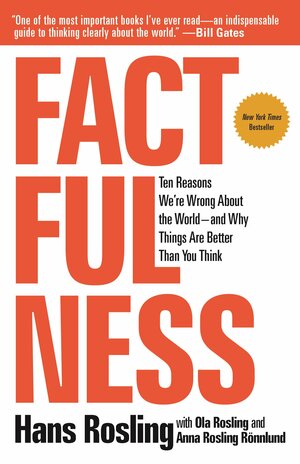
Factfulness

Factfulness: Ten Reasons We're Wrong About the World -- And Why Things Are Better Than You Think by Hans Rosling, 288 pages.

The book starts with Hans Rosling, a professor of public health and medical researcher, gathering a whole lot of data. He surveyed people in all sort of specializations, at all sorts of income levels, in countries around the world; and found that people consistently did much WORSE than they would have guessing randomly when asked about global trends. His questions had to do with things like rates of childhood vaccination, global population trends, and extreme poverty. People worldwide consistently not only overwhelmingly got the questions wrong, but usually thought things were much worse than they were. 

This book is Rosling's attempt to get at the kinds of logical fallacies and thought traps that contribute to all of this incorrect information. Each of the ten chapters is dedicated to a different one of these "instincts" he has identified, such as the "gap instinct" or the "straight-line instinct" (respectively: the tendency to want to separate things into two distinct groups, and the tendency to think rates of change are constant). Each chapters uses both a plethora of examples and data to illustrate the point, then ends with easily actionable bullet points to help reform your own thought patterns. 
I think this is a pretty useful little book! It is both easy to read and fairly actionable, and I appreciate that the author is very excited to share where he gets his information from. This is also not written as an inflammatory book at all, but rather something that's intended to be both comforting and productive. There were times that I found his reasoning to be a little simplistic and occasionally lacking in nuance, but I would still consider this to be a book worth reading, especially with the vitality of media-literacy today.