Showing posts with label science fiction. Show all posts

Monday, March 23, 2026

Moss'd in Space

Moss'd in Space by Rebecca Thorne, 368 pages

For years, Torian has been saving up her meager pay to buy a spaceship, which she plans on using to take her sister to a human planet where scientists can help cure her sister's chronic pulmonary condition. When she finally gets to buy a spaceship, it turns out the only one she can afford is an alien ship that's been hanging around the dock for a century, and is covered in moss. Still, she can work with that. But then she learns that the moss is actually an organic computer with abandonment issues and way more sarcasm than anyone Torian has ever met. Seems like an excellent setup for some problematic hijinks.

I absolutely loved Thorne's Tomes & Tea cozy fantasy series, and I'm thrilled that she's taking things into space (but keeping the pirates, because duh). Moss is an amazing character, Torian's just reckless enough, and all of the supporting characters are fantastic. I loved this series-starting science fiction, and I can't wait to read more of Torian and Moss's adventures.

*This book will be published July 7, 2026.

Friday, March 20, 2026

Sleeping Giants

Sleeping Giants by Sylvain Neuvel, 320 pages

This book has been reviewed and recapped by lots of UCPL staffers in the past, most recently by Regan, who read it for Orcs & Aliens (just like I did) and wrote an excellent summary and review that you can see here. I will say that I listened to this book, which was read by a full cast, and really brought to life the transcripts and journal entries that comprised the book. Interestingly, the people in Orcs & Aliens who read the physical book didn't seem to enjoy it as much, which says a lot about the quality of the audio production. It's thrilling and keeps you guessing, and I definitely loved it. I'll be listening to the rest of the trilogy in the near future.

Monday, March 16, 2026

The Best of Adrian Tchaikovsky

 The Best of Adrian Tchaikovsky by Adrian Tchaikovsky, 624 pages

Adrian Tchaikovsky is a prolific cross-genre writer, and this (his first short story collection) collects work from the entirety of his long career. The book is sorted into six sections: sci-fi (post-apocalyptic and dystopian flavor), fantasy (low fantasy variety), weird, weird but it's a series of related paranormal stories, fantasy (high fantasy variety), and sci-fi (space flavor). This structure does a good job highlighting Tchaikovsky's range, although it's not ideal for reading straight through, which is in fact what I did. That being said, I am genuinely impressed at how variable Tchaikovsky's writing voice is. When reading more than 600 pages of short stories by the same author, it is easy for things to begin to feel repetitive (especially, for example, eight consecutive stories about post-apocalyptic settings), but Tchaikovsky does a great job inhabiting the narrators, and making them feel different. 

I think the greatest strength of this collection is stories that have the kernel of an idea that is interesting to think on later. Especially in the case of many of the shorter stories, the plot is interesting enough, but what hooked me was thinking about the concept and expanding on it in my own mind. That being said, there were a couple of stories that were real standouts in their entirety. Precious Little Things, which is about a society of tiny homunculi that arose in a wizard's tower as the wizard stood frozen in time but leaking power, apparently serves as a prologue for the novella Made Things, which I will definitely check out. The Final Conjuration is one of the most unique takes I've seen on a Sherlock Holmes story, which is a pretty competitive field, and is also very good in it's own right. Goblin Autumn is the last story in the collection, and I think I will be thinking about it for a long time. I will say, after reading enough stories, the structure that Tchaikovsky tends to gravitate towards becomes a little more obvious, and it becomes easier to anticipate the plot twists when you come to recognize the types he likes to use. Overall I think this is a very strong collection, but it may be best enjoyed a little at a time. 

Wednesday, February 25, 2026

Tailored Realities

 Tailored Realities by Brandon Sanderson, 428 pages.

This short-fiction collection contains the non-Cosmere short stories and novellas from Brandon Sanderson's entire writing history. Because these are the works that don't fit in his very wide fantasy universe, most of the stories here are science fiction. It is interesting to have a collection like this that contains as many novellas as short stories, and it gives the stories a lot of time to breathe. I also really enjoyed that every story was followed by a postscript that talked about both the story's inspirations and its publishing history. The novella "Perfect State" was a particular standout to me. I wasn't quite as impressed by this collection as his Cosmere universe short fiction collection, but I'm also a bigger fantasy fan than science fiction. This collection is still definitely worth a read. 

Monday, February 23, 2026

Man's Best

Man's Best by Pornsak Pichetshote, illustrated by Jess Lonergan, 160 pages

Earth is long dead and Dr. Winters has set out to find a new home for humanity, aided by robotics-enhanced animals Athos, Porthos, and Lovey. When giant robots attack their ship, the two dogs and cat are separated from Dr. Winters, and must fight through robots and strange alien lands to find her.

OK, have you ever wanted to read Homeward Bound set in space? If you have, this is the book for you! Honestly, that's really the best way to describe this fun, silly, and somehow still touching graphic novel. Crazy art, loving creatures, fun story. Give it a whirl!

The Tea Master and the Detective

The Tea Master and the Detective by Aliette de Bodard, 86 pages

We read this for Orcs & Aliens in January, and Regan did a much better job summing it up than I ever will. While the world was intriguing, the story was too short and felt too much like a writing prompt (assignment: write a Sherlock & Watson tale set in your fictional universe). This somehow won the Nebula Award for best novella, and I'm not entirely sure how, unless it was a bum field that year. Meh.

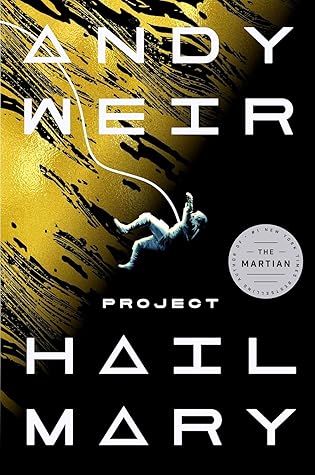
Project Hail Mary

 Project Hail Mary by Andy Weir (2021, 476 pages)

Imagine you wake up on a... space ship? With a robot nurse and no idea who or where you are. You can barely move, yet your muscles haven't atrophied. You slowly start to remember the impending disaster on Earth, and what your mission is.

INSTANT classic sci-fi for sure!!! Heartwarming, funny, emotional, scientifically mysterious. I absolutely love all the characters. It goes into the depths of science, but in a non pretentious way. You won't miss the plot if you don't understand it. My favorite bit is how the main character is a renowned scientist, but still makes silly mistakes. As he says: "At least being stupid isn't permanent. I'll press on. I know I shouldn't, but I'm too stupid to take that into consideration."

Do NOT watch the trailer for the movie before the read the book! It has a major spoiler that I think would take away from reading the book.

Sat on the couch crying after I finished it for a bit. I highly recommend this book to anyone regardless of their background.

What I liked:
✨Incredible speculation on space travel and more
✨Lovable characters with great backstories
✨Flipping narrative between present and past -- you get to figure out parts of the journey as you read. Adds a layer of mystery!
✨Goes into detail about some science, but in a non-pretentious way

What I didn't like:
💤Some parts felt a little over the top with trying to be funny
💤Bit of an emotional roller coaster near the end

Favorite quote: "This is astronavigational equivalent of doing donuts in the 7-Eleven parking lot."

⭐⭐⭐⭐⭐
 

Tuesday, February 17, 2026

The Maze Runner Trilogy

The Maze Runner series by James Dashner

The Maze Runner by James Dashner (2009), 375 pgs.
Imagine waking up in a dark elevator, ascending to God-knows-where, with no memory of how you got there or--more importantly--who you are. That is what happened to Thomas when he entered the Maze. After arriving in "the Box," as the other boys called it, Thomas stepped out into a world entirely new to him, but somehow slightly familiar. The group of guys who greeted him explained that he was the newest member of the Gladers, a group of teenagers who lived in the center of a huge maze with no memory of why they are there. Thomas knew he must have a purpose, and when the newest arrival came up in the Box, that purpose became all the more clear: he must escape the Maze. 


The Scorch Trials by James Dashner (2010), 360 pgs.
After the dramatic conclusion to The Maze Runner, Thomas and his closest friends find themselves once again trapped in another large test, grasping for ways to survive. This time, the team of teenage boys--and some new friends--are given a mission: cross the desert and receive the cure for a deadly disease to which they have all been exposed. As the friends fight their way across the "Scorch," encountering other desperate, infected people, they begin to see more clearly the terrible state of the world outside of the Maze, and they start to uncover more about the mystery of why they were put there.


The Death Cure by James Dashner (2011), 325 pgs.
In this third and final installment of The Maze Runner series, Thomas faces all that has happened. He must finally confront the corporation which has been running experiments on him and his friends in the name of scientific discovery. He must determine what his role will be going forward, and how he will save his friends--those who are still alive--and the rest of society. It all comes down to Thomas, and after the trials he has been put through, he better be ready.


This series very much runs in the same vein as other YA dystopian novels-turned-movies from the early 2010s like Hunger Games and Divergent, but beyond similarities in terms of setting and overall themes, The Maze Runner books are nowhere near as good as those other genre legends. The first book is the strongest, with the most interesting and well put-together plot, but after that the series loses focus and wanders in different directions, seemingly without a point or destination in sight. The characters and their relationships are pretty shallowly written. The main character especially is also reallllyyy annoying in my opinion. Dylan O'Brien plays him much more likeable in the movies than he is written. I was not a big fan of this series on my re-reading, but the first one is still a fun pick if you're craving a nostalgia read from that era of YA dystopia (although you would be much better off just reading The Hunger Games).

Wednesday, February 4, 2026

Two Truths and a Lie

Two Truths and a Lie by Cory O'Brien, 304 pages

Set in a futuristic waterlogged Los Angeles where information is literally currency, this debut novel follows combat-drone veteran Orr as he tries to sort out the details of a murder the cops assume he has something to do with (even though he isn't aware of it at all) and also track down an ex-lover, who may somehow be involved. While some of the ideas are intriguing and some of the scenes are entertaining (playing truth or dare with a bunch of people dosed with truth serums? Scandalously fun!), a convoluted plot and the odd noirish vibe of Orr's narration keep this one from really coalescing. Still, I'm interested to see what O'Brien comes up with in the future, assuming he's able to hone these fiction-writing skills.

Thursday, January 8, 2026

Mechanize My Hands to War

Mechanize My Hands to War by Erin K. Wagner, 320 pages

Four events hold the center of this novel of Appalachia, AI, and a militant cult:

  • The director of the ATF holds a press conference about an AI-soldier-involved shooting
  • A farmer and his sick wife bring home an AI nurse and another AI farmhand to help out at their rapidly deteriorating home, surrounded by toxic soil and water
  • An ATF agent leads a raid on a house occupied by the child soldiers of an anti-technology militia leader
  • An AI soldier spends months awake and captive in a cell following his actions in the raid, which resulted in the death of a child
While it may seem like I've given away the entire story with that bulleted list, but I haven't, as the book looks at those events (and the time before and after them) through the eyes of a variety of characters. It's a bit confusing at the outset, but quickly draws you in, forcing complex musings on morality, personhood, guilt, empathy, and the role of technology in the military. While it would have been nice to get a bit more info about the kids who were armed at the behest of the militia leader (especially since his kid is one of the POV characters), it's a surprisingly intriguing tale, though perhaps not a particularly cheerful one. Still, I'd definitely recommend it!

Tuesday, December 30, 2025

Where the Axe is Buried

Where the Axe Is Buried by Ray Nayler, 336 pages

In the futuristic Federation, the president is a man whose consciousness keeps getting downloaded to successive bodies as the previous ones die (whether through natural or nefarious means), creating a decades-long regime of little actual change, despite new faces. Now, however, there's a plot to assassinate the president, and if all goes to plan, it may disrupt the flow once and for all. Meanwhile, outside the Federation, many Western European countries have given up on human governance, instead installing AI prime ministers to rule and regulate. But when one starts malfunctioning, it becomes abundantly clear that AI isn't the answer either.

Nayler has a great way of presenting current geopolitical and environmental issues in a thought-provoking way while still offering a compelling and exciting plot. This book is no exception. It's smart, it's complex, and it's a great example of what science fiction can do. Highly recommended.

Friday, December 19, 2025

Hole in the Sky

Hole in the Sky by Daniel H. Wilson, 288 pages

When strange things start happening in the sky above Oklahoma, everyone from military leaders to astrophysicists to the people who live on the Cherokee reservation below the titular "hole in the sky" are on high alert and wondering what could possibly be happening. It's obvious that whatever's going on is an alien response to the golden record sent out on Voyager spacecraft in 1977, but whether that response is diplomatic, investigative, or hostile, nobody knows, which means everyone has to be prepared for all contingencies.

Told from the rotating points of view of a U.S. military leader, a rogue astrophysicist, a mysterious hidden interpreter of cosmic prophecies (all of which have been true), and a Cherokee man attempting to rebuild a relationship with his teen daughter, this first contact story is a bit of a different spin than we usually see. While the plot wanders a bit at times and there's a bit more gore than I prefer, I really appreciated seeing an indigenous take on alien contact. I haven't seen that perspective before, and the way it's presented here makes it an excellent story.

Thursday, December 18, 2025

Frankenstein

Frankenstein by Mary Shelley (1818), Illustrations by Philippe Munch, 253 pgs. 

You have heard the story:
Victor Frankenstein, through months of restless study, uncovers the secret to reanimating human flesh. He brings to life a being of his own morbid creation and, after looking upon the gruesome face of what he has done, he flees from the monster. As Frankenstein flees his shame, he only inflicts more pain upon himself and those he loves most. Try as he might to outrun his past, it always finds a way to catch up with him.

It is always interesting to read the original version of a tale so widely known and parodied. Although the language is out of date and the prose is a bit lengthy, the overall story remains captivating, and the different narrators offer interesting points of comparison. Mary Shelley has truly created a story that has lasted the test of time.

(P.S. If you read the version which is pictured here (The Whole Story), there are little illustrations and helpful blurbs about poems and places that Shelley references, which were really helpful for me.)


Tuesday, December 16, 2025

Moonrising

Moonrising by Clare Barner, 320 pages

Not too many years in our future, genetically modified crops are clearly the way to provide food for an ever-growing human population, though many people don't trust them, thanks to some poorly regulated crops causing widespread illnesses in the science's earlier days. But that's not keeping Dr. Alex Cole from continuing to fight for GMOs, even if there are ecoterrorists threatening her life at all times. When her latest funding request is denied, Alex is forced to accept a position creating a functioning farm on the new moon colony. When she arrives, however, she learns that some of the first consumers of her new crops will be the ultrawealthy tourists who come to stay at a planned moon hotel being built by Emirati billionaire Mansoor Al Kaabi — not at all the people who she wants to help with her science. However, Alex finds Mansoor a surprising ally, and when sparks begin to fly between them, nobody is more surprised than she.

Given that this is supposed to be a science fiction romance blend, one would hope that the science would be solid and that the main characters would be likeable. However, some of the science seemed particularly hand-wavy and convenient, and I found it REALLY hard to root for a billionaire who unrepentantly admits to manipulating and buying off U.S. politicians to benefit his own pocketbook. Nah.

The Two Lies of Faven Sythe

The Two Lies of Faven Sythe by Megan E. O'Keefe, 352 pages

Faven Sythe is a cryst-born navigator, a semi-human capable of creating faster-than-light pathways between the stars. When her mentor, Ulana, mysteriously disappears into the Clutch, a cosmic graveyard that even the most intrepid interstellar travelers avoid, Faven is convinced that something fishy is going on. Luckily (or perhaps unluckily), she crosses paths with notorious pirate Bitter Amandine, who is one of few who has been to the heart of the Clutch and lived to tell the tale — though she won't, as it was that scarring to her psyche — and the odd pairing embarks on a mission to track down Ulana and figure out what could be going on.

Generally speaking, a standalone space opera with pirates and human/alien hybrids is right up my alley, reading-wise. But something about this one didn't quite catch and hold my attention. The plot felt a bit repetitive, I couldn't really see much character growth in Faven or Amandine, and the cryst backstory felt a bit confusing and flimsy. There are better space operas out there.

Thursday, December 11, 2025

The Afterlife Project

The Afterlife Project by Tim Weed, 272 pages

In the near future, climate change and a global pandemic have decimated the human race, leaving just a few scattered communities still alive and next to no children being born (literally — fertile women are so rare that they're commodities easily kidnapped and thus guarded closely). Given this drastic change, a project originally created to send people to off-world colonies has shifted focus to try sending people 10,000 years into the future in the hopes of re-establishing the human race. And that takes us to this book's second storyline: a scientist from that group has awoken sometime around the year 11,000 AD, and is trying to find some sign of other humans in the vast, environmentally reclaimed world.

Told in alternating timelines between the near future and far, far distant future, this is an interesting take on climate fiction, showing that it's not the world so much as humanity that's suffering from what we've done to the planet. That said, it's also really questionable that the scientists who see what we've done would think that yeeting a human 10,000 years into the future to restart the destructive species is a good idea, which makes that whole premise pretty hard to buy. Between that and a few other problematic choices by the scientists, I'm inclined to think of this as an OK thought experiment, but not a particularly great book.

Wednesday, December 10, 2025

Of Monsters and Mainframes

Of Monsters and Mainframes by Barbara Truelove, 424 pages

Well, Regan just barely beat me to the punch on this review, so instead of reinventing the wheel with this post, I'll just direct you to hers. It's science fiction with cameos by Universal Studios monsters, and while that's weird as heck, it's also a bunch of fun. Yeah, it took a while to come together, but yes, still fun.

Wednesday, November 26, 2025

Drunk on All Your Strange New Words

Drunk on All Your Strange New Words by Eddie Robson, 277 pages

I first read and reviewed this science fiction mystery back in 2023, and that review still rings true — it's inventive, well-conceived, engaging, and amazing. It was a hit with the Orcs & Aliens too, which is always nice.

Tuesday, November 25, 2025

Exiles

Exiles by Mason Coile, 224 pages

While a few robots have gone ahead to prepare the space, the first three permanent human inhabitants of the new Mars colony are finally on their way. But when they arrive, they find half the base destroyed and one of the three robots missing. Following protocols, the three astronauts must interrogate the remaining two robots, who have developed identities and personalities in the absence of human input, and determine what happened, and if the humans are safe to stay — not that they have a way to get home, but at least if they solve the mystery, they can be reasonably assured that they're not going to have a rogue robot kill them in their sleep.

This is an odd mix of locked-room mystery and space horror, all tied up in a fairly short but insanely creepy book. I wish the author had taken a couple more pages to flesh out some of the backstory. The "logic" of the robots didn't always make sense, and I feel like the author may have used robotic logic only when it was convenient to the story. Still, if you'd like a good Mars-based scare, give this one a whirl. It's a quick read.

Tuesday, October 21, 2025

System Collapse

 System Collapse by Martha Wells, 245 pages.

Murderbot is still stuck on the planet from Network Effect, trying to make sure the abandoned colonists don't end up scooped into de facto slavery or some other terrible corporate fate at the hands of the Barish-Estranza corporation. Unfortunately, it still hates planets, and the fact that it's still reeling from the traumatic events of the last book sure aren't helping. It has to find some way to get itself back under control, or a whole lot of humans are going to pay the price.

It was neat to get another story so quickly following the last one chronologically! I also really enjoyed the non-standard climax of this book, which ends not so much in a huge battle, but something more creative.