Showing posts with label indigenous author. Show all posts

Friday, December 19, 2025

Hole in the Sky

Hole in the Sky by Daniel H. Wilson, 288 pages

When strange things start happening in the sky above Oklahoma, everyone from military leaders to astrophysicists to the people who live on the Cherokee reservation below the titular "hole in the sky" are on high alert and wondering what could possibly be happening. It's obvious that whatever's going on is an alien response to the golden record sent out on Voyager spacecraft in 1977, but whether that response is diplomatic, investigative, or hostile, nobody knows, which means everyone has to be prepared for all contingencies.

Told from the rotating points of view of a U.S. military leader, a rogue astrophysicist, a mysterious hidden interpreter of cosmic prophecies (all of which have been true), and a Cherokee man attempting to rebuild a relationship with his teen daughter, this first contact story is a bit of a different spin than we usually see. While the plot wanders a bit at times and there's a bit more gore than I prefer, I really appreciated seeing an indigenous take on alien contact. I haven't seen that perspective before, and the way it's presented here makes it an excellent story.

Tuesday, December 9, 2025

Dog Flowers

 Dog Flowers: A Memoir by Danielle Geller, 272 pages.

After Danielle Geller's mother dies from alcohol withdrawal, she is left with a suitcase full of her papers and a profound feeling of not knowing nearly enough about her mother's life before it was over. In the years that follow Geller uses her archival training to make sense of both her mother's papers and her own grief, both for her mother and the life they could have had together. This journey takes her not only to her childhood home in Florida, but to the Navajo reservation her mother grew up on, bringing Geller to family she had never had the opportunity to meet.

I'm not sure that this book had significantly more primary source material than the average memoir with photos, but the most interesting parts of this book were consistently where Geller's training granted her an unusual perspective on her own life. That being said, this is definitely a troubled family memoir, which isn't a genre I am particularly interested in. This ended up being structurally a much more conventional memoir than I was expecting, and I'm afraid I found it a little dull. 

Friday, October 24, 2025

Ceremony

Ceremony by Leslie Marmon Silko (1977) 244 pages

This is historical fiction from an Indigenous perspective. Tayo is a young man who has returned from WWII, from the Bataan Death March specifically, with serious PTSD. He has been raised by his Aunt and Uncle for many years. He went to serve in the military with his cousin, who is like a brother. His brother, the star athlete and perfect son, does not return from the war. Tayo doesn't fit in the Laguna Pueblo community, being only half Indigenous. The novel is not divided into chapters. There are section breaks and occasional poems. We jump from the present to different times in the past. Sometimes the memories are reflected through Tayo being drunk and sometimes through fever dreams while Tayo is sick. In the middle of the book I found it difficult to follow the changing points of view and time periods. It ends strongly though. Tayo seeks an Indigenous medicine man who helps him connect to his heritage. The man's healing ceremony helps Tayo in a way the white culture's medicine could not. Tayo's Uncle bought a herd of Mexican cattle that he expects will be better adapted to the desert environment on the reservation. The cattle escape and head back south before ever making it to the Uncle's farm (although they are already branded by Tayo's family). As he heals, Tayo goes on a quest to find the cattle and recover his Uncle's lost dream. The whole novel is a journey of self-discovery.


Monday, February 10, 2025

The Serviceberry

 The Serviceberry: Abundance and Reciprocity in the Natural World by Robin Wall Kimmerer, 128 pages

In this short book Robin Wall Kimmerer, best known for the fabulous Braiding Sweetgrass, examines the potential for a more gift-based economy in place of the current scarcity-based economy. While Kimmerer is the first to admit that she is not an economist, she does do an admirable job bringing together sources who are experts in the kinds of things she is writing about, with a special emphasis on the developing field of ecological economics. She also relates many economic issues back to principles of resource distribution observed in nature. 

I got the feeling about halfway through this short book that it was an expanded version of an essay or article, which turns out to be exactly the case. This book is short and digestible, and provides a lot of food for thought. That being said, I do think it suffers a little for being so far outside of Kimmerer's area of expertise. This book feels like a good jumping off point for thinking about different possible economic models. 

Tuesday, January 14, 2025

Sheine Lende

 Sheine Lende by Darcie Little Badger, 391 pages.

Shane, like many of the women in her family before her, has the power to rouse ghosts from the world below. She and her mother use these powers, including the tracking power of their ghost dog, to find missing people (whether they can pay or not). Which is the right thing, but also hard, since money has been tight since they lost their home, community, and several family members in a flood many years ago. Things get even harder when her mother goes missing on a search and rescue mission for two siblings, and Shane has to go further than she ever thought possible to get her back.

This prequel to Elatsoe really works as a prequel in a way that many don't. The story didn't undercut anything from that book, while also not being rendered less meaningful because we know how Shane eventually ends up. Rather it added a lot of depth and history to a character we only see in passing, letting her own her story in the same way the Ellie does in her book. That being said, this book didn't work for me quite as well as Elatsoe. I found the pacing to be a little slow and clunky, and I had a hard time really getting into this book. It's still worth reading for fans of Darcie Little Badger, but I would recommend her other books first if you're looking for modern fantasy mixed with Lipan Apache mythology. 


Wednesday, August 30, 2023

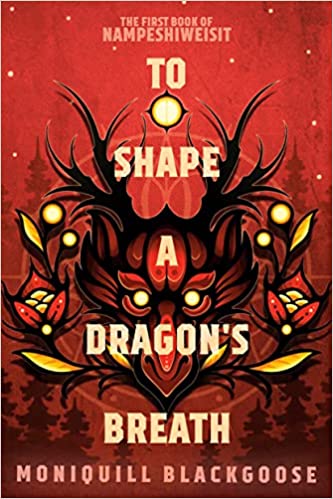
To Shape a Dragon's Breath

 To Shape a Dragon's Breath by Moniquill Blackgoose, 511 pages.

There have been no dragons on Masquapaug for generations, so it is a cause for celebration in the community when a dragon egg hatches and bonds a member of the tribe. But times have changed since her people worked with dragons; they have been colonized, and the Anglish have laws about how a dragon (and their companion) are to be trained. So Anequs goes off to the Anglish boarding school with all of it's rich Anglish pupils and quickly learns that their attitude towards dragons are very different than her people's. For example, they kill dragons that are deemed too dangerous or unmanageable. So if she wants to save her dragon and learn enough of managing her magic to help her people she has to endure the Anglish school, and the polarizing political effect of her enrollment.

This is an exceptional novel. The whole thing feels very fresh and original, even while treading old ground (dragons and magic boarding schools are staples for a reason). I was never entirely sure if this was meant to be high fantasy or alternate reality Earth, but ultimately it doesn't matter all that much one way or the other. Most cultures on Earth have their own versions of dragon in folklore, and Blackgoose does a phenomenal job building up the fictional folklore of her world to reflect the same variety. Even more impressive, the stories that many characters tell about their culture's own version of the first dragon story still feel like folklore, rather than history, which isn't a distinction many writers preserve when the stuff of folklore is unarguably real. I also found the way the lines between magic and science were blurred to be very interesting, but it makes total sense in a world where societies developed alongside dragons. This novel is definitely structured around a more indigenous storytelling method, which I also found really interesting. 

My only complaint is that this is very much a first book in a series, so there are a lot of things that feel very unresolved. Related to that the author (necessarily) spends a lot of time on world-building, so this book is sort of plot-light and lacking in a single central conflict. That being said, I suspect the series will really hit it's stride in the next book, and I'm very excited to read it when it is published.


Wednesday, June 14, 2023

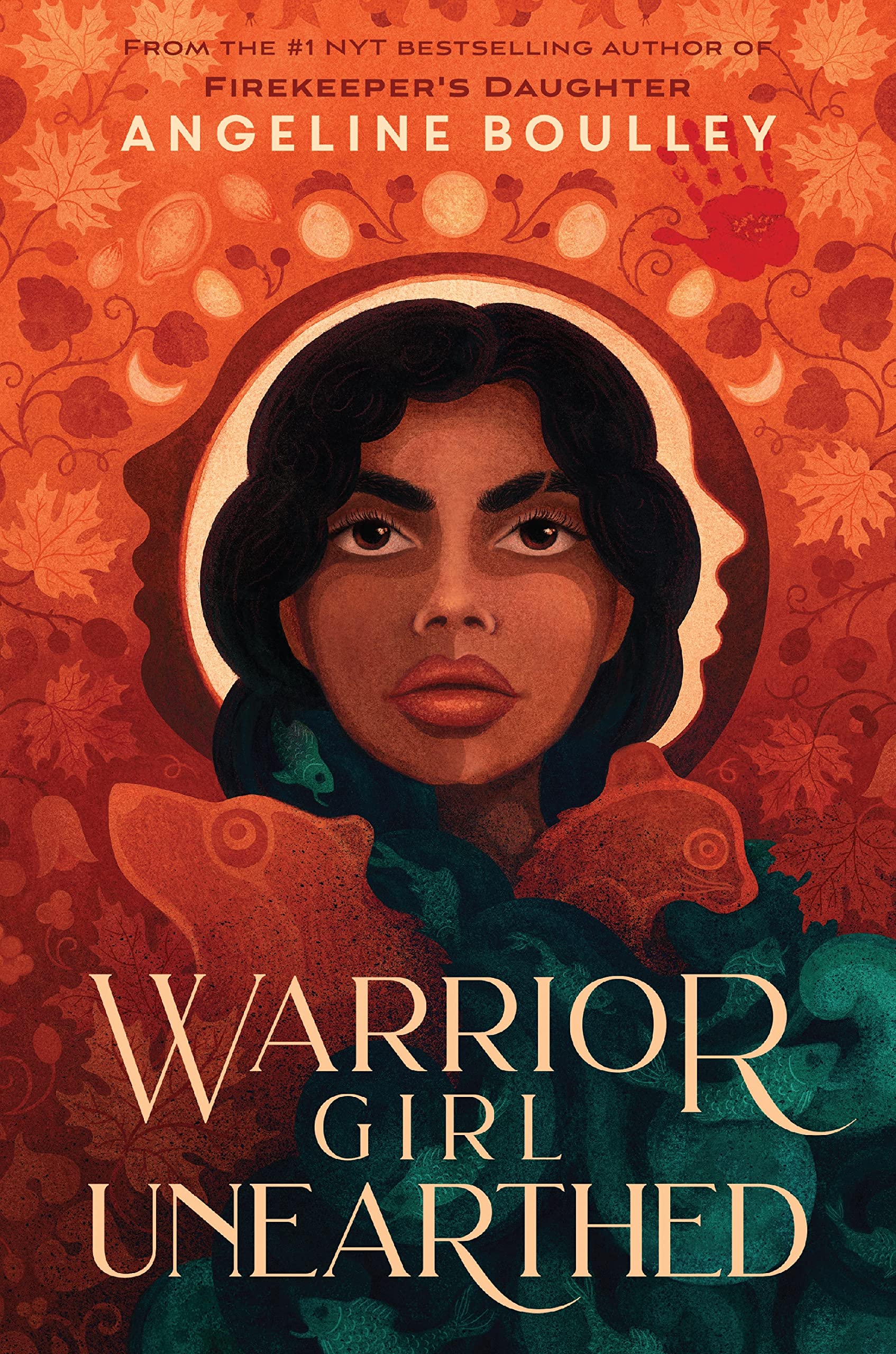
Warrior Girl Unearthed

 Warrior Girl Unearthed by Angeline Boulley, 400 pages.

Perry Firekeeper-Birch was looking forward to a relaxing summer of fishing and hanging out with her dog. Instead, she ends up stuck in the tribe's summer internship program to pay off damages after a minor car accident. Even worse, she ends up assigned to Cooper Turtle, manager of the Sugar Island Cultural Learning Center and local weirdo. However, she soon comes to like and appreciate Cooper Turtle as he draws her into the fight for repatriation of ancestral remains and grave goods, a topic she quickly finds a passion for. Also featuring in Perry's summer is the possibility of romance, illegally obtained Anishinaabe artifacts, and a slew of missing girls. 

I quite liked this book, and Perry in particular. I found the plot engaging, the characters good, and the information about NAGPRA thorough and informative. Unfortunately, I feel like this book was trying to do a bit too much, and it ended up feeling sort of unfocused, and the resolution felt like it only sort of made sense. Still, I consider this a pretty enjoyable book, and a good addition to the growing category of young adult novels by indigenous authors.


Thursday, May 25, 2023

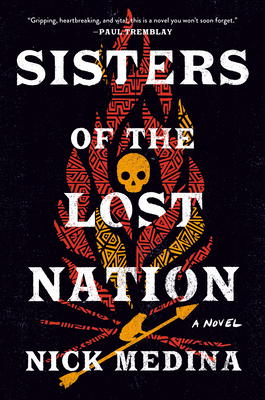
Sisters of the Lost Nation

 Sisters of the Lost Nation by Nick Medina, 352 pages.

Anna Horn has plenty of worries. She's constantly bullied at school, her parents' marriage is falling apart, her little sister is growing away from her, her boss at the reservation's casino is sketchy, and when she walks alone she often sees the ghostly severed head her uncle told her about as a little girl. That's all before teenage girls start going missing. Due to some thorny (and all too real) jurisdiction problems surrounding law enforcement on reservations, it is hard to pursue the investigation of these cases, and easier to pretend that the girls all just ran off. So when Anna's little sister joins the missing she throws everything she has into finding her herself, following leads and tribal legends both in an attempt to bring her sister home.

This was more thriller than the horror I think I was expecting, but it was quite good. I found Anna to be an engaging protagonist and the story to be haunting, not only narratively but also in reality. Medina notes at the end that Indigenous women are staggeringly more likely to be murdered or go missing than any other demographic (about 12 times more likely in fact). This book is fiction, but it is obviously very invested in dealing with real world problems. My one major criticism is that I'm not sure the structure Medina decided to use worked very well. Chapters jump back and forth between before and after Anna's sister goes missing, and I found that they really interrupted the narrative tension. There would be very high intensity investigations, and then suddenly we were spending chapters concerned with our clothes and parents marital problems. It also doesn't help that the way we differentiate is by numbering the days at the top of the chapter, which is a little bit too subtle, especially close to where the timelines are meeting up. That being said, I do consider this a pretty strong first novel and would recommend it. 


Sunday, May 23, 2021

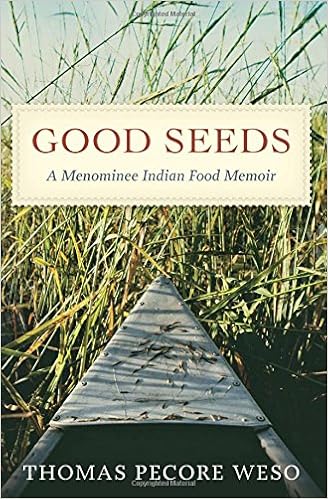
Good Seeds

 Good Seeds: A Menominee Indian Food Memoir by Thomas Pecore Weso, 124 pages.

Thomas Pecore Weso is a Native anthropologist and artist, and this memoir centers on his childhood with his grandparents and extended family on the Menominee reservation in the 60s, all through the lens of what they ate. This was, through his lens, a period of transformation on the reservation, as modernization changed many traditional ways of life even as other aspects were still practiced by tribal elders.

I was very interested in this book, and especially with what Weso's training as an anthropologist would bring to it. Unfortunately, this wasn't an element the memoir seemed to be very interested in dealing with. It was, also unfortunately, not very well written. The whole thing is pretty disjointed and lacks any real cohesiveness. The end result being that despite being only slightly over 100 pages the book dragged. It also didn't help that most of the recipes at the end of every chapter weren't very interesting. They were mostly for very basic versions of very basic dishes, such as pan-fried fish, oatmeal, and baked beans. Overall, I'm sadly disappointed in this memoir.