Showing posts with label social science. Show all posts

Thursday, December 11, 2025

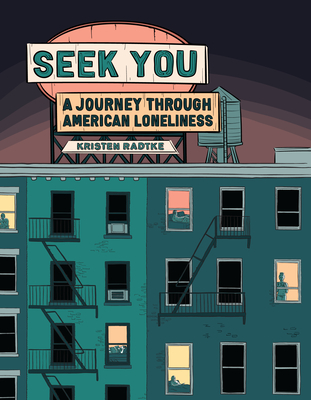
Seek You: A Journey Through American Loneliness

Seek You: A Journey Through American Loneliness
by Kristen Radtke (2021), 352 pgs.

In Seek You, Kristen Radtke blends many ideas about loneliness--historical, personal, scientific, cultural, controversial, universal--through words and drawings which all come together to paint a picture of the importance of seeking connection. She presents reasons why we experience loneliness, and how modern American culture amplifies it. She argues that movies and TV often show loneliness as a positive trait in men (like the gunslinging cowboys riding off solo into the distance) and negative in women (like the somewhat slovenly, yet loveable, rom-com lead). Radtke disputes the idea that loneliness is "cured" by finding a partner to marry, and she implores each of us to reach out into our communities--like we are biologically designed to. 

Byron and Regan have each already reviewed this one really well, but my two cents are:
I found the author's use of examples to be very effective in representing the universality of loneliness. Her drawings of the poor primates used in experiments were absolutely heart-breaking. 


Wednesday, May 21, 2025

Seek You

Seek You: A Journey Through American Loneliness by Kristen Radtke, 352 pages.

This graphic novel attempts to trace the broad and winding path of loneliness in all of it's manifestations through American history, and does a remarkably good job. This book includes elements of memoir, but also history, cultural analysis, and scientific studies. This is an extremely thorough book that never loses its emotional core under generous amounts of fact. 

I am really impressed by the execution of this book. It works in harmony with it's medium, and the images definitely make the words stronger, while still containing enough text to convey a lot of information clearly. I would definitely recommend this book widely, even to people who don't read many graphic novels. 


Wednesday, April 26, 2023

Atomic Habits

 Atomic Habits: An Easy and Proven Way to Build Good Habits and Break Bad Ones, by James Clear, 306 pages


This was a fast read. I usually despise  "business" self-help books like this but another author I enjoy recommended it. Ultimately, the advice here can be used for anything.

What caught my attention initially was the author's personal story in the introduction. As a young man, he's involved in a horrific baseball accident that puts him into a coma and on a ventilator. He rebounds, but his arduous recovery forces him to develop positive habits to ensure the return of his health and achieve his academic dreams. He attributes this system of habit-building to his current success. 

Bottom line: if you want to get started on a new habit, whatever it is, follow these 4 laws:

  • Make it obvious
  • Make it attractive
  • Make it easy
  • Make it satisfying
Each section of the book dives into these laws with abbreviated scientific studies, true-to-life vignettes, and tips on how to implement these laws while trying to solidify your new habit. One interesting trick is known as "habit-stacking," where you attach your newly desired habit to an already existing habit. For example:

1. After I (CURRENT HABIT), I will (HABIT I NEED). 
2. After (HABIT I NEED), I will (HABIT I WANT). 

So after you get back from lunch, you will call three new clients (need).
After you call three new client, you will check social media (want). 

For me, trying to make a new habit produce a dopamine hit seems to be the best way to add it to my schdeudle. If you can associate your desired habit with the reward center in your brain, you'll be on a surefire path to learning how to...knit? Skateboard? Juggle? Juggle your knit creations while skateboarding? Try it out and let me know how that goes. 

Recommended for adults. 

Friday, March 3, 2023

Negotiating the Nonnegotiable

Negotiating the Nonnegotiable: How to Resolve Your Most Emotionally Charged Conflicts, by Daniel Shapiro, © 2016, 319 pages

There have been many books written recently documenting our current level of intense polarization across the United States and elsewhere, highlighting the growing increase in an ever-present state of conflict, but few books written with the sole intention of providing us with the tools needed to navigate, defuse and otherwise deescalate some of those conflicts. Negotiating the Nonnegotiable does just that. 

Daniel Shapiro, founder and director of the Harvard International Negotiating program, lays out a fundamental text for anyone interested in how to get beyond conflict, how to bridge the gap between individuals and groups, and how to think about conflict from a birds-eye perspective. And this author has the credentials. This is not some feel-good, self-help book--Shapiro has launched conflict resolution initiatives across the globe. 

He starts off by identifying what he calls "the Tribes effect," showcasing the subtle ways our identity is shaped by our surroundings and the social groups with which we become aligned. Shapiro then writes of the different ways the tribal mindset sabotages our faculties and essentially our abilities to think critically and objectively about a conflict. One of those ways I found fascinating was what he refers to as vertigo. Have you ever been so mad at another person during an argument that all you can see is the color red? That's vertigo. It's a state we find ourselves in during a conflict when we feel our identity is under threat. It affects us outside our awareness, makes us fixate on negatives, and diminishes our capacity to self reflect. Shapiro provides the reader with strategies that improve self-awareness during conflicts so that we be forward-thinking about what exactly is at stake and what our main objectives are. 

This book is not a political book but focuses on  resolving conflict between any kind of relationship--political or personal, groups or individuals, everything in-between.  If you've ever had a disagreement with a family member and you felt that there was no getting over it, this may be a good start to learning how to bridge the gap. Check out this video to get a sense of what this book is about: https://youtu.be/PBkDdWzXTO0

Recommended for adults interested in social science, psychology, conflict resolution and improving relationships. 

Tuesday, February 28, 2023

Rationality

 Rationality: What It Is, Why It Seems Scares, Why It Matters by Steven Pinker, 412 pages


If it snows, it's cold. That is a true statement, right? But think about that in reverse. If it's cold, it snows. Is that always true? No, because there are a multitude of reasons why it could be cold but also not snowing. Welcome to the wonderful world of logic! If you were in a freshman logic course, this might be the first logic puzzle you encounter. Logicians swap the nouns for letters (if A, then B) and try to turn statements like these (and longer) into a mathematical equation to be proven true or false. This is where the book Rationality gets started. 

In this text, Harvard psychologist Steven Pinker makes his case for the importance of rationality, a concept as old as Greek civilization, but no less important, especially in our modern time. Pinker discusses how rationality, more than anything else, predicates most of what we do and what we achieve as individuals and as a society. If you've felt like the world around you is descending into chaos, Rationality is a good book to offer some hope about the world while improving your own critical thinking skills. Some of the best parts of this book involve Pinker's descriptions of informal fallacies, arguments labeled as straw man, ad hoc, ad hominin, bandwagon and more. But he not only writes of rationality as a basic paradigm for better understanding, but illustrates how some of our unseen biases can hinder that understanding in ways you've never considered. 

Pinker dives into probabilities and statistics and gives a laypersons understanding of how each works and how one might apply such thinking to everyday scenarios. One such scenario that had me testing it at the dinner table involved a logic problem dubbed the Monty Hall Dilemma, which, based off an old television show called "Let's Make A Deal," indicates that a contestant should always switch doors when given the option of winning a prize (at the time this was confirmed by Marilyn vos Savant in 1990, widely considered to be the world's smartest woman due to her inclusion in the Guinness book of World Records for the highest score on an intelligence test). 


I will admit, that, at times, Pinker singles out "woke" culture, which gives me the impression that he's of an older generation railing against the youth today, but he does list some concerning instances of college culture becoming too protected and too politically correct--so much so that it conflicts with rationality as Pinker sees it. However, this book doesn't really go into a political diatribe for one side or another. Pinker's devotion is to critical thinking and furthering the main principals of the enlightenment for a new age. 

Recommended for adults interested in math, probability and critical thinking.