Showing posts with label history. Show all posts

Monday, April 6, 2026

History Lessons

 History Lessons by Zoe B. Wallbrook (2025), 373 pages.

After reading Annie's review, I thought I would check this out. Overall, I really enjoyed the cozy mystery and insight into higher academia. My only (very slight) gripe is that Daphne is almost too worldly with too much of an interesting family background to be relatable. Although - it does serve her well in detecting. 


Tuesday, March 17, 2026

The Library Mule of Cordoba

 The Library Mule of Cordoba by Wilfrid Lupano and LĂ©onard Chemineau, 263 pages.

In 976 Cordoba is the center of learning for the Western world, and people come from far away to study in its magnificent library. But after the caliph dies young and a vizier is appointed to rule Al-Andalus everything changes very quickly. The new vizier decides that most of the library's texts are heretical, and burns them to help push for wars that will allow him to conquer more of what is today Spain. Tarid is the head librarian, and although he is a slave and a eunuch he won't allow this to happen. Tarid, a copyist, and a thief all set out to save the most precious books, taking them on a dangerous journey across Al-Andalus.

Byron wrote about this graphic novel almost exactly a year ago, and it has taken me this long to get around to reading it. I appreciated that this was both very historically interesting and a solid adventure story. It's not very common to find books set during this period, and this one has a fairly extensive section in the back giving history and context after the story was over. It is sad to see how often book burning and suppression go hand-in-hand with religious extremism (regardless of the religion), but it also makes the history feel very present. Recommended for people interested in Muslim Spain, historical libraries, and a wild adventure to save books. 

Friday, February 13, 2026

End Times

End Times: Elites, Counter-elites and the Path of Political Disintegration by Peter Turchin (2023) 352pp 

Turchin, a scholar in ecology and evolutionary biology, has a cross-disciplinary approach to the study of history which he labels “cliodynamics”. In a nutshell, the author is analyzing history using a large historical dataset to identify patterns. The author presents a variety of anecdotes from ancient times to the present using the concepts of out-of-control “wealth pumps”, overproduction of elites, and general immiseration; leading to instability, revolution, civil war and all things unpleasant. But I kept thinking, isn’t he neglecting too many variables and what confounding factors make this a fool’s errand? Nonetheless he forges a cogent argument that vast inequalities are destabilizing and, most interestingly, he posits that an overproduction of elites is just as threatening. Recommended to readers with a passion for history and those who appreciate novel approaches to complex and chaotic problems.

Tuesday, February 10, 2026

Making History

 Making History by K.J. Parker, 128 pages.


Aelia's head academics have a problem. First Citizen Gyges needs a war to help people forget that his claim to power is less than totally legitimate, and to help the people swallow his harsh policies. But he can't just start a war for the sake of starting a war, so he needs justification. He has decided to make this the problem of the city's professors. Their task is to create a lost utopian city underneath the plains, so convincing that nobody can question the the righteousness of their anger, or the fact of this hitherto unknown civilization. After all, if history is just a story we tell ourselves, who says it can't be changed?

This was a really cool premise, but I found the execution a little lacking. Very little time was actually spent on any of the mechanics of changing history, and more was dedicated to weird metaphysics and speeches on history I mostly found self-indulgent. For a book that plays in this space in a more compelling way, I recommend The Everlasting by Alix E Harrow. 

Tuesday, November 25, 2025

The Everlasting

 The Everlasting by Alix E. Harrow, 320 pages.

Owen Mallory has been obsessed with Sir Una Everlasting, hero of Dominion and part of the nation's foundational legends, since he was a child. It was her face that sent him to war, and her story that drove him to study history. But when he is sent through time to preserve Dominion's history, he learns that the woman is not so simple as the legend. Una is a broken woman; her decades at war have left her scarred inside and out, and she wants nothing more than to abandon the story she is trapped in. Instead they must live out the end of her life: her final quest, a great betrayal, her noble death, again and again. Finding a different ending means breaking her myth, so they both have to decide what is more important: the woman or what she represents.

I liked this book so much it's hard to talk coherently about it. This book is doing so much at once, and it's doing it with balance, grace, and beautiful prose. This is partially a love story about knowing someone on a bone-deep level built through an uncountable amount of time. It's also a tragedy. It's also a scathing critique about how fascism needs to rewrite history to justify its own existence. I cried at the end and haven't stopped thinking of them since. I do believe this is my best book of the year. 

Wednesday, September 3, 2025

The King's Shadow

 The King's Shadow: Obsession, Betrayal, and the Deadly Quest for the Lost City of Alexandria by Edmund Richardson, 352 pages.

When James Lewis deserted the East India Trading Company's army, he walked into the desert and kept going until he became one of the first westerners to live in Afghanistan for centuries, and so Charles Masson was born. Masson would take on many roles living in Afghanistan: fake holy man, alchemist, political advisor, and unwilling spy. But the role he took on enthusiastically (and many would say obsessively) was archaeologist, as he relentlessly pursued Alexander the Great and the lost city of Alexandria beneath the Mountains.

This was a completely fascinating history, one of those stranger-than-fiction stories that feels to exciting to be true. Richardson does an excellent job focusing the narrative in a way that is both engaging and informative. This book is impeccably researched, and draws heavily on firsthand accounts from disparate sources. Richardson does an excellent job adding context, so that even with no background knowledge the book is easy to follow. Also, in a rare treat for a 19th century archaeologist, Masson himself was a deeply sympathetic figure, which made it very easy to invest in his story. This book reminds me quite a lot of David Grann's The Wager, so fans of that book would almost certainly enjoy this one, but I would also recommend it highly more generally. 

Friday, August 29, 2025

A selection of August graphic novels

 Middlewest: The Complete Tale by Skottie Young with art by Jorge Corona (2021) 560 pages

I first encountered Skottie Young's work as an artist in the Marvel Oz adaptations. When I saw the story synopsis of this adventure Young wrote I knew I would enjoy it. There are multiple homages to the land of Oz. Middlewest could be Kansas. There's a deep level and a surface layer. The story explores generational trauma and men with anger issues. But visually it is a thrilling fantasy world, not quite like our own. Abel's closest confidant is a talking fox, there are diesel-punk flourishes, and a found family in a traveling carnival. By about half way through, the story ventures in its own direction with less obvious Oz references. There is human trafficking of children as farm workers. As more characters become involved in the story, and with multiple characters who turn into violent storms, there are wide shots with a lot of chaos where it is hard to keep track of all the moving parts. However, the art by Jorge Corona with color by Jean-Francois Beaulieu really pops the majority of the time.

Climate Changed: A Personal Journey through the Science by Philippe Squarzoni (2012) 467 pages

Through references to films and other books the author let's us into his thought process on how to begin, end, and present compelling arguments in graphic non-fiction form. It is part memoir, but still the bulk of it is presenting the facts about human technology and its effect on the Earth's environment. The author is French and he interviews several experts from France, but they represent international nonprofits or governmental advisory boards in many cases. Climate change is true. It is time to stop denying it. We must reduce greenhouse gas emissions! But will Capitalist powers in the industrialized world get behind changing our way of life? There is a metaphor that the author describes about a parachutist who forgot his parachute that is very impactful. At over 450 pages, there are so many facts and figures, as well as sociological concerns to take in. The strongest message that Squarzoni conveys is that we are running out of time to stop or reverse the damage done to this ecosystem we share.

A Girl Called Echo Omnibus by Katherena Vermette with art by Scott B Henderson (2023) 224 pages

Issue #1 feels too short. You spend quite a bit of time with Echo in the real world, not just time traveling back to the 19th century. There isn't a fantasy or sci-fi method to her time traveling. It is more like she has a great imagination and a good history teacher. Echo seeks out other books about the Pemmican Wars period in her school library rather than just relying on the class's textbook. She's a good student although she has a hard time making friends. She loves rock music and has a shaky relationship with her mom. The art is good, but not super exciting. In issue #2, Echo begins to make friends in middle school and falls in love with a boy back in the 1800s. The Metis fight for their right to govern themselves when their territory is sold to Canada. Again with the history lesson we are given very brief highlights of major events, but I wish it was more in depth. I wish we learned more about the people and how they lived. I did not fully understand the political maneuvering. There are a couple pages that act as montages, but the writer and artist are trying to pack too much information into those pages. They should have been given more pages to tell the story. Issue #3 spends less time in Echo's modern day life with more pages devoted to 1885. The history is the real selling point and we get some continuity between issues 2 and 3. I like that the authors acknowledge the emotional trauma that Echo is experiencing as a witness to history. The resistance fighting can lead to death and loss, but it is necessary. The writer connects Echo to her ancestry directly in this one. Issue #4 is a pretty strong conclusion that wraps up the loose threads. Echo gains more control of when she travels back and forth in time. US history and Canadian history are fairly similar in constantly taking land from Indigenous people. There are no big surprises in this issue, but Echo is shown by people in her life (past and present) that despite the anger and pain her people have survived and have a future.

Star Trek: Strange New Worlds - The Scorpius Run by Mike Johnson and Ryan Parrott with art by Angel Hernandez (2024) 128 pages


Fun adventure. This takes place sometime before the current third season, which is airing as I read this. Good art of new characters and old. The villain seems to have god-like powers. The full Enterprise crew, plus newly introduced aliens, all have important parts to play. A dangerous spaceship race is set up in this new Scorpius Sector and Captain Pike must figure out how to unite the competitors.


Stitches: A Memoir by David Small (2009) 329 pages

A blurb on the back cover from a critic at the Washington Post is spot on.      "[Small] employs angled shots and silent montages worthy of Alfred Hitchcock." The author's ability to show us his dreams and nightmares is amazing. His real life is so full of angry silences and repressed emotions. One dream while visiting grandma with Jesus on a crucifix repeating his grandma's words, "He was a Durn Little Fool!" is especially memorable. Alice in Wonderland provides some meaningful symbolism through Small's young life too, including his therapist being the white rabbit. The many surprise revelations of his troubled family are tough, but somewhat relatable.


The Faithful Spy: Dietrich Bonhoeffer and the Plot to Kill Hitler by John Hendrix (2018) 176 pages

Good coverage of Dietrich Bonhoeffer's life and some German history. I like the visuals too, a combination of realistic and symbolic. The rise of Hitler is described in detail. Then we learn about Dietrich's rebel seminary as Nazi's were coming to power and the German spy agency Abwehr (pronounced UP-fair) that contained many agents who were conspiring to stop Hitler. Each of three attempts to assassinate Hitler are described with high suspense. The author says, "This story is not primarily a work of scholarship but a work of art," but I commend his research. Very successful graphic nonfiction.

Wednesday, August 27, 2025

Here

 Here by Richard McGuire, 304 pages.

McGuire takes a single room and uses it to overlay the history of a single place, from prehistory to the distant future. The result is a startling graphic novel that feels like it pushes against the edges of the medium and into something that feels innovative and new. McGuire frequently overlays both recontextualized similarities and dramatic differences into something that feels like it really captures the spirit of history. Although there isn't any plot to speak of, I still found myself engrossed in this graphic novel. It is difficult to describe the effect of the layout, so I am also including a page of the book here to capture the spirit. I don't believe this is a book only limited to fans of graphic novels, it has a lot to offer anyone. 

(It was also apparently based on comic strips by the same author published in 1989, which i think adds an interesting extra dimension)


Friday, May 30, 2025

Another selection of graphic novels read in May

My Time Machine by Carol Lay (2024) 168 pages


IN A WORLD, where H.G. Wells' book is nonfiction and the 1960 movie is a documentary, "Carol Lay's My Time Machine is serious and funny, a sly cautionary political satire." It was a fairly quick read that I read in one day. I loved the pop culture sci-fi references as the author's stand-in and her engineer ex discuss theories about time travel and build a working time machine. Survival and exploration and a concern for our future are all reasonably realistic. It is a fun adventure with solid art.


Laika by Nick Abadzis (2007) 205 pages


This is only around 200 pages, but it is jam packed with story panels. Unless you are cold-hearted, you will cry. It is such a sad story. There are moments when Kudryavka "Little Curly" later renamed Laika "Barker" is treated with kindness, but also neglect as if expendable. We follow Chief Designer Korolev of the space program and Yelena the dog handler hired by the medical department as well. Yelena truly cares, Korolev is ambitious to prove Soviet technological supremacy. Kudryavka's voice and inner imagination is also brought forward. She just wants to be free and in a loving home. I finished it while cuddling with one of my cats with kleenex close by.


On a Sunbeam by Tillie Walden (2018) 537 pages


This combines coming of age, a found queer family, and two timelines. It is difficult to describe, but I do love sci-fi and fantasy being mixed. Sunbeam is the name of the fish space ship that Mia's found family flies to restoration jobs. We meet Mia post-high school starting a new job with this crew that does building restorations through outer space. Five years earlier, we see Mia's experiences in a girl's boarding school where she befriends Grace. Through games, work and learning, and through mischief, pain and challenging relationships, Mia discovers herself. Finding out how past and present converge feels so satisfying. I love the art! The limited color scheme works and even delivers some beautiful nature shots and awe inspiring galaxies and nebulas. Floating buildings and creatures that take on gaseous forms are magical too. As the primary color of different sections change it does sometimes take a moment to recognize who is who, since some of the main characters have similar haircuts. But it is not a problem often. The mystery of where Grace comes from and the serious trouble Mia goes to to reunite with her makes for a heartwarming conclusion.

Thursday, May 22, 2025

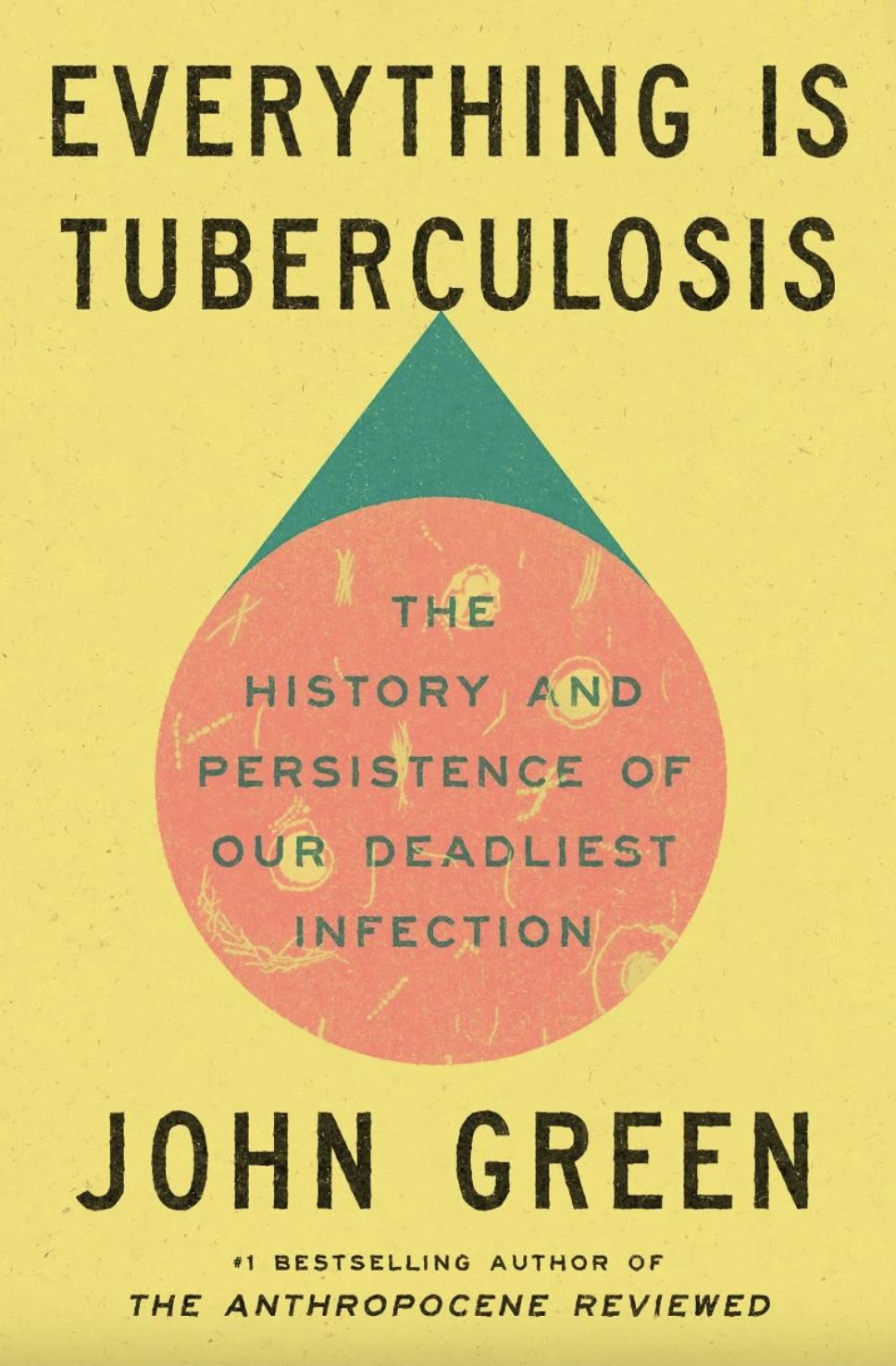
Everything is Tuberculosis

 Everything is Tuberculosis by John Green, 198 pages.

Tuberculosis is the world's deadliest disease, killing 1.5 million people every year. This is especially staggering, because it is also generally completely curable. Tuberculosis is a very old disease (maybe even older than humans), and it has gone through many name changes throughout the years as human conceptions of the disease evolved. The term Consumption, tragically beautiful disease of poets, changed to Tuberculosis, highly stigmatized disease of the poor. 

John Green weaves both scientific and social histories together with the story of tuberculosis in the modern day. What emerges is a strong call for healthcare reform, as the neglect of the richest nations denies life-saving medicine to residents of the poorest parts of the world, enabling the truly staggering death toll of TB today. It is often clear that Green started as a novelist, as he has a gift for reminding the reader that these collection of facts also have real, tangible effects on people alive today. One of these people is Henry, a young tuberculosis patient from Sierra Leone, who Green met when traveling with Partners in Health, and who's story is a narrative anchor through the book. This is a very accessible (if focused) introduction to global health and healthcare reform, and I would definitely recommend it. 


Wednesday, May 21, 2025

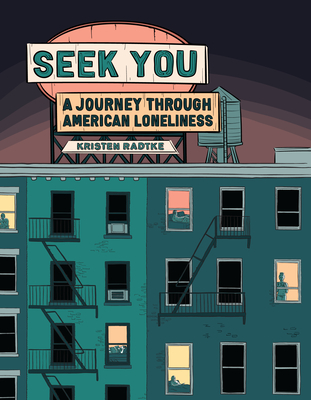
Seek You

Seek You: A Journey Through American Loneliness by Kristen Radtke, 352 pages.

This graphic novel attempts to trace the broad and winding path of loneliness in all of it's manifestations through American history, and does a remarkably good job. This book includes elements of memoir, but also history, cultural analysis, and scientific studies. This is an extremely thorough book that never loses its emotional core under generous amounts of fact. 

I am really impressed by the execution of this book. It works in harmony with it's medium, and the images definitely make the words stronger, while still containing enough text to convey a lot of information clearly. I would definitely recommend this book widely, even to people who don't read many graphic novels. 


Tuesday, May 20, 2025

Thunderstruck

 Thunderstruck by Erik Larson, 463 pages.

In Larson's trademark style, he traces two separate men's histories that intersect in spectacular fashion. Dr. Hawley Harvey Crippen was described by everyone who met him as a kind, gentle man. Yet he almost got away with a sensational murder that held Edwardian England transfixed. Guglielmo Marconi was a man consumed by obsession. His obsession with developing a way to wirelessly send transmissions across the Atlantic was immense, and it would intersect with the manhunt for Crippen in a way that would forever alter both of their lives. 

Although running parallel, these narratives are less interwoven than those in Larson's more famous The Devil in the White City, and for most of the book they feel connected only by their setting. That being said, both pieces of the book were very interesting, and Larson has a very engaging, readable style. I also appreciate the thoroughness of his research, and his talent for taking disparate elements and combining them into something that feels expansive and cohesive. I especially found the examinations of science as an institution in Edwardian England very interesting. I don't know that I liked this as much as my first book by the author, but I still think it's worth a read, especially for anyone interested in the period. 


Friday, May 2, 2025

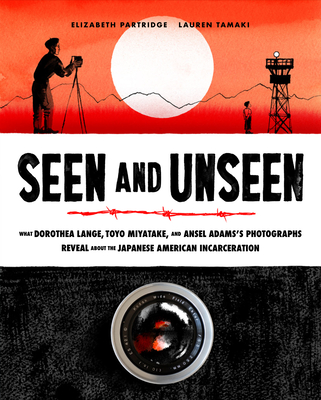
Seen and Unseen

Seen and Unseen: What Dorothea Lange, Toyo Miyatake, and Ansel Adams's Photographs Reveal About the Japanese American Incarceration by Elizabeth Partridge, illus. Lauren Tamaki, 132 pages.

This short work of nonfiction combines illustrations, photographs from the photographers in the title, and written information on the incarceration of Japanese Americans into a fresh perspective on the topic. The three photographers were all coming from different backgrounds, working towards different ends, and reporting to different people; so, taken together, they present a much more nuanced and complete view of this historical injustice. 

I didn't initially realize when I added this book to my reading list that it was written for younger readers. That being said, I think it's still a valuable book for anyone. It has a good depth of topic, while still being very easy to understand and digestible. I do wish that there were more photographs, which seemed a little lacking given that they were allegedly the topic of the book, and that they were more clearly credited in the text, and not just in the notes at the end. Still, this is an interesting and informative book on a topic that is unfortunately feeling very relevant lately. 


Wednesday, April 23, 2025

The Ride

The Ride by Kostya Kennedy (2025) 289pp
Finished reading this on the day of the 250th anniversary of the oft-quoted and perhaps the best-known action of the revolutionary war – Paul Revere’s ride out of Boston. This is an enjoyable read, a non-threatening history of a vital moment in our nation’s history. By non-threatening, I mean it is accessible, kind of like watching the History Channel. Kennedy is best known for his sports profiles and is obviously enamored with the drama of the ride. Since we know the outcome before we crack the book, it is to Kennedy’s credit that throughout this well researched saga he keeps the story flowing, introducing a fair amount of drama. Unfortunately, he leans into “what ifs” a little too often and has an irritating penchant for describing the weather, the dark of night, and the sounds of silence, interfering with the narrative. The chapter on Revere’s mention of the Mark, the enslaved person left on the road where he had been gibbeted (murdered and hung in chains), simply as a waypoint on the ride where Revere encounters British soldiers, could be interpreted as gratuitous, except for fact that this did happen. It is horrendous and is directly connected to the compromise of the founding of the country. He does this once more regarding 16-year-old Sybil Ludington, sometimes referred to as a female Revere, who purportedly rode 40 miles to warn militiamen in Connecticut. Minor quibbles in a worthy effort in replaying the ride. Longfellow would approve.

Tuesday, April 8, 2025

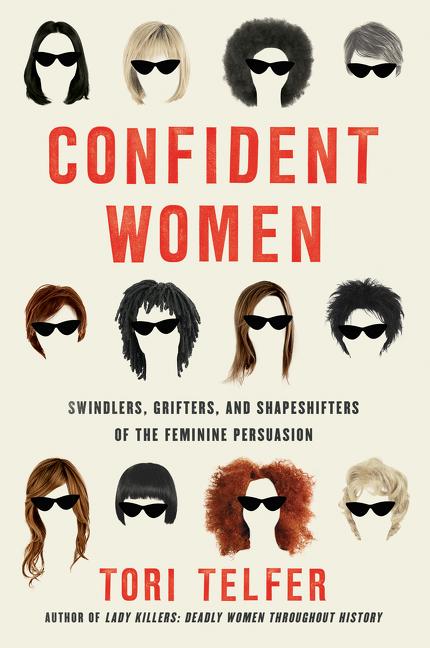
Confident Women

 Confident Women: Swindlers, Grifters, and Shapeshifters of the Feminine Persuasion by Tori Telfer, 352 pages.

Tori Telfer follows the history of female cons and grifters from the 18th century to present. The book is roughly sorted by the general types of scams the women pulled off, and it gives the overall impression of a very thorough treatment of the topic. Although mostly centered in America, Telfer also takes the occasional field trip to other parts of the world, furthering this impression of a broad view. 

In addition to relating the facts of the case and the specifics of the stories that these women told, Telfer spends a lot of time considering why we, societally, are so fascinated by grifters. Their feats of audacity made many of these women media sensations in their own times, and the allure does not seem to have faded. I listened to the audiobook, which really had the feeling of being told outrageous stories. I think this, more than anything else, really made the newspaper readers ravenous for more details very relatable to me. This is a light, fascinating nonfiction work. I would definitely recommend it to people who like reading about crimes that lean towards the spectacular, emphasis on the spectacle. 


Thursday, March 20, 2025

Bury Your Dead

Bury Your Dead by Louise Penny (2010), 371 pgs. 

Unable to resolve terrible events in his own recent history, Chief Inspector Armand Gamache turns to historical mysteries for comfort. He spends his days in the Literary and Historical Society, an enclave of English literature in the midst of Francophone Quebec, distracting himself with research on incidents that occurred many years ago. Inspector Gamache soon realizes he is not the only one ruminating on the past, as an obsessive historian turns up dead in this safe haven of research. While Inspector Gamache works with Canadian history, Inspector Beauvoir returns to Three Pines for comfort and clarity on the team's most recent case there. The two soon realize that the past, like the present, is never quite as it may have once seemed.

This story has a lot of plot lines to follow--the mystery of Quebec's founder, the mystery of the historian's murder, the case in Three Pines, and the recent case which left Gamache and Beauvoir so wounded--so many that I think the impact of each is dulled. As you move through the book, you learn a little about each plot line at a time, meaning that at times it does not even feel like you are progressing, rather taking four steps to the side before moving forward. I do, however, love how unabashedly Canadian this book is. I loved learning about the tense situation between languages spoken in Quebec, and I loved getting a glimpse of Canadian history (the good, the bad, and the ugly) through the Louise Penny's lens. This is an interesting story; it is just a lot. 


Wednesday, February 26, 2025

Side Quest: A Visual History of Roleplaying Games

 Side Quest: A Visual History of Roleplaying Games, by Samuel Sattin and Steenz, 208 pgs.

This graphic novel takes a broad view of tracing the early origins of roleplaying games, going far back into global history to trace early origins of imaginative play, improv, and strategy games. Although I would argue that the authors maybe took on too wide of a scope, I did learn a lot of interesting facts about topics I wouldn't otherwise know much about, so I can't be too upset! The illustrations were easy to understand, and they whole book was extremely digestible. 

My biggest criticism is that while this book spends a lot of time on ancient history, there is proportionally way less time spent on the history of actual roleplaying games, and contains almost nothing at all after the 1980's (despite the current boom in the genre). I think I might have liked this book better if it billed itself as being on the origins of roleplaying games, rather than a history of a specific medium that it was ultimately a little sparse about. Still, it was an interesting little book, and if you are interested in the description of the actual contents of the book I suspect you would quite like it!


Friday, February 7, 2025

A selection of February graphic novels

 Marie Curie: A Quest for Light by Anja C. Andersen and Frances Andreasen Osterfelt, with art by Anna Blaszczyk (2018) 136 pages


The writing is succinct. The art on every page looks like collages with paper cut outs of different colors and textures. Diary entries and letters make this biography very personal. I really enjoyed the creativity of this one.


Heartstopper: Volume 1 by Alice Oseman (2018) 288 pages


I'm working on the Hoopla challenge for 2025 while focusing on reading more graphic novels this year. February is Romantic Reads.  I flew through this first volume in one day. There is a lot of space between the panels on many pages and not much text in speech, thought, or mobile texts. Very creative how it tells the story visually as often as it does. I have not seen the TV series yet, and I'll probably wait to continue this comic series.


Laura Dean Keeps Breaking Up with Me by Mariko Tamaki and Rosemary Valero-O'Connell (2019) 289 pages


Compared to the one above, I liked the art and writing a bit better. The pages are denser with emotive visuals. Freddy Riley has her group of queer friends in high school. Laura Dean doesn't see their relationship as monogamous. Laura has so much extrovert energy and doesn't seem to care that she discards Freddy so easily when she wants attention from others. Freddy is so enamored with Laura's brief moments of attention that she doesn't notice her other truly good, close friends, or the new girl working several part-time jobs in town to pay for college. Freddy's eye opening journey is pretty special.


The Puerto Rican War: A Graphic History by John Vasquez Mejias (2024) 112 pages


I appreciate the timeline and interview with the author that is included at the end. It is a short story of Puerto Rican history that I was not familiar with before. The author makes prints from woodcuts. The text is challenging to read at times, but with concentration it could all be understood. The unique style is visually expressionistic and very detailed.


Deep Cuts by Kyle Higgins and Joe Clark with various artists (2024) 312 pages


I loved this! #1 in New Orleans 1917, the art and story are amazing, looking at the roots of modern jazz. #2 in Chicago 1928, a novice Broadway songstress has an adventure that references The Wizard of Oz. You begin to see that there are threads that connect the stories. #3 in Kansas City 1940, Alice, a young black girl, tries to solve the mystery of why her dad stopped his music career. This includes research at her local library! #4 in New York City 1956, is documentary-like looking at the jazz scene and the influence of harder drugs. #5 in Los Angeles 1968, shows threads connecting some of the previous stories, but is more countercultural and the art took me longer to embrace. #6 in multiple locations 1977, ties all the issues together. Characters and themes return. Jazz history comes full circle. Oh, and the lead sheets at the end are a cool bonus. I, too, wonder if there are audio tracks somewhere of this music.

Friday, January 17, 2025

A selection of January graphic novels

 Battlefields: The Night Witches by Garth Ennis with art by Russ Braun (2009) 79 pages


It is fascinating that Russia did have women pilots in their air force during WWII. Half the story is following a German squad pushing into Russian territory with one conscientious young man as our narrator. The other half focuses on just a couple of the women pilots who fly night missions dropping bombs. One in particular, Nadia Anna, achieves the rank of Captain and is a survivor despite a brief romance with heartbreak and her plane going down. The story succeeds in showing the horrific tragedy of war. The art work is a bit cartoon-y, but not far-off in portraying the gritty realism.


Hokusai: A Graphic Biography by Giuseppe Latanza and Francesco Matteuzzi (2021) 128 pages


I really enjoyed the art and the biographical story. Like Hokusai making woodblocks to stamp multiple prints of his art, some of the graphic novel's images are repeated. In between the story of his life there are full pages of text with historical background about Japanese art, or explaining terms and historical periods. Some of this felt repetitive, unfortunately, like a different author had lost track of what had previously been explained. However, this did not drastically lessen my enjoyment. I thought the book was aimed at teens at first, but it does mention and show a bit of the erotic art that Hokusai made during one part of his life.


The Secret to Superhuman Strength by Alison Bechdel (2021) 240 pages


I loved this even more than Fun Home. Bechdel is even more revealing about herself, and explores engrossing related topics. Exercise trends through the second half of the 20th century, Romantic poets, Transcendentalists, Kerouac, Zen Buddhism are all connected. She explores mountains as a symbol for human achievement. The aphorism "it is about the journey, not the destination" comes across.


Will Eisner's New York: Life in the Big City by Will Eisner (2006) 421 pages


I've read a couple of his other realistic graphic novels and highly recommend this one as well. "New York: The Big City" consists of short vignettes. "The Building" tells the backstory of four ghosts who hang around a particular intersection where a historic building has been torn down and a new one constructed in its place. These stories reveal the tragicomic world Eisner is drawn to portray. "City People" is filled with more observations in mostly one or two page vignettes. A longer tragic story is told in Collisions. "Invisible People" contains three longer stories. Sanctum tells the sad story of Pincus Pleatnik. The Power tells a symbolic story of a healer named Morris. Eisner says of Mortal Combat, "In relating the story of Herman, who became the unwilling prize in a clash of wills, I hoped to evoke the helplessness of a person caught in an intersection of the traffic of life."

Past Tense: Facing Family Secrets and Finding Myself in Therapy by Sacha Mardou (2024) 336 pages


A courageous memoir. I picked it up at my new comic shop because it is by a local St. Louis author. Her journey to overcome her anxiety and unpack her childhood trauma is fascinating. She specifically delves into a therapy model called Internal Family Systems (IFS) because she finds it helpful after some initial skepticism. Mardou's art style is a bit loose, but expressive. Freeing herself from generational trauma reveals truly healthy outcomes.