Showing posts with label transcendentalism. Show all posts

Friday, January 17, 2025

A selection of January graphic novels

 Battlefields: The Night Witches by Garth Ennis with art by Russ Braun (2009) 79 pages


It is fascinating that Russia did have women pilots in their air force during WWII. Half the story is following a German squad pushing into Russian territory with one conscientious young man as our narrator. The other half focuses on just a couple of the women pilots who fly night missions dropping bombs. One in particular, Nadia Anna, achieves the rank of Captain and is a survivor despite a brief romance with heartbreak and her plane going down. The story succeeds in showing the horrific tragedy of war. The art work is a bit cartoon-y, but not far-off in portraying the gritty realism.


Hokusai: A Graphic Biography by Giuseppe Latanza and Francesco Matteuzzi (2021) 128 pages


I really enjoyed the art and the biographical story. Like Hokusai making woodblocks to stamp multiple prints of his art, some of the graphic novel's images are repeated. In between the story of his life there are full pages of text with historical background about Japanese art, or explaining terms and historical periods. Some of this felt repetitive, unfortunately, like a different author had lost track of what had previously been explained. However, this did not drastically lessen my enjoyment. I thought the book was aimed at teens at first, but it does mention and show a bit of the erotic art that Hokusai made during one part of his life.


The Secret to Superhuman Strength by Alison Bechdel (2021) 240 pages


I loved this even more than Fun Home. Bechdel is even more revealing about herself, and explores engrossing related topics. Exercise trends through the second half of the 20th century, Romantic poets, Transcendentalists, Kerouac, Zen Buddhism are all connected. She explores mountains as a symbol for human achievement. The aphorism "it is about the journey, not the destination" comes across.


Will Eisner's New York: Life in the Big City by Will Eisner (2006) 421 pages


I've read a couple of his other realistic graphic novels and highly recommend this one as well. "New York: The Big City" consists of short vignettes. "The Building" tells the backstory of four ghosts who hang around a particular intersection where a historic building has been torn down and a new one constructed in its place. These stories reveal the tragicomic world Eisner is drawn to portray. "City People" is filled with more observations in mostly one or two page vignettes. A longer tragic story is told in Collisions. "Invisible People" contains three longer stories. Sanctum tells the sad story of Pincus Pleatnik. The Power tells a symbolic story of a healer named Morris. Eisner says of Mortal Combat, "In relating the story of Herman, who became the unwilling prize in a clash of wills, I hoped to evoke the helplessness of a person caught in an intersection of the traffic of life."

Past Tense: Facing Family Secrets and Finding Myself in Therapy by Sacha Mardou (2024) 336 pages


A courageous memoir. I picked it up at my new comic shop because it is by a local St. Louis author. Her journey to overcome her anxiety and unpack her childhood trauma is fascinating. She specifically delves into a therapy model called Internal Family Systems (IFS) because she finds it helpful after some initial skepticism. Mardou's art style is a bit loose, but expressive. Freeing herself from generational trauma reveals truly healthy outcomes.

Monday, June 10, 2024

Finding Margaret Fuller

Finding Margaret Fuller by Allison Pataki, 395 pages

In the late 1830s, an aspiring writer went to stay at the home of Ralph Waldo Emerson and over the next decade, became a sought after literary critic, founding mother of the women's rights movement, and bestselling author. Yet few today know of Margaret Fuller, who died in 1850 at the age of 40. This book tells her story, from that first visit to Emerson's home through her work becoming a literary critic and foreign correspondent covering Italy's bid for unification. Peppered throughout the book are many literary heavyweights including, Emerson, Henry David Thoreau, Louisa May Alcott (who was a little girl at the time), Nathaniel Hawthorne, George Sand, and Elizabeth Barrett Browning.

I don't know much about the Transcendentalists, much less Margaret Fuller, but after reading this book, I can honestly say I want to learn more about her. The first half of the book felt very focused on the men around Fuller, which seemed unfortunate for a book about such a fiery feminist, though the second half (which roughly corresponds with when she stopped spending so much time at Emerson's house) finds Fuller finally in the spotlight, and as such, is a much better part of the book. I can only wish that the whole book had been that way, and that I could have heard more about her travels as a single woman (which was very risque at the time). I suppose I'll have to track down some of her own writings to learn more about that.

Thursday, January 12, 2023

Self-Confidence: A Philosophy


Self-Confidence: a Philosophy, by Charles Pepin (2019, 176 pages)

I am a bit of an introvert and side-musician dealing with more anxiety issues as I get older, especially in crowds or playing music, so I was looking for texts that could speak to basic strategies on gaining more self-confidence in those areas. While this book was not as procedural as I imagined it would be, it was actually very aspirational, and reminded me of my time in undergrad reading transcendentalist authors, like Emerson and Thoreau. Much of the book is written in an uplifting, inspirational manner, which I generally sort of despise, but this doesn't feel sappy. The book abounds with analogies and metaphors intended to get the reader to reflect on their own experiences with confidence, while referring to famous quotes throughout the ages. There's a bit of philosophy, a lot of straight talk that is very down to earth and serves as a good reminder to what's important in life. The book first breaks down what confidence is, or rather the concept of confidence--what we tend to think of it. It then begins to investigate how self-confidence works and provides useful examples both historical and modern. It was an interesting concept to think of achieving self-confidence as something you cannot do on your own, paradoxically. According to the author, confidence is derived by others in our life, who help to make us feel confident--people who help us increase our feelings of competence--and then we begin to (or should) move forward in the direction of trusting ourselves, our intuition, of building a natural resistance to fear of the unknown and developing a categorical mistrust of life as a whole. We must become brave and learn to navigate uncertainty, to listen to ourselves and trust our rational minds. That is the only way to true self-confidence. Personally, this is less of a self help book and more of an agnostic, inspirational text, I definitely enjoyed it. It was a fast read and really aims to get you out of your own head. Good for adults and teens. 

Friday, December 9, 2022

Thoreau: A Sublime Life

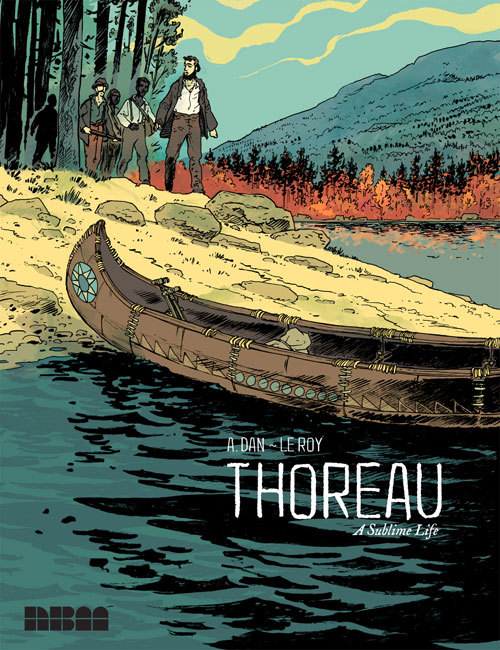
Thoreau: A Sublime Life by Maximilien Le Roy with art by A. Dan (2012) 88 pages

I loved this. Super short read since words are used sparingly. Many pages and panels visually show the world in which Thoreau lived with no dialogue or quotes from his speeches. The words Le Roy chooses to highlight are perfect for emphasizing Thoreau's thoughts through his adult life. In 1845 he begins to construct his cabin by Walden pond. Walden and the time he was arrested for not paying taxes as a protest of America's slavery are perhaps the most famous moments of his life. But these are very brief parts of it. 

Thoreau spoke against slavery many times and assisted with the underground railroad for a short time. We hear him speak against Capitalism. We see him express interest in Eastern philosophies. We see his enthusiasm for nature. This book also traces the contemporary events of abolitionist John Brown. We learn Thoreau's thoughts on Brown, which might surprise those who oversimplify his pacifism. Then we see the decline of his health due to tuberculosis. 

Following the sources of the quotes there is an excellent essay with a Thoreau specialist, Professor Granger, who spoke with author Le Roy.