Showing posts with label June 2017. Show all posts

Monday, June 19, 2017

The First Four Sean Duffy Novels and then the Sixth

The Cold Cold Ground 320 pages
I Hear Sirens in the Street 256 pages
In the Morning I'll Be Gone 314 pages
Gun Street Girl 311 pages
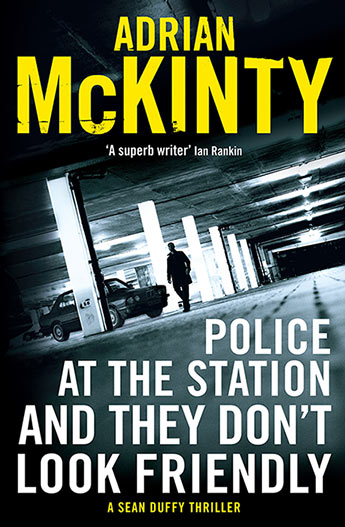
Police at the Station and They Don't Look Friendly 319 pages

All by Adrian McKinty.
Detective Sean Duffy joined the Royal Ulster Constabulary shortly after Bloody Sunday. To a lot of people that seemed like an odd thing for a Roman Catholic to do, especially since he had first tried to join the IRA. But Duffy's not a man who is much moved by what other people think. This attitude repeatedly causes him trouble with his higher ups, and as the seriers progresses, with British intelligence, the FBI, random IRA kill-teams, UVF kill-teams and most of the women he dates, and maybe one young man he meets in a highway rest-stop bathroom. Duffy drinks too much (even for a Northern Irish Peeler), smokes too much weed, and cuts a lot of corners. When describing himself Duffy says he's plodding instead of brilliant, he's aware that other
Well-written, with great dialogue, a terrific (as far as I know) sense of Belfast and the surrounding area in the 1980's and tight, intricate plotting throughout. Strongly recommended to fans of noir, fans of Ed McBain or Elmore Leonard. Plus, you get McKinty's take (through Duffy's acerbic commentary) on popular music from the 1950s through the 1980s as well as classical music. I'm really glad I found these. I saw Nancy Pearl's recommendation after I was already hooked, so I have to credit Christa for this one. She had a copy of the book on CD and I had to drive for 11 hours. Of the five I have finished, I have listened to 3 of them. They are all read brilliantly by Gerard Doyle. Pretty much everything McKinty has written is available on Hoopla. Check it out.
Now I have to go and finish Rain Dogs.

Thursday, June 15, 2017

All the Missing Girls

All the Missing Girls by Megan Miranda,  371 pages.
Miranda has produced a nice addition to the growing genre of twisting, turning, well-plotted books about missing women. Nic Farrell returns home after a ten-year absence in order to deal with her father, his declining health, and his tumbledown house. She doesn't really want to deal with her brother and his new wife, nor does she want to relive the events that happened right before she left. Ten years ago her best friend, Corrine disappeared. No one knows what happened to her. Did she run away? Did Corrine's potentially violent boyfriend do something? Did Tyler, Nic's sometime ex-boyfriend do something? What about Nic's brother or her father? Her father seems to know something; through the fog of dementia he keeps mentioning seeing "that girl." Plus the fair was in town, and you know how those carnies can be.
While she's home the fair returns and another young woman goes missing. Miranda's reverse chronological tale-telling keeps the suspense going until the end. A good, fast-paced read. Fans of the genre (sub-genre?--Girl on the Train, Gone Girl, etc.) will enjoy.

This One Summer

This One Summer by Jillian Tamaki and Mariko Tamaki, 319 pages.

This graphic novel was written and drawn by Canadian cousins Mariko and Jillian Tamaki. I had recently read Jillian's outstanding SuperMutant Magic Academy and really enjoyed it. This graphic novel was quite different, though good in its own way. Rose and her family vacation at a cottage on Awago Beach every summer. Rose is fourteen and Windy, her friend and companion every summer, is a little younger. The two girls spend the summer observing the problems that others are having; an older boy on whom Rose has a crush may have gotten his mysterious girlfriend pregnant, and Rose's mother and father are in the middle of a long-simmering bad spell. The characters believable and relateable and the drawings are consistently well-done. Overall an interesting YA graphic novel.

Paradise Lodge

Paradise Lodge: A Novel by Nina Stibbe, 274 pages.

I read this one over spring break and quite enjoyed it. I have checked out other books by Nina Stibbe, but have not read any yet. Kathleen, Kara, and Christa have all read and reviewed this book, and it is thanks to them that I read this account of  year-old Lizzy Vogel and her adventures as an aide at the Paradise Lodge nursing home. A sweet book, with interesting characters.


Every Night I Dream of Hell

Every Night I Dream of Hell by Malcolm Mackay, 291 pages.

I read the Glasgow trilogy last year, and they were very good. Apparently, Mackay has continued writing and is still doing a good job of it. There's been a book between this one and The Sudden Arrival of Violence, but the criminal organization that Peter Jamieson and John Young had run before they went to prison is still in disarray. Jamieson himself calls Nate Colgan, a brutal man who used to be an independent, and asks him to take over security for what remains of the organization. Colgan doesn't like the idea, but feels that his choices are limited. As with the other Mackay novels, Every Night is a grim book, with violent unhappy characters, that is, nevertheless, a fast-paced, well-written, and captivating novel. Mackay is a very good writer, and his latest book is the equal to any he's written. Fans of hard-boiled crime novels will enjoy. Reminiscent in tone of the Richard Stark novels featuring Parker.

The Underground Railroad

The Underground Railroad by Colson Whitehead, 306 pages.

Whitehead won the Carnegie Medal for Fiction, the Pulitzer Prize, the National Book Award, and a host of other prizes for this excellent novel. Cora's grandmother ended up on the Randall plantation in Georgia after being kidnapped, and bought and sold. She lives a horrific existence. Her daughter Mabel manages to escape from captivity when Cora is about eleven, but Cora is left to fend for herself and she can not forgive her mother for leaving her behind.
Whitehead, an author who seems to be able to tell an engaging and readable story on any subject, does not falter when the subject is the something as horrific as slavery. He does not hide the larger tale by focusing on his characters and their small part in history. In fact he is at his most compelling in this amazing book when he casually conveys the vastness of the horror and cruelty suffered by so many as they form the backdrop in the circles Cora travels through. Each station on the railroad is a different place and time in this warped America, and at each station Cora must witness some fresh hell as it is visited upon her or on someone she knows. I imagine that this is a book that the reader will need to return to again and again.

Wednesday, June 14, 2017

Before Dawn on Bluff Road: Selected New Jersey Poems / Hollyhock in the Fog: Selected San Francisco Poems

Before Dawn on Bluff Road: Selected New Jersey Poems / Hollyhock in the Fog: Selected San Francisco Poems by August Kleinzahler,  71 and 77 pages.
Two excellent collections of poems bound together tete-beche (two books together with one starting at each cover, text of the one flipped 180 degrees from the other).
I guess that I lack a real appreciation of the places described in the tow different volumes, for while I have always felt that San Francisco was one of my favorite places in the world, and I don't believe that I have ever visited New Jersey, I was equally moved by the poems in each volume. The author's sense of home, his nostalgia for the time and place for each poem is transmitted clearly to the reader leaving the reader to share in the longing for a look back, a visit, a reconnecting (even if, as I mentioned, the reader might not have previously connected). Kleinzhaler alludes to popular culture, and shabby, worn down memory, in a breezy, familiar tone to draw you in and keep you listening.
The poems seem familiar, and some seem to hearken back hundreds of years; as if they were brief and evocative missives from the old Chinese poets translated by Kenneth Rexroth or Ling Chung, as in "Late Indian Summer" from the San Francisco Poems:

The rains hold off another week,
And the midday heat,
long after the wine grapes are in, has the cat
sprawled flat under the jade plant.

Nights already belong to winter.
You know that tuning fork in its jacket
of bone
broadcasting to the body's far ports.

Days like this so late in the year
inflame desire, perturb
the ground of dreams, and roust us from sleep,
exhausted and stunned.

Great stuff. Really worth a read.

Monday, June 5, 2017

Waking Gods

Waking Gods by Sylvain Neuvel, 324 pages.
The follow-up to 2016's Sleeping Giant, Neuvel's latest is still somewhat fresh and compelling but does suffer a bit from middle-book syndrome. The robots appear from whatever place they were originally made. Dr. Franklin, still trying to recover from having died and then found alive on a roadside some years later, is still around. The unnamed interrogating agent is back too, and we find out his name in this volume. Old characters come back, and a few new surprise characters emerge. All-in-all, a fun book. I look forward to seeing where this series goes from here.

Exit West

Exit West by Moshin Hamid, 231 pages.
When Saeed and Nadia first meet, they are in school, college, and Saeed works writing copy for a billboard advertiser. Their country is at war, but it hasn't reached their city yet. Saeed is religious, but not devout; Nadia wears a full black robe, not because she is religious, but so that "men don't fuck with me."
The first door appears in the story, but we don't know that yet, though they soon change the flow of the story, giving escape and hope to those who had neither. Doors appear around the world, connecting distant cities and countries; you walk through and you are suddenly hundreds or thousands of miles away. They appear without warning and without explanation, and they fundamentally remake the world. As they grow in number, these doors mean that national borders become meaningless, as refugees from war-torn regions, or people struggling with extreme poverty are free to wander into downtown London, or into a seaside Greek village. People re-form the groups they belong to based on other criteria besides country of origin, village, or neighborhood. For the most part, the people in this story choose to remain with people from their same ethnic or religious group, and the first-worlders attempt to fight back with camps and police and repression, but that changes as the book progresses. Saeed and Nadia's story becomes less central to the book as the world opens up for them and they make choices about how they are going to live their lives. A sharp and incisive book, and a very good read.

Saturday, June 3, 2017

Supermutant Magic Academy

 Supermutant Magic Academy by Jillian Tamaki, 274 pages.

Great graphic novel featuring a group of teens at the school from which the book gets its name (though no one in the book refers to the institution by name). The classwork at the school isn't featured in the tales that make up the book, neither are the powers or abilities of tphe students, except as they annoy their classmates, or help or hinder them sexually. The mostly single-page vignettes are chronologically arranged and tell of the day-to-day frustrations, anxieties, and mini-traumas the teens face while attending the school. Marsha is trying to come to grips with her sexuality and her love for her friend Wendy. Wendy is beautiful and popular and can turn into an actual fox. She doesn't seem to have any problems. Cheddar is smart, popular, good at sports, enjoys reading Joyce, and is eventually mistake for the "Chosen One." Frances and Everlasting Boy are two of my favorites; Frances is the school's inappropriate (my reaction to her art is valid) performance artist, and Everlasting Boy doesn't quite fit in, but he does endure. Nicely drawn. Interesting stories.