Showing posts with label humanity. Show all posts

Tuesday, February 11, 2025

In the Lives of Puppets

In the Lives of Puppets by TJ Klune, 420 pages

Rather than summarize again, I'm going to make you click this link to my previous post about In the Lives of Puppets. Generally speaking, I agree with what I said back in 2023 when I first read it, though I'll admit that chatting about this with the Orcs & Aliens last night made me consider it more critically. That's why I love discussing stuff with this group! If you read and like this one, I highly recommend Service Model by Adrian Tchaikovsky, which I'll be posting about one of these days.

Tuesday, November 26, 2024

Here

Here by Richard McGuire (2014) 304 pages

The new film Here by Robert Zemeckis starring Tom Hanks and Robin Wright is based on this graphic novel. With such big stars the narrative thread must be more consistent and traditional, but I am still curious to see how it is adapted. This graphic novel is quite abstract with a "camera" view that does not move, but the time period depicted does jump wildly forward and backwards in time. It only gives you glimpses, often in small windows, into the broad stretch of time. We see ancient prehistory, history when no house is in the foreground, nearly the whole twentieth century history in the house that might be the main character, and speculation about our near future. There are some mini stories that are sequential over several pages: siblings sharing a joke, archeologists hoping to find relics on the property, Ben Franklin's family in a colonial house "across the street," a painter from the 1870s, and the building of the house in the foreground. After climate catastrophe, I especially loved the virtual tech imagined a couple centuries into our future. Following the time stamps is a nice mental puzzle, but I think the point is more to see the commonalities of how humans act and react to each other.
 

Tuesday, October 24, 2023

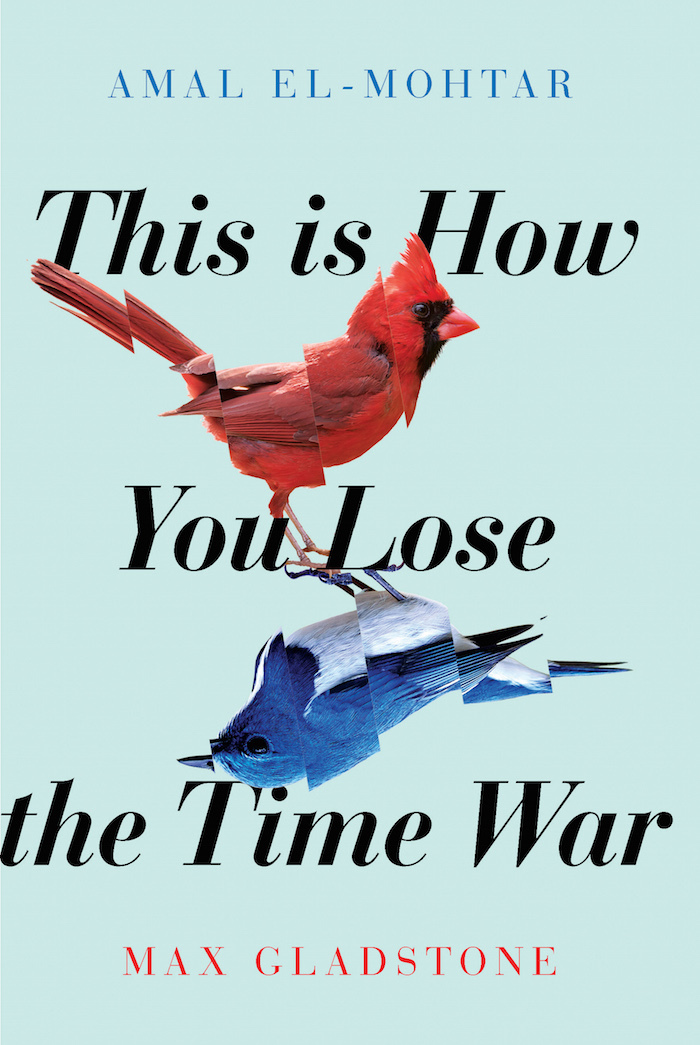
This is How You Lose the Time War

This is How You Lose the Time War by Amal El-Mohtar and Max Gladstone (2019) 209 pages

I listened to the audiobook on Libby narrated by Cynthia Farrell and Emily Woo Zeller. Amal answers a reader's question on Goodreads about how the two authors divided the writing with "In brief, Max wrote all of Red and I wrote all of Blue." I struggled to follow the story and understand what was really happening in the early chapters of the book. It is a very abstract book with lots of poetic language and mind-bending multi-verse time jumps. The two main characters named Red and Blue are female time agents from two warring factions. If you are a fan of espionage stories, I wouldn't recommend this because the spy work of these two time agents is left pretty vague, or, at least, it is difficult to follow the thread of the consequences of their actions forward and backward through time. There are letters that Blue and Red send to each other in this short book, which start as taunts between competitors and turn into proclamations of love. Red's world includes many more references to human civilizations throughout history and has a sci-fi bent. Blue's world has many references to plants and animals and has a fantasy angle. Ultimately, I think this is really talking about the competition between humanity and nature through the millennia, and a star-crossed couple representing these two things begins to see value in each other.


Thursday, July 20, 2023

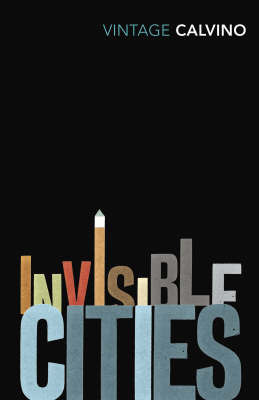
Invisible Cities

 Invisible Cities by Italo Calvino, 165 pages.

This book is difficult to describe. The frame device is famous explorer Marco Polo describing the cities he has seen to Kublai Khan. The actual book is mostly dozens of vignettes no more than a few pages long about the fantastical cities that he has seen. But really it is a meditation on the possible ways that cities could be, and what that means on a human scale. The book is extremely philosophically compelling, and once I managed to stop taking it so literally I thoroughly enjoyed it. My ebook copy is very full of bookmarks. The short chapters (and short overall page count) make it very easy to casually pick up this book. A great book to read at a leisurely pace, I thoroughly recommend it.

Tuesday, May 9, 2023

In the Lives of Puppets

In the Lives of Puppets by T.J. Klune, 420 pages

Human male Victor Lawson lives in the woods with his dad (an android named Giovanni) and two refurbished household robots named Nurse Ratched and Rambo. Victor and Giovanni spend their days tinkering with robots, and hauling bits and pieces out of a nearby scrap heap to create all manner of robotic stuff. But when Victor pulls a dying android named Hap out of the scrap heap, he learns that his dad isn't exactly who he thought he was, and must confront his fears — and his dad's past — to save their little family.

Klune has quite the talent for creating amazing characters, and this book is no exception. Nurse Ratched's sociopathic tendencies and Rambo's enthusiastic goofiness are an absolute delight, and add just the right amount of levity to what, in other hands, could be a tough story. I loved this science fiction take on Pinocchio, and really dug the ruminations on power, kindness, trust, and emotional strength. Another amazing book from Klune.

Wednesday, April 12, 2023

Exhalation

 Exhalation: Stories by Ted Chiang, 350 pages.

Kara just beat me to writing about this month's Orcs & Aliens book, so I'm going to go ahead and link her review here.

I thought this was a really neat collection! It does what I tend to like short story collections to do and is filled with stories that are more about keeping you thinking rather than being focused on narrative. What I also found really cool about it's collection was that by focusing pretty hard on a couple of themes (I found themes of personhood and free will to be particularly prominent) it managed to give a very nuanced examination of them. It felt at times like the collection was in conversation with itself, which was very interesting. This was a great book club discussion, and I definitely think the stories contained within deserve the many awards they've won.
 

Tuesday, April 11, 2023

Exhalation

Exhalation: Stories by Ted Chiang, 350 pages

In this collection of nine science fiction stories, Chiang offers readers many chances to muse on the nature of sentience, humanity, intelligence, memory, and the choices that make us who we are. From the ridiculously short "What's Expected of Us" (about a button that proves destiny and a lack of free will) to the novella-length "The Lifecycle of Software Objects" (about artificial intelligence beings that are being raised and shaped by humans over a span of decades) there are a lot of things to think about in this acclaimed collection, and it gave the Orcs & Aliens plenty to discuss.

Sunday, December 30, 2018

Alice Isn't Dead

Christa summarized the plot very well in her review of the book last week. Click this link to read her review. This book is based on a podcast by the same name. It follows the same plot but changes certain aspects to work better within a novel format. I am an avid fan of the podcast (and subsequent novels) Welcome to Night Vale and so was instantly hooked when the authors released the Alice Isn't Dead podcast.

I don't even know how to convey how much I adored this book. Its exploration of human nature, mental health, and the nature of relationships made me examine on my own experiences. It is a book that I am going to reflect upon for a long time.

Tuesday, August 11, 2015

Lock In

Lock In by John Scalzi, 336 pages

After a meningitis-like virus hits, thousands of people are left "locked in"--able to use their brains, but not the rest of their bodies. To help the locked in (also referred to as Hadens, after the syndrome they survived), advancements were made in robotics and neural transmissions to allow the Hadens to continue to contribute to society through avatars. Our narrator is Chris Shane, a Haden who is also an FBI agent working with an able-bodied partner to solve a series of Haden-related murders in Washington, D.C. Part sci-fi (OK, very sci-fi) and part detective story, Lock In is an easy read that offers up plenty of food for thought, on everything from gender to disability to what it means to be human. This would be a great offbeat choice for a book club. I loved it.

Friday, November 23, 2012

God is Not a Christian

God is Not a Christian: And Other Provocations by Desmond Tutu  256 pp.

In 1993 I heard then Archbishop Tutu give a dynamic talk at the United Church of Christ International Synod in St. Louis. I have been enamored of this dynamic, if tiny, man ever since. This book is a collection of some of his most powerful speeches and sermons of the last 40 years. They include the apartheid struggle in South Africa, the fall of the Berlin wall, genocide in Rwanda, Israeli-Palestinian conflict, and gay civil rights. The basis of all his writings is the philosophy of Ubuntu or the fact that every human being has worth. There's a lot to think about and applaud in this little book.

Sunday, February 20, 2011

The Walking Dead: Book Three/ Robert Kirkman

The Walking Dead: Book Three by Robert Kirkman. zombies, survival horror, graphic literature, adventure, thriller 304 pages.

I was warned by a fellow staff member today that if I was going to keep reading the Walking Dead, I would need to prepare myself for some intense content. I assumed that he was talking about incidents of murder, suicide, and graphic violence similar to those featured in the first two volumes. Tonight, I learned exactly how wrong I was...

Don't get me wrong, I absolutely LOVED this book, but HOLY CRAP!!! Things really do get a lot more intense and simple incidents of murder and violence are replaced with brutal mutilation and aggressive rape. It is clear that the zombies that infest Kirkman's world aren't the only monsters anymore...I would have to say, however, that the startling content fits perfectly with the focus of the third book, which splits the survivors into two groups with the majority remaining at the prison to pimp out their fortified sanctuary while a small band (protagonist Rick, the mysterious swordswoman Michonne, and stealthy bumbling pizza boy Glenn) set out to investigate a helicopter that they witnessed crashing into a nearby forest.

This book also introduces us to the colony of Woodbury. I have to applaud Kirkman on doing such an excellent job in creating the perfect anti-survivor camp. While the prison fortress of our heroes looks scary from the outside but is actually quite wholesome on the inside, Woodbury is the opposite, looking like a fortified small town from the outside but holding some deadly and disturbing secrets on the inside. Also, Kirkman totally nails his creation of a real villain with the introduction of the Governor. So far, we've seen minor villains who have caused hiccups for our favorite survivors, but the Governor is the first real scumbag that they have encountered. What makes him an extremely real character, too, is that his backstory makes him seem very similar to Rick in a lot of ways and shows us what Rick could become as a leader if he fails to redeem himself and quench his bloodlust in the name of survival. Although the Governor gets worked over by Michonne near the end of the book, I can't help but feel that I haven't seen the last of him.

As you can tell, this was my favorite of the series thus far, and if Kirkman continues to work his magic in book four, it can only go uphill from here. This just goes to prove that even with a kick ass first installment, a writer's best work still won't come until he really gets immersed in what he is writing and I believe Kirkman really brought himself into his own world in this edition.

The Walking Dead: Book Two/ Robert Kirkman

The Walking Dead: Book Two by Robert Kirkman. zombies, survival horror, graphic literature, adventure. 304 pages

I am writing this blog post just minutes after I finished the second Walking Dead book, and I have to say that I am pleasantly surprised with the direction that Kirkman took his zombie epic in the volumes contained within book two. I said in my post yesterday that I thought book one had placed the characters in just about every zombie genre situation imaginable and that I was worried the story would run out of steam. I can sense that this was probably an issue for Kirkman as well, because instead of the nomadic existence that the characters had in book one, almost all of book two takes place in the same place-- a high security prison that the survivors are attempting to turn into a sanctuary. The sanctuary features multiple fences that would keep the zombies out, and although there are some pretty good zombie showdowns as the characters clean out the infested prison, I would venture to say that the zombies aren't the real enemies in book two.

Book two features a real breakdown of humanity. Kirkman's second book deals less with the human vs. zombie interactions and more of the human vs. human stuff. When the survivors are all locked safely in the prison, they might be safe from the zombies, but in such contained quarters, personalities are bound to collide...and they do. Some major themes of book two are guilt, betrayal, murder, and helplessness. While no zombie story can be called "happy", I think that book one looks like sunshine and daisies compared to the dark nature of book two.

Another thing I need to comment on is that seeing death in book two was a lot harder than book one. By this point, I've started to really know the characters, and any loss is a sad loss. I'm starting to wonder if anyone is safe (even the story's protagonist, Rick Grimes, is starting to get a little too big for his britches...would Kirkman be ballsy enough to off his main character for the sake of the story?). I realize that it's a zombie story and character deaths are ALWAYS going to be present, which is something that is actually a credit to the series. In most other stories, you can pick a select few characters that you think are death proof, but I find that any character in the Walking Dead, regardless of their roles in the survivor camp or their surviving family members, has the potential to die, and this keeps the reader on their toes.

I already said that I'm a big fan of the Walking Dead's characters, and I was eager to meet some new ones in book two, but this was the only area where the book fell short. Only five new characters were introduced, and by the end of the story, only two of these characters remained (and all of the new characters with one exception, which I will praise in a second, were pretty flat...I mean, really? prison inmates? The whole story with them was SOOOO predictable). The one character that shows any promise is the mysterious, sword-toting Michonne, who not only kicks ass, but also opens up some brand new story options that Kirkman experimented with in book two. I just wish there would've been more of a debate about Michonne keeping her pet zombies!!! They didn't have any arms and were on leashes!!! I realize that Kirkman's zombies have no potential for domestication, but excuse me for dreaming that the survivors might adopt a lovable pet zombie.