Showing posts with label gardening. Show all posts

Friday, November 21, 2025

Violet Thistlewaite Is Not a Villain Anymore

 Violet Thistlewaite Is Not a Villain Anymore by Emily Krempholtz, 368 pages.

Violet Thistlewaite has spent her whole life as the fearsome Thornwitch, right-hand to the dark sorcerer Shadowfade. But after Shadowfade is killed by a hero, and the hero tells her to "be good," Violet has to reinvent herself. She wants to be someone better, and the town of Dragon's Rest is the perfect place to set up a flower shop and try to make up for some of the evil she did in her life. But when a mysterious blight strikes the plants of the town she will have to work with her landlord (a grumpy, but handsome, former alchemist) to save the town that is becoming her new home. 

This book was good enough, but it ended up being a strangely generic book for how unique and interesting it's premise was. The book was cute and fairly well-written, and I quite liked the supporting cast. However, I felt like the drive to preserve this cute and cozy vibe rather undercuts the frankly massive death count in Violet's backstory in a way that wasn't particularly balanced. This was a fine book, but I'm afraid it didn't quite live up to the great book it could have been. 

Wednesday, January 8, 2025

The Twilight Garden

The Twilight Garden by Sara Nisha Adams, 391 pages

In a small London neighborhood, two of those neighbors are at odds, as neighbors sometimes are. But these two also have the quirky complication of a shared garden, one that once used to be a cheerful gathering spot for the community but in the intervening years has become overgrown and neglected. Bouncing back and forth between the early days of the garden and the modern struggle, the book illustrates how a bit of dirt and hard work can create a community. It's a heartwarming story, and one that will certainly resonate with many readers.

Wednesday, September 13, 2023

A House with Good Bones

A House with Good Bones by T. Kingfisher, 247 pages

Sam is a furloughed archaeoentomologist (she studies the bugs at archaeological digs) who decides to spend the time she would have been at a dig visiting her mom, who lives at the home she inherited from Sam's late grandmother. Gran Mae was a piece of work — very judgmental and obsessive, with Southern racist sentiments just bubbling under the surface of her "nice and normal" lifestyle — and when she arrives, Sam is dismayed to find that her mom has returned the previously funky and colorful house to the boring off-whites and doilies of Gran Mae's time there. But what really weirds her out is the garden, which is full of perfect roses but completely devoid of insects. Things are obviously not right.

I've been on a bit of a Kingfisher kick recently, so this short horror novel is right up my alley as we head into spooky season. It's relatively gore-free (if you don't count all of the thorns from the rosebushes), but with plenty of "something's off here" atmospheric vibes and Kingfisher's trademark no-nonsense, realistic protagonist. No surprise that I loved it.

Sunday, July 11, 2021

McGee & Stuckey's Bountiful Container: A Container Garden of Vegetables, Herbs, Fruits, and Edible Flowers

 McGee and Stuckey's Bountiful Container by Rose Marie Nichols McGee and Maggie Stuckey, 448 pages. 

I picked this book up in late spring with the intention of doing slightly less winging it in my gardening this year. This was especially nice because I grow exclusively in containers and mostly things that I can eat, so all of the books on making pretty floral arrangements in containers were not terrible helpful to me. 

Once I started reading this book, which I expected to use mostly as a reference manual, I proceeded to read the whole thing cover-to-cover. This is a really thorough guide, both for what you need to get started and sorted individually by plant. A really fun additional bonus are the projects and ideas for themed gardens, a couple of which I would definitely love to try. 

This book has a really good mix of the staples that people would want to grow in containers (basil, tomatoes, etc.) and more niche plants that I had never heard of, but am now definitely interested in trying my hand at. This guide, especially with the great attitude of the authors, makes me really excited to try new things. I am definitely looking forward to ordering my own copy of this book tp reference for years to come.


Wednesday, March 17, 2021

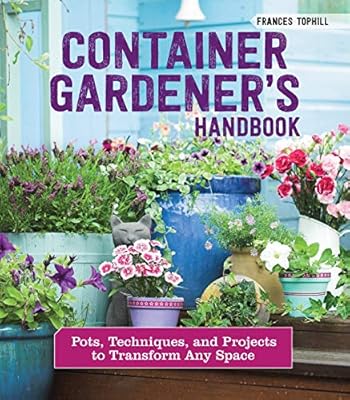
Container Gardener's Handbook

 Container Gardener's Handbook by Frances Tophill, 157 pages. 

I got checked out this book, and a number of similar ones, because it's Spring and I am so excited to start growing things again! I've been growing things, mostly herbs and vegetables, in containers for a number of years, but I've always sort of played it by ear. This year I thought it would be fun to try and read up on what I should  be doing.

This book did not quite suit my purposes. It is much more focused on the aesthetics of a container garden than the how-to's that I would expect from something labeled a handbook. I would say this is a guide book to designing a fashionable garden more than any sort of growing guide.

That being said, there are some really cute project ideas in here! I love the succulent picture frame and will likely try making one of my own! Interspersed with these really cute projects are several projects that I suspect would look more like plants had started sprouting in the kind of debris that accumulates around an abandoned house. Still, it is a fun book to flip through for ideas. 


Thursday, February 22, 2018

The Night Gardener

The Night Gardener by Jonathan Auxier  350 pp.

This was another one of my Treehouse Book Club books. The story is a creepy but intriguing tale about storytelling and greed. Irish orphans, Molly and Kip, have landed in England in search of work. Molly is a storyteller and uses her stories to comfort her younger brother's fears. Molly is hired to be a servant to the Windsor family but everyone they meet on the way cautions them not to go there because the manor house in the "sourwoods" is evil. The house is built with a large tree engulfing it inside and out. The tree is the source of the evil and the family is suffering the effects of the tree's magic. The appearance of the "Night Gardener" is just one facet of the strange goings-on. Auxier has produced a story that has potential to become a classic.  His masterful use of descriptive language makes this book something special. One of the book club kids declared it was one of the best books she ever read.

Thursday, July 21, 2016

Truck

Truck: A Love Story by Michael Perry  281 pp.

I chose this book about a man and his truck - a 1951 International Harvester pickup - solely for sentimental reasons. My husband had an old truck - a Chevy - that I nicknamed "His Mistress" because during the time he owned it he spent more time and money on it than he did me. Reading Perry's descriptions of the process of rebuilding his old IH brought back some memories. But this book is much more than that. It is not just about the truck. There are the author's gardening foibles, cooking, tales of his work as an EMT with the local volunteer fire department in his small Wisconsin hometown, descriptions of the locals, his brothers and mother, and small town life in general. Then there is the love story part involving a young woman he meets on a book tour and manages to woo and eventually marry in spite of his history of disastrous relationships for which he mostly blames himself and perhaps on his "crush" on the fictional "Irma Harding", the face of International Harvester's home appliance advertisements and classic series of cookbooks. Perry's writing is funny, touching, and philosophical. The man is a master of hilarious similes and metaphors and I frequently laughed out loud while listening to the audiobook read by the author.

Tuesday, February 2, 2016

Counting by 7s

Counting by 7s by Holly Goldberg Sloan  378 pp.

This is another of the books for the Treehouse Book Club. This is a wonderful book. Twelve year old Willow Chance is a genius who is on the autism spectrum and has a problem with social skills. She has obsessive interests in plants and human diseases. Willow's coping mechanism is counting by sevens, her favorite number. Her adoptive parents are supportive of her interests but send her to middle school in hopes that it will improve her life. After finishing a standardized test in 17 minutes with a perfect score, she is accused of cheating and sent for weekly visits with a counselor who is more dysfunctional than she is. When her parents are killed in an auto accident (yes, she now has lost two sets of parents) Willow ends up temporarily with the family of her only friend, a teen-age girl whose brother is a client of the same counselor. But they live in a garage behind the small manicure shop owned by her friend's mother, a Vietnamese immigrant. The mother and daughter conspire to commandeer the counselor's apartment to make social services believe the temporary situation is adequate. In the end, the lives of Willow, her friends, the counselor, a friendly cab driver, and others in the community are changed in a myriad of ways. I enjoyed this book even more the second time around.

Friday, November 20, 2015

Grow all you can eat in 3 square feet

Grow all you can eat in 3 square feet / Kate Johnsen (ed) 255 pgs.

When I first saw this on the cart, all I could think of was "they don't know how much I can eat" but really this isn't a book about surviving the apocalypse.  Although, if the apocalypse DOES come, I'm going to put some effort into consolidating some high quality potting soil.  How many of us have the dream of being a farmer?  Living off the land?  Well this book gives you a good starting point.  Start with 3 square feet and actually manage your crops and you can eat pretty well.  The recommendations for turning over your crop and replanting on a schedule make for continuous bounty.  This book is full of great ideas.  Now to consider getting my hands dirty...

check our catalog

Friday, October 9, 2015

The Book of Tea

The Book of Tea by Kakuzo Okakura  pp. 94

This small book is not about tea per se although there is a bit of history about the use of tea. Instead it is a book on the philosophy of "Teaism" and the practices of tea masters with regards to aesthetics and life practices. It includes the connections between Teaism and Zen, Taoism, architecture, garden design, and floral arranging. Interesting, especially for those who study Asian religions. Don't pick this up looking for a reference on varieties and uses of tea.

Tuesday, October 30, 2012

Possum Living

Possum Living: How to live Well Without a Job and With (Almost) No Money

by Dolly Freed

Possum Living is a new edition of Dolly Freed's cult 70's classic on how to live as self-sufficient as one possibly can. At the age of eighteen and with a 7th grade education, Dolly Freed takes you through the ins and outs of how she and her father manage to live off of their own means without traditional wage labor jobs or spending large amounts of money on living expenses. It's more than a step-by-step guide, however. Freed's straightforward voice and often libertarian commentary entertain as well. Although I'm probably not going to start raising rabbits in my cellar for meat and making my own moonshine, parts of this book helped remind me that there are things that I can do on my own without having to buy something new. In a culture of hyper-consumption, it's a healthy reminder and a grounding read.

Monday, August 22, 2011

Wicked Plants

Wicked Plants: the weed that killed Lincoln's mother & other biological atrocities by Amy Stewart  235 pp.
The gist of this book is that darn near every plant has at least some part of it that can be dangerous or deadly, even the ones we commonly eat. It is written in an engaging manner that introduces the reader to common and uncommon plants that may grow in your own yard or in a far away jungle. Many are mildly dangerous, causing discomfort, rashes (like the bane of my existence, poison ivy), or other allergy symptoms. Others are so dangerous even a  minor encounter can result in serious illness or even death. You may have some of the toxic offenders blooming prettily in your flower beds. Included are tales of how various plants have caused illness and death or, as in the case of Mussolini's men using castor oil, used for torture. There's a lot of information packed in this small book and it's written in an engaging way. This is a worthwhile read for anyone who gardens.


Friday, July 8, 2011

Green Witch

Green Witch by Alice Hoffman  135 pp.

This is the sequel to Green Angel. A year has gone by since the 9/11-like attack on the city that killed Green's parents and sister, along with many others. The attackers are now known as "The Horde", a group that wants to abolish all vestiges of modern life and technology. Green still has the ability to make anything grow. In addition, she has begun to write, making her own paper and ink, and traveling to visit different women survivors of the attack. These women, known as "witches" because they have withdrawn from what is left of society, are believed to have powers that others don't have. Green visits these women: Stone Witch, Sky Witch, Rose Witch, and River Witch to learn their stories and how they have gone on with their lives. Green is still waiting for Diamond, the young man she fell in love with in the first book. Green learns about love from these and finds the strength to mount a rescue against the Horde prison. Once again there is a lot in this small book and it finishes up Green's story nicely.

Monday, September 27, 2010

The Botany of Desire: A Plants' Eye View of the World by Michael Pollan

The Botany of Desire: A Plants' Eye View of the World by Michael Pollan, Botany, 271 pages. Check our Catalog!
Downloadable Audio.
Pollan's classic book from several years ago takes a look at the effect four plants have had on people throughout time and the effect that people have had on these plants. He covers apples through the story of Johnny Appleseed, and points out what has, I believe, become common knowledge because of this book, that Appleseed's efforts were aimed at cider production for that common frontier alcoholic beverage and not at healthy eating. He also tells the stories of tulips, marijuana, and potatoes. All the stories have great anecdotes and are informative. Maybe it was the smug narration on the audio version of this book, or maybe it's that thing where you have been hearing for so long about how great a book is, but despite the interesting stories, the smug tone of the book left me a little cold.