Showing posts with label translated. Show all posts

Wednesday, February 18, 2026

To Broadway

 To Broadway by Maurane Mazars (2025) 248 pages

This is historical fiction set in the late 1950s about a young gay German man studying modern dance who dreams of Broadway or Hollywood in America. The watercolor art is brilliant. We ride the ups and downs of Uli's career, love life, and friendships. Fantastically emotive with the use of visuals without too many words. And the Epilogue reveals some of the real people involved in the story. Translated from French.

Monday, August 29, 2016

Super Extra Grande

Super Extra Grande by Yoss, translated by David Frye, 156 pages

Dr. Jan Amos Sangan Dongo is an extreme version of a large animal vet. Set in a distant future in which Latin Americans pioneered quick space travel (go across the galaxy in a matter of hours!), Super Extra Grande tells of Dr. Sangan's escapades with the tsunami (an alien whale-like creature that's easier measured in kilometers than feet or inches) and the laketon, a single-celled organism that is often hundreds of kilometers in diameter. Both of these tales focus on the doctor, who is larger than life himself, being eaten and expelled by these creatures. And along the way, he attempts to help avert a political catastrophe among the galaxy's seven intelligent races.

It's an interesting story, and the parts where Dr. Sangan is navigating through these huge beasts are scientifically compelling, similar in style to The Martian. However... there are two major stumbling blocks for me. First, the recognized human language is Spanglish, which is left as-is in the text. For someone with only 7th-grade Spanish under my belt, it was not exactly easy to follow. Second, Dr. Sangan (and, I'm suspecting, Yoss) veers toward misogyny WAY too much. And seems really obsessed with the reader knowing the doctor's sexual tendencies, despite the total lack of sex in the book. That gave me the creeps WAY more than the detailed descriptions of the tsunami's digestive tract. Not really sure I can recommend this one.

Wednesday, August 17, 2016

Agatha

Agatha: The Real Life of Agatha Christie by Anne Martinetti and Guillaume Lebeau, art by Alexandre Franc, translated by Edward Gauvin, 119 pages

While she's best known for her fantastic mystery novels, Agatha Christie had an extraordinary life, full of travel, archaeology, family, and her own mysterious disappearance for several months in the 1920s. This graphic novel provides a skimming biography, touching on her young life, her two marriages, her travels, her time as a nurse during the war, and, of course, her writing. I liked how the creators used Christie's best-known characters to help illustrate her thoughts; her arguments with Poirot are fantastic. That said, I would have felt much better reading this right after an in-depth regular biography; this one assumes that the readers already know the ins and outs of Christie's life.

Tuesday, July 19, 2016

God is Round

God is Round: Tackling the Giants, Villains, Triumphs, and Scandals of the World's Favorite Game by Juan Villoro, translated by Thomas Bunstead, 255 pages

If you're looking for a truly universal talking point anywhere in the world, try starting up a conversation about soccer (or, as the rest of the world calls it, football). While it hasn't really truly caught on in the U.S., the rest of the world lives and breathes by it. In this collection (of essays? of articles? it's never really clear), Villoro talks soccer in both broad strokes--fans, the mentality of the game--and in narrow discussions about specific players and their styles.

While it's obvious that Villoro has a deep love of the game at all levels of play, he has a tendency to write without giving a frame of reference for those of us who aren't as familiar with global soccer's intricacies (read: Americans). This could be more the fault of the translator, however, who must have known that this version would be marketed to the U.S. and other English-speaking countries, which are little discussed in the book. That said, I enjoyed Villoro's discussions of Cristiano Ronaldo (who he can't stand) and Lionel Messi (who he loves), as well as his ruminations about left-footedness and his scathing takedown of FIFA. I also love the sometimes-hilarious ways he describes players, which completely illustrate the players' style that, even though I'm not familiar with them, I feel like I've seen them play (for example, "When Maradona doesn't have the ball, he's as lonely as Adam on Mother's Day.")

If you're a fan of soccer only when the World Cup rolls around every four years, feel free to pick and choose; I'd only recommend reading the whole thing if you're a diehard fan of soccer in the Spanish-speaking world.

Monday, April 11, 2016

Seeing Red

Seeing Red by Lina Meruane, translated by Megan McDowell, 157 pages
In this autobiographical novel, Meruane details how complications from a chronic illness left her essentially blind, able to see only the dark red blood from burst veins in her eyes. Told in a deliberately disorienting style, Meruane details the initial panic of not seeing, the awkward visits to doctors, the trip home to Chile to visit her family, the incessant fumbling through life to figure out how to be blind. It's illuminating, and made this reader infinitely grateful that my eyes work just fine.

Thursday, April 7, 2016

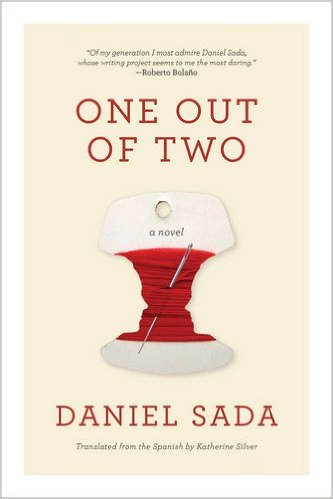
One Out of Two

One Out of Two by Daniel Sada, translated by Katherine Silver, 100 pages

Forty-something sisters Gloria and Constitucion Gamal are identical twins, with only an easily hidden birthmark distinguishing them. For their entire lives, they've embraced their similarity, wearing the same clothes, makeup and hairdo every day as they work together as tailors. But when a suitor emerges, they must determine the degree to which they are interchangeable.

While the story is intriguing, what makes this quirky short novel so fun and readable is how it's told. Sada presents the story as if he was telling it to a group of friends over a bottle or two of wine, and Silver does an excellent job of maintaining that feeling throughout. Through the telling, it's not easy to distinguish between the Gamal sisters, but that's kind of the point. It's a fun little story about sisterhood, and well worth the read.

Friday, January 15, 2016

The 6:41 to Paris

The 6:41 to Paris by Jean-Phillippe Blondel, translated by Alison Anderson, 146 pages


On a packed commuter train to Paris, Cecile is sitting by the sole open seat when a man sits down next to her. As fate would have it, the man is Phillippe, a man she dated briefly 27 years earlier. But this is no sunny trip down memory lane: their short affair ended in brutal humiliation for Cecile, and impacted both of their lives in ways they would never have imagined. Taking place entirely on the 90-minute train ride, The 6:41 to Paris jumps between the thoughts of Cecile and Phillippe, who are unsure of how to interact (or even if they should) given their painful history. For a short book set almost entirely in the minds of the two main characters, this is a surprisingly suspenseful tale, as Blondel masterfully uses their emotions to drop hints about their past before revealing it in the final pages of the book. This is an excellent short read. I highly recommend it.

Wednesday, January 6, 2016

Kafka on the shore

Kafka on the shore / Haruki Murakami 436 pgs.

Somewhere I read this book described as a metaphysical mind-blower and that seems like a perfect description.  Like many of Murakami's other books (each, that I've loved), you really don't know what is going to happen and sometimes not even how things relate to the story.  This book largely follows two characters whose stories are related but don't intersect too much.  Kafka is a 15 year old runaway and Nakata is an older guy who isn't very smart following a childhood accident.  Nakata's talent is his ability to talk to cats and so there are many in the book.  Kafka finds refuge in a library. Seemingly this is a book written to appeal to librarians!

As with all of Murakami's books, I feel very happy to read them and I'm also very confident that I'm missing out on tons of hidden meaning and larger lessons.  I still think he is an amazing author.

Monday, December 28, 2015

The Shapeshifters

The Shapeshifters by Stefan Spjut, translated from the Swedish by Susan Beard, audio read by Ray Chase, 587 pages.

An unexpectedly marvelous read (to me anyway, since I had heard nothing about the book, and was just looking for something in translation) from a very self-assured author. By and large, I'm not a fan of books featuring missing children. I probably would have  put the book back on the shelf after reading the description, "a young boy disappears without a trace from a mountain cabin" if it wasn't for the next line, "His mother claims he was carried away by a giant."
The myth is mixed in with the thriller portion of the story artfully; the stallo,  the shifters, giants, and trolls, are all presented in a way that makes them both matter-of-fact and unknowable. The creepy parts never go full-bore into horror. The (human) characters are mostly sympathetic and well drawn.
Ray Chase does an excellent job of reading the book.

Monday, December 14, 2015

The Murder of Halland

The Murder of Halland by Pia Juul, translated by Martin Aitken, 147 pages

The titular Halland is murdered--shot outside his home in a small Danish community--within the first few pages of the book, and his longtime live-in girlfriend Bess is immediately the prime suspect. As our narrator, Bess does exactly the opposite of what we expect someone accused of murder to do: she ignores the investigation, avoids seeking the answers to questions, and instead of planning a big funeral and reception (Halland was a well-known author, and his death has been splashed across the headlines), she's turned inward, focusing on missing her long-lost daughter. Juul takes a noirish setting full of rain and the odd fjord, and makes what could be a straightforward murder mystery into something much odder and introspective. It's an interesting read, though I'd avoid it if you're hankering for a straightforward mystery.

Wednesday, November 18, 2015

Ripper

Ripper by Isabel Allende, 478 pages

It's winter in San Francisco, and a series of odd murders has flummoxed the SFPD. Thankfully, Deputy Chief Bob Martin is getting an assist from his teenage daughter, Amanda, and a crew of her friends, who have begun investigating the murders as an offshoot of their online game, Ripper. The tension ratchets up when Amanda's mom (and Martin's ex-wife) is kidnapped, possibly by the killer.

This is my first stab at reading Allende, who I'd heard great things about, and I've got to say, I was underwhelmed. Some of that can be blamed on the translation of Ripper, which resulted in plenty of awkward phrasings and repetition. But the story becomes so convoluted, and tries to weave in the back stories of way too many characters, and the blame for that lies solely with Allende. She admits in the acknowledgments at the end of the book that this was her first stab at a murder mystery; it shows, and unless she seriously ups her game, I hope this will be her last foray into that genre. Will I read another of her books? Maybe. But probably not until I get the bad taste of Ripper out of my mouth.

Wednesday, November 11, 2015

Submission

Submission by Michel Houellebecq, 246 pages

It's 2022 and Francois is a 44-year-old academic who is, as he says, "about as political as a towel." His world revolves around 19th-century French novelist J.K. Huysmans, young coeds, and drinking vast amounts of wine. But while he's concentrating on these obsessions, a national election puts the Islamic party into national power, throwing France--and Francois--for a loop. Soon he's out of a job (since only Muslims can teach under the new regime) and becoming increasingly isolated and impotent (the modest dress imposed on French women certainly isn't helping in that regard). Should he throw aside all that he believes to convert and thus become employable? Or should he just drink himself to death? These seem to be his only choices.

I'll admit that I don't know a lot about French history or literature, and so felt a bit in-over-my-head in some of the discussions on those topics. However, Houellebecq presents an innately readable satire in his tale of a self-absorbed academic who is forced to consider politics on a personal level for possibly the first time in his life. Well worth a read.

Saturday, November 7, 2015

Tram 83

Tram 83 by Fiston Mwanza Mujila, 211 pages

An always-open, always-busy bar, Tram 83 serves as the hub of an unnamed seceded African city, the place at which miners come to drink beers and meet prostitutes after work, the place where both legitimate and below-the-table business deals are reached, the place where you can find anything and everyone you might be looking for. The plot of this short novel revolves around three people: Lucien, a penniless writer who has returned to the city-state to write his stage-play; Requiem, a kingpin of the city-state's underground who lets Lucien stay with him, despite holding a grudge against him; and Malingeau, a publisher and foreigner who keeps changing the terms under which he'll publish Lucien's text. And then there's Tram 83, which serves as the setting for most of the scenes in the book and gives the book life through the ever-present refrains from prostitutes, waitresses, miners, and tourists.

Reading this book is not easy, and is more akin to reading a jazz song. There are familiar refrains that pop up throughout the book, mixed in with long comma-filled sentences that feel something like an instrumental solo. So while it's a relatively short book, I found it best to approach it in small portions; it may be best read out loud, in a cadence that might be found at a poetry slam. This certainly isn't a book for everyone, but for those who care to brave it, the lyricism and rhythms of Tram 83 (both the book and the business) create an experience that isn't often found in books.

Saturday, October 31, 2015

The bus driver who wanted to be God

The bus driver who wanted to be God / Etgar Keret 130 pgs.

This is Keret's first collection of stories and it is, like the others, pretty fabulous.  The description on the cover says is all "Warped and wonderful short stories."

It is hard to pick a favorite but maybe the one about the guy who tries to hire someone to kill him but he is such a wonderful nice guy, no one will actually do it.  He has tried three times now.  Or maybe the one about the death of Rabin - a cat that is hit by a man on a scooter.

Like Keret's other books, you should read slowly and take many breaks because each story is so full it takes time to understand and digest them.

check our catalog

Monday, October 26, 2015

The girl in the spider's web

The girl in the spider's web / David Lagercrantz 400 pgs.

Lisbeth Salander is back!  Along with all your other favorite characters.  This time Lisbeth is involved with a shadowy group of hackers, murderers, and all around thugs.  Is this group a remnant of the crime syndicate her father used to run?  Of course Lisbeth is involved in a few other things too.  Mikael Blomkvist and the entire Millennium magazine staff is in financial hot water.  They accepted some money from an investor who is turning out to be a bit of a control freak and general ass hole.  Mikael thinks maybe it is time to end the magazine or he needs to come up with one heck of a scoop to increase revenues.

With many plot twists and some new interesting characters (plus MOST of the old favorites), new author David Lagercrantz does a good job of continuing the Millennium series.  I think Stieg Larsson would be ok with this book.  It isn't perfect but has many of the features that made the earlier trilogy a hit.  Plus, it is the first book in a long time that I could not put down.

check our catalog

Saturday, October 10, 2015

The Three-Body Problem

The Three-Body Problem by Cixin Liu, 399 pages

In the near future, a Chinese nanotechnologist is drawn into an investigation to uncover the mysterious deaths of a series of prominent scientists. Going undercover, he also goes down the rabbit hole of a perplexing computer game and learns about a 40-year-old top secret project involving transmitting radio messages to outer space.

Cixin creates a complex world in this book (the first of an epic trilogy), a world based in theoretical physics, philosophy, history, and math but reaching far beyond. He also creates intriguing situations and moral dilemmas, both in the computer game and out. While at times I felt a bit in-over-my-head with the technical information, Cixin (and his translator, Ken Liu) did a good job of explaining things simply enough for a decidedly non-techie like me to keep up. This won those scandal-filled Hugo Awards this year, and given the thought-provoking nature of the book, it's easy to see why. I'd recommend this for fans of Michael Crichton's novels and for those who liked Orson Scott Card's Ender's Game and Ender's Shadow series.

Wednesday, September 9, 2015

The Seven Good Years

The Seven Good Years / Etgar Keret 177 pgs.

The seven good years are those between the birth of his son and the death of his father.  Like Keret's fiction, this book is a series of short essays that are broken up into "years".  Some essays are about his family, some about very random events, all are pure genius.  He tells of his trip to Europe as a kid and the thing that left the biggest impression that he was given a tiny can of Coca-Cola and a mini box of cornflakes on the airplane. He doesn't want to brag but he has managed a special status among parents at the playground because he is a man who is hardly ever working.  When asked by his mother about the game Angry Birds, he learns the slightly distressing fact that his wife that she plays because "I love killing things."

Keret has become one of my all time favorites.  I have Kathleen to thank for introducing him to me.

check our catalog

Wednesday, September 2, 2015

Vincent

Vincent / Barbara Stock 141 pgs.

A graphic biography of Vincent Van Gogh that talks a lot of his relationship with his brother Theo and focuses on his time in Arles and after.  Theo was devoted to Vincent but that relationship worked both ways.  This book really talks about the dependence of Vincent on Theo and the amount of encouragement and money Theo gave to Vincent.

The graphics and colors are beautiful and the relationship between the brothers is as well.


check our catalog