Showing posts with label black history. Show all posts

Wednesday, February 4, 2026

Happy Land

Happy Land by Dolen Perkins-Valdez, 368 pages

Nikki hasn't seen her grandmother for decades, not since a falling-out between Nikki's mother and Mother Rita led to years of silence between them. But when Mother Rita calls with an urgent request for Nikki to visit her, she views it as an opportunity to mend fences and get to know her long-estranged grandmother. What Nikki doesn't anticipate, however, is learning that her ancestors were the founders of their own kingdom in the hills of western North Carolina and that her great-great grandmother Luella was their queen.

Told in alternating chapters focusing on Luella and her fellow recently-freed settlers, and Nikki and Mother Rita's fight to keep hold of the land 150 years later, this is a captivating story of legacy, identity, and family ties. It's also filled with all kinds of fascinating information about the very real Kingdom of the Happy Land and thorny property laws, which enhanced this already enchanting read. Highly recommended.

Wednesday, February 26, 2025

Another selection of graphic novels read in Feb.

 Queenie: Godmother of Harlem by Elizabeth Columba and Aurelie Levy (2023) 160 pages


I was very intrigued by this history. Art in black and white is very realistic. Very traditional and symmetrical panels. The flashbacks to Stephanie St. Clair's childhood all deepen who she was as a person. A shadowy death always waiting for her is a great dramatic device. Astericks appear multiple times leading to a glossary in the back with historical context or translations of French at the bottom of the page. I love when Queenie and Bumpy, her right hand man, are in a movie theater and an indigenous character on screen breaks the fourth wall to address one asterisk right away. He explains a quote by James Baldwin. Black history is violent and often terrifying.


Ms. Marvel by Saladin Ahmed Omnibus by Saladin Ahmed with various artists (2021) 403 pages


This combines volumes 1-3. 
I had previously read volume 1, which is issues #1-6. The rest of this run by Saladin Ahmed felt like a smooth transition from G. Willow Wilson's series for this superhero. I love the further development of Kamala's family and high school friends. #7-18 had pretty good villains/monsters and fun uses of Ms. Marvel's powers to overcome the obstacles.


Roaming by Jillian Tamaki and Mariko Tamaki (2023) 443 pages


Second book I've read by Mariko Tamaki. This time she is working with her cousin Jillian Tamaki. Two friends and a new classmate, who are all in their first year of college, have different ways of being tourists in NYC. Over five days I love the way the story moves and how movement is illustrated across the page. The four tone color scheme works well. The relationship drama, the symbolic butterfly, the playfulness is all great and engaging.


Surrounded: America's First School for Black Girls, 1832 by Wilfred Lupano with art by Stephanie Fert (2025) 144 pages


Another great historical graphic novel for Black History Month! I'm not sure who is responsible for lettering, but it was tricky reading this font at times. Especially on my phone screen, but also on a desktop monitor, I had to really squint to make out some of the speech. I loved the way the story was told and the art. I could not find evidence that Stephanie Fert worked on the animated films Wolfwalkers or The Secret of Kells, but her art style reminded me of  those. The beauty of nature, the ugliness of racism, the promise of uplifting education are all explored. Crossing paths with Crandall's School for Girls is a young "feral" boy and a "witchy" woman who offer clever storytelling complications. There are pages with silent action, which work very well. And there are historical tidbits in an Afterword provided by the Crandall Museum.

Erased: A Black Actor's Journey Through the Glory Days of Hollywood by Loo Hui Phang with art by Hughues Micol (2024) 200 pages


This is a fascinating subject. Published in French first and translated. I just don't think the writer and artist were totally successful in delivering on the promise of the story. On one page director Josef von Sternberg, talking about exoticism, describes it as "a great big aesthetic shambles." I think that describes this graphic novel overall. It is trying to do so much tracing racism and politics in Hollywood. Maximus Wyld has Indigenous, African, and Chinese ancestry, so he is given many ethnic supporting roles. He is fictional, but he crosses paths with many real people who worked in Hollywood. He works on many real film projects. I didn't love the black and white art. Maybe the color scheme of the cover should have been used throughout. "Camera" angles change too abruptly and without the most logical flow. The likenesses of famous people aren't always recognizable. And sometimes the pages are too dark and cluttered. Writing-wise I wish there was more of a flow too. It is disjointed in attempting to cover so many faults in the way Hollywood operated. It is not always clear who is speaking, or what text bubbles are thoughts rather than speech. Purely non-fiction sketches of real people and films would probably have been more successful than this amalgamation of one guy linking all these different experiences.


Tuesday, October 15, 2024

The Humanity Archive

The Humanity Archive: Recovering the Soul of Black History from a Whitewashed American Myth by Jermaine Fowler (2023) 416 pages

I listened to the audiobook on Hoopla narrated by the author. The book was recommended by a friend. I was unfamiliar with the author's podcast that is also called "The Humanity Archive." I love that the author loves libraries. Fowler has read much about history and picks out gems of stories featuring Black experience from across the breadth of history. In America, in particular, many of these examples have been forgotten or actively whitewashed. Fowler is an excellent storyteller. There are both traumatic stories and stories of excellence. Both injustices and uplift are important for building empathy with our fellow humans.
 

Thursday, February 29, 2024

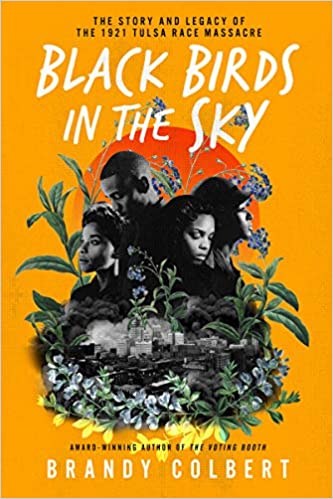
Black Birds in the Sky

 Black Birds in the Sky: The Story and Legacy of the 1921 Tulsa Race Massacre by Brandy Colbert, 224 pages.

This work of young adult nonfiction is about the Tulsa Race Massacre, but it also more broadly covers the history of racism in America, especially in the late 19th and early 20th centuries. Being a young adult book, the writing is simple, and breaks the history up into quick to read and easy to understand chunks. It also handles very dark subject matter in a way that neither sensationalizes its darkness nor softens it for the younger audience. My only real complaint is that it sometimes felt a little unfocused and meandering. However, despite feeling a little disorganized, the book gives lots of context on it's subject matter, and is very thorough. Contextual topics that get a lot of focus include lynching, Jim Crow laws, and race riots. Colbert also spends the last chapter discussing the legacy of the Tulsa Race Massacre, both in terms of popular culture and academic representations and in terms of how Oklahoma has dealt with this legacy in the present day. Overall I would say this is a very good book for young people about a long hidden tragedy.


Tuesday, March 28, 2023

Kindred

 Kindred by Octavia E. Butler, 264 pages


I was stunned to find this gem was written 35 years ago, and (to me) has not "aged" a bit. The voice, dialogue, tone and context are clear, unpretentious, and (sadly) still culturally/socially relevant. Also, I didn't feel voyeuristically or perversely entertained by the hardships of the main character, but empathetic and enlightened. Butler draws her characters with dignity, even the bad guys. I wish I had more spare time to read, I would devour all of Butler's books.

Sunday, February 26, 2023

The Monsters We Defy

The Monsters We Defy by Leslye Penelope, 392 pages.

Clara Johnson has seen ghost, spirits, and Enigmas her whole life. Enigmas are powerful spirits that can grant a wish (called a Charm), but in return inflict a curse (known as a Trick). Due to her own deal, Clara is magically bound to broker these deals for anyone who comes to her for help. This trick ways heavy on her, as all tricks do, because almost nobody ever comes out of these deals better off. So when the Empress, the Enigma who holds Clara's debt, offers to cancel their deal if she steals a ring for her, she feels she can't help but accept. And soon she's got a whole team of people with Enigma debts of their own working under the same deal, but the whole job is tied to something much bigger and darker than any of them knows. 

This is a supernatural heist book set in the black communities of Washington DC in the 1920s, and it's extremely cool. It manages to keep the flavor of classic heist media, while expanding the scope of what is possible with a cast of really cool characters. It in fact kept the flavor so much, that at times it felt like it would really like to be a movie. The author did a whole lot of research, so it felt sort of transportive to a place I didn't know that much about. This is a really neat book, and I would definitely recommend it to fans of heists and black historical fiction.
 

Saturday, February 4, 2023

Magnolia Flower


Magnolia Flower by Zora Neale Hurston, adapted by Ibram X. Kendi, illustrated by Loveis Wise, 40 pages

This is a gorgeous adaptation of the folktale by the beloved Ms. Hurston. National Book Award winner and bestselling author Ibram X. Kendi adapts the tale for young readers, aided by the lush artwork of Loveis Wise. This picture book tells the story of Magnolia Flower, the daughter of an escaped slave and an indigenous woman who fled the Trail of Tears. After the Civil War, a man of letters comes to their community, and Magnolia falls in love with him. However, her father does not approve and so the couple run away, only to return many years later.

What is unique about this tale is that it is told by the River that Magnolia grew up around. It is a tale of love and resilience, and the connection between the land and the people. It also shows the connection between Black and Indigenous people--how some of them were able to build community together, in spite of the United States trying to destroy and subjugate them. And the illustrations! This book is large, and I was so glad because the pictures needed that space. The art bursts with life and color, and I think children will want to stare at them for hours. Highly recommended for all ages!

Friday, November 4, 2022

Blues People


 Blues People: Negro Music in White America by Amiri Baraka (1963) 256 pages

Baraka, who was also a poet and playwright, published this originally under the name LeRoi Jones. I listened to the audiobook narrated by Prentice Onayemi. I added this to my reading list because I've become more interested in the roots of rock 'n roll. Being new to the St. Louis area I'm excited to explore the National Blues Museum eventually. Baraka's essay writing is super inciteful and detailed. He touches very briefly on rock 'n roll toward the end as it was still such a new genre in 1963. However, his illumination of the history and culture of Africans brought to the Caribbean and the Americas as slaves provides so much value in understanding the development of blues and jazz. White mainstream popular music constantly adopted aspects of black music, but always with a delay and a watering down through racist attitudes of each era.

Thursday, December 2, 2021

Wake: The Hidden History of Women-Led Slave Revolts

 Wake by Rebecca Hall, illustrated by Hugo Martinez, 208 pages.

This work of graphic non-fiction follows both Dr. Hall as she does historical research on the titular women-led slave revolts and speculative versions of the revolts themselves. It is the generally accepted wisdom that women had only a secondary role in slave revolts, and that they certainly didn't lead them. Hall digs deep into the historical record to challenge this belief. 
This was an interesting account, although it definitely left me wanting more. When Hall says hidden, she isn't kidding. The fact that this is non-fiction means that everything isn't always wrapped up neatly, and it feels like even by the end of the book there are more research dead ends than actual history, making much of what is set in the past more like hints and reasonable conjecture. However, the switching between the past and the modern day made for some very powerful visuals about the ways that the past is still influencing the present.