Showing posts with label French Resistance. Show all posts

Monday, March 23, 2026

Josephine Baker and Orlando

 Josephine Baker by José-Louis Bocquet with art by Catel (2017) 568 pages

I like that this writer/artist pair make hefty graphic bios. I previously read their graphic biography about Alice Guy. They are able to include so many details and episodes from Josephine's life. I've previously read the biography about Josephine's espionage work for the British and French Resistance during WWII. This graphic book provides a lot more depth about her early life and her work as an entertainer. The WWII period, by contrast, is quite brief. Her later life related to her raising the "Rainbow Tribe" of orphans was fascinating too. The biographical notes at the end on secondary historical figures that crossed paths with Josephine are extensive. In fact, I thought some did not need to be included, since they barely played a role in her story.


Orlando adapted by Susanne Kuhlendahl (2026) 224 pages

I really enjoyed Sally Potter's movie version of Orlando. And this is one of two graphic novel adaptations of Virginia Woolf's queer story coming out this year. I had not read any Woolf novels in school, so it is only through recent Wiki research that I learned Woolf is part of the Modernist literary movement with "stream of consciousness" passages. Kuhlendahl's adaptation definitely keeps this style front and center. However, instead of Orlando breaking the fourth wall like in the movie, Woolf, the "biographer," is present on the page and comments on being a biographer of this character. There is no scientific or magical explanation for how Orlando is able to live more than 300 years, nor for how Orlando transforms from a man into a woman. We are simply asked to ponder "what if" this is true. The story is episodic with changing art styles. It is full of commentary on gender, poetry, love and life, and changing fashions. I thought the chapter set in the Victorian 19th century was the weakest part and the finale set in the early 20th century (Woolf's era), while things truly move at a faster pace, still felt rushed after the depth of the earlier historical periods.

Tuesday, December 30, 2025

Another selection of graphic novels read in December

Closing out the year that I've been focused mainly on reading graphic novels. Genres of all types are available in the graphic format, and I've sampled quite a few. I won't stop reading graphic novels next year as I really love them, but they won't be my sole focus.

It's Lonely at the Centre of the Earth by Zoe Thorogood (2022) 196 pages

I love the summary on the back cover. "[This graphic memoir] is an intimate and metanarrative look into the life of a selfish artist who must create for her own survival." The meta use of the graphic form is one of my favorite things about it! The author struggles with anxiety and depression. I will not use the overused word r******** that she hears from so many people at comic conventions that it becomes meaningless. I have empathy and understand some of her challenges with these mental health issues. The different versions of herself are a great visual way to illustrate the way she copes with life.  Revealing the script and the process of creating a graphic memoir is fun.


Stone Fruit by Lee Lai (2021) 231 pages

This is about the joys and tensions of a queer couple who are aunties to a six-year-old niece. There is a bit of Where the Wild Things Are. And the hard conversations between couples with the psychological and emotional wounds passed down through families are featured. Intimately emotional as sibling relationships are repaired.


Yucatan 1512 by Alex Vede (2025) 80 pages

This reminded me I wanted to watch the Aztec Batman movie on HBO Max. And it reminded me of the video game Shadow of the Colossus. I loved the visual style. The story is simple and less than 100 pages, but it serves the purpose. Spanish conquistadors search for Mayan gold and slaughter innocents. One rogue soldier helps a Mayan girl escape. The cover image shows the type of creatures that rise to push back the conquistadors. I'm curious to see what else Alex Vede can do as he is just starting his career as an illustrator.


The Reprieve by Jean-Pierre Gibrat (2008) 128 pages

WWII historical fiction from France that is a prequel to the author's Flight of the Raven. Paintings are gorgeous and cozy of this French town under German occupation. The main character is witty and jokes around a lot. Julien deserted conscription by the Germans, goes into hiding, and continues falling in love with a high school girlfriend. The humor and the beauty of the art made me forget the dangers of war and the role of fate/death that cannot be escaped. I did not see the final dramatic turn coming.

Tuesday, January 14, 2025

The Last Days of New Paris

 The Last Days of New Paris by China Mieville, 209 pages.
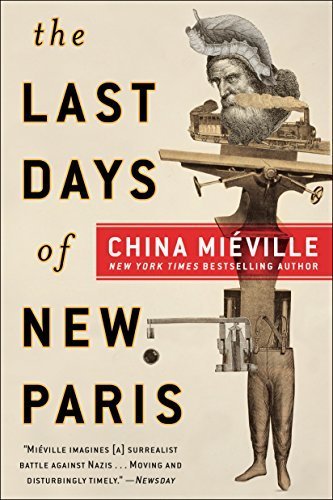
This book is difficult to categorize and even more difficult to describe, but I will do my best here. In 1941, while the Nazis were occupying Paris, a strange bomb went off. The so called S-Blast filled the city with physical and uncontrollable manifestations of Surrealist art. Between the so-called manifs and the demons the Nazis summon to attempt to maintain control, Paris is rendered strange and unstable, as well as being totally cut off from the rest of the world.

The story bounces back and forth between a solitary Surrealist soldier trying to resist the occupying Nazis in 1950 and a house full of Surrealists resisting in their own, more cognitive, way before the S-Blast. This book was extremely weird, but I found it very compelling throughout. I think fans of the Surrealist movement in particular will love this novel (and it's extensive index of references), but I enjoyed it as someone who knows little of the movement as well. This is a short book that packs a lot in with a startling degree of complexity, and I would recommend it for people feeling like they want to read something different. 


Wednesday, January 18, 2023

Agent Josephine: American Beauty, French Hero, British Spy


Agent Josephine: American Beauty, French Hero, British Spy by Damien Lewis (2022) 496 pages

The title sounded fascinating and there is a local St. Louis angle, since Josephine Baker was born here. Before I worked here at the library I attended a virtual author talk organized by one of the area book stores, which further heightened my interest. Mr. Lewis shared that there is a film adaptation in the works with Janelle Monae expressing interest in playing Josephine Baker. I really hope this project is greenlit and completed.

The author explains in his introduction that British espionage files are kept classified with no set time period when they will be released to the public, so there are gaps in the details he can present in the history here. There are two male secret agents who worked with Josephine either from afar or in person, who are described as inspiration for Ian Fleming's James Bond. One of those, Jacques Abtey, a French Resistance agent, had a very close relationship with Josephine. A major source used by Lewis is a memoir written by Abtey, so this spy who used multiple aliases throughout his career sometimes seems to take center stage at the expense of showing Josephine's accomplishments. Josephine spends over a year, in the year before America entered WWII, dealing with abdominal infections in a Casablanca clinic. This period is covered through multiple chapters. Josephine's clinic room becomes a meeting place for the sharing of intelligence between Free French, British, American, and North African Arabic and Berber agents, a place that the Axis agents don't dare attack or bug. Her room becomes the important thing, but she is sick and unable to actively engage in gathering intelligence. This is just to indicate that large portions of the story put her in a passive role. She didn't share details of her war years later in her life, so the author is forced to leave out many specifics. Still there are gems of facts that really capture the imagination. She used her singing and dancing performances as cover for moving intelligence for the Allied powers, or she used a Red Cross nurse position in the Free French military to do the same. She also was a trained pilot and as a superstar was able to move amongst powerful people in Europe and North Africa. She showed a deep conviction for fighting against Nazi hate and American segregation.

Wednesday, November 6, 2019

A Woman of No Importance

A Woman of No Importance: The Untold Story of the American Spy Who Helped Win World War II by Sonia Purnell, 352 pages

In the years before World War II, American Virginia Hall rejected the traditional housewife role her parents wanted for her and decided that she wanted to work abroad for U.S. intelligence community. She applied for, and was subsequently rejected for, every job that wasn't secretarial, eventually taking one of those secretary positions just so she could make it to Europe. Despite the boring work that was given to her, Hall never gave up on her ambitions, and ended up becoming a spy for England's Special Operations Executive in France. During her years in France (which took her through the end of WWII) the misogyny surrounding her was astounding, even as she built networks of informants, evaded the Gestapo, broke several of her colleagues out of prison, planned sabotage missions of German forces, and provided intelligence that helped Allied forces liberate France. Oh, and she did all that with a prosthetic foot that most of her colleagues didn't know about.

If she was alive today, Hall would probably be a bit miffed that Purnell had written this book about her — she wasn't one for glory or accolades, going so far as to never discuss her role in the war with relatives or even colleagues. But thank goodness this book was written! It's wonderful that this amazing woman's story has come to light. She's inspiring, her story is jaw-dropping, and her impact on the intelligence community continues on to this day. This is a fantastic story told in a fantastic book.

Tuesday, October 22, 2019

Mistress of the Ritz

Mistress of the Ritz / Melanie Benjamin, read by Barbara Rosenblat, 372 pgs.

Claude and Blanche are a little bit of an odd couple.  She is an American in Paris to work on her acting career.  He is the manager of a hotel.  He prides himself on his service.  They fall deeply in love and marry.  But when Claude tells Blanche how marriage works in France, she is less than impressed.  Claude ends up managing the Ritz and sometimes managing Blanche is as much work.  Then the Nazi's invade.  By now the couple has fallen into an uneasy truce but communication between them is poor.  Both, independently, start their own resistance efforts.  When Blanche makes a mistake and is arrested, Claude is heartbroken and tries to save her.  The narration is well done making the audio version a pleasure to read.

Friday, July 12, 2019

A woman of no importance

A woman of no importance: the untold story of the American spy who helped with World War II / Sonia Purnell, read by Juliet Stevenson, 360 pgs.

Virginia Hall was an American looking for adventure.  She started out driving ambulances then moved into the world of underground resistance and spy craft in France during WWII while working for the British SOE office. She had a way with organizing and provided leadership for efforts that ranged from disabling Nazi vehicles to blowing up bridges.  All the while, her personal safety was at stake and many of her network were captured and tortured but somehow she escaped.  There was plenty of peril, at one time forcing her to march over mountains during the winter.  The stress of her work stayed with her forever.  Not surprisingly, she was never given the recognition she deserved and was not promoted because of her gender.  After the war, she signed up with the new American CIA and was discounted despite her experience in the field.  Hall's life is a remarkable story and Juliet Stevenson does an excellent job narrating.

Tuesday, November 29, 2016

The Nightingale / Kristin Hannah, 440 p.

A World War II novel depicting the woman's war, this is the story of estranged sisters Vianne and Isabelle.  Vianne leads a quiet life in rural France with her family when her husband is forced to enlist and the Germans occupy her town. Isabelle, younger and rebellious, finds her home in the Resistance.  I found myself entirely diverted by the quality narration, solid character development, and just-right amount of physical detail in spite of the stock nature of the plot.  An almost-familiar tale, very well told.

Sunday, January 17, 2016

The Nightingale

The Nightingale by Kristin Hannah, 440 pages.

Vianne and Isabelle Mauriac lost their mother in 1924, and when she was gone their world fell apart. By 1939, when the novel begins, Vianne is married and now has an eight-year-old daughter. Vianne and Isabelle, now 18, have never been able to reconcile themselves to their loss nor to their father's rejection of them, and the subsequent splintering of their own relationship.
As the war begins and the German army comes, the sisters must decide where their loyalties lie, with whom they must keep faith, and must continually decide what they are willing to do in order to survive and protect what they hold dear.
Fans of All the Light We Cannot See and fans of well-written historical fiction will certainly enjoy this.

Sunday, September 14, 2014

All the Light We Cannot See / Anthony Doerr 531 pp.

I had a long wait for this one, and it was well worth it.  This lovely novel is set in the heart of European World War II, but telescopes that massive backdrop into the stories of two young people, the Parisian teenager Marie Laure, blind since age 6, and Werner, an orphan in a coal-mining village in Germany.  Werner is a kind of prodigy of electronics, assembling and repairing radios throughout his village.   Meanwhile Marie Laure learns to navigate the streets of Paris by memorizing wooden models crafted by her adoring father, a locksmith at the Museum of Natural History.  The long winding plot bounces back and forth between the years leading up to the war and an intense few days in August 1944 during the bombing of St Malo on France's west coast.

Mr Doerr's writing is almost too good for the plot, dense and clever as it is, even featuring a mysterious diamond shrouded in a dangerous legend.  He, or his editors, may have had their hopes set on a Hollywood deal (and they may get one), but this story is more than a fast-paced tearjerker.  It is a beautiful look at what it means to see, and to hear, and to live a good life.