Showing posts with label literary. Show all posts

Monday, August 25, 2025

The Saint of Bright Doors

 The Saint of Bright Doors by Vajra Chandrasekera, 356 pages.

Fetter lives in a world where near-misses at chosen ones are a dime a dozen. He himself was raised as a weapon to kill his own father, a holy, almost divine, figure who's cult stretches across the continent and reaches to the city of Luriat. That is the kind of destiny that gives a man a lot to talk about in group therapy, especially after he chooses to reject his destiny. Here he comes in contact with revolutionaries and radicals, and is pulled into conflicts both political and metaphysical

This book is very hard to describe, partially because there is a lot of craft in how it starts slowly making more sense as you read, satisfactorily answering questions you didn't even know were questions yet to create a cohesive and layered whole. This book is complicated and engrossing, and I found myself very invested in it. It is also sometimes pretty difficult to follow, especially before you know much about how the world works. It reminded me a lot of The Seven Moons of Maali Almeida (by a fellow Sri Lankan author), but on a more mythic scale. I would definitely recommend this book for someone looking for political intrigue with a mythological twist. 

Wednesday, February 26, 2025

Erasure

 Erasure by Percival Everett, 280 pages.

Thelonious "Monk" Ellison is an English professor who writes impenetrable literary novels, which are frequently rejected not only for being impenetrable, but for not being "black" enough, a maddening criticism for Monk since they weren't meant to be addressing his race at all. The runaway success of the exploitative debut novel "We's Lives in Da Ghetto," his own stalling career, and a personal tragedy all push Monk to the edge, and in a fit of rage he writes a parody of the exploitative fake-ghetto genre that seems to be thriving. When the book turns out more successful than all of his other work put together (and being taken completely at face value), Monk is forced to reckon with his new place in the world, and the false identity he's constructed to reach it. 

I saw the movie adaptation of this book (American Fiction) last year, and when I found out it was based on a book I was instantly curious about it. I think this is another case (much like Cloud Atlas) where the book and the movie are very different, because each fully leans into the strengths of their medium. This is a complex, layered book. I feel certain I missed a lot of details of what Everett was doing, but even so there are elements that I will be thinking on for a while yet. The structure was sort of experimental and interesting, Monk was a compelling protagonist (if not necessarily a likable one), and the whole novel feels like it comes together into something greater than it's parts. It's easy to see why this author won the National Book Award for his most recent novel. I would recommend this thoughtful book widely. 


Tuesday, January 14, 2025

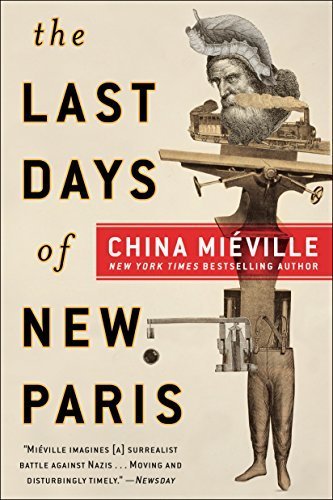
The Last Days of New Paris

 The Last Days of New Paris by China Mieville, 209 pages.

This book is difficult to categorize and even more difficult to describe, but I will do my best here. In 1941, while the Nazis were occupying Paris, a strange bomb went off. The so called S-Blast filled the city with physical and uncontrollable manifestations of Surrealist art. Between the so-called manifs and the demons the Nazis summon to attempt to maintain control, Paris is rendered strange and unstable, as well as being totally cut off from the rest of the world.

The story bounces back and forth between a solitary Surrealist soldier trying to resist the occupying Nazis in 1950 and a house full of Surrealists resisting in their own, more cognitive, way before the S-Blast. This book was extremely weird, but I found it very compelling throughout. I think fans of the Surrealist movement in particular will love this novel (and it's extensive index of references), but I enjoyed it as someone who knows little of the movement as well. This is a short book that packs a lot in with a startling degree of complexity, and I would recommend it for people feeling like they want to read something different. 


Tuesday, August 20, 2024

Tomorrow, and Tomorrow, and Tomorrow

Tomorrow, and Tomorrow, and Tomorrow by Gabrielle Zevin (2022) 401 pages

I listened to the audiobook on Libby narrated by Jennifer Kim with a short section narrated by Julian Cihi. The title comes from a speech in Shakespeare's Macbeth. A couple of my co-workers have also read and reviewed this novel here on the blog. I really enjoyed this story of two friends, their love of video games, and their careers as game designers. The characters of Sam and Sadie are just a bit older than I am growing up in the '80s and '90s. I remember learning computer skills in elementary school, in part, by playing Oregon Trail. Sadie also shares a love of Magic Eye images, those repetitive patterns that you stare beyond to bring out a hidden 3D object. Their lives and the other people in their lives are so richly drawn and realistic. I found exploring the process of video game design fascinating. The ups and downs of building and marketing their games, as well as family and romantic relationships kept me engaged.


Wednesday, April 10, 2024

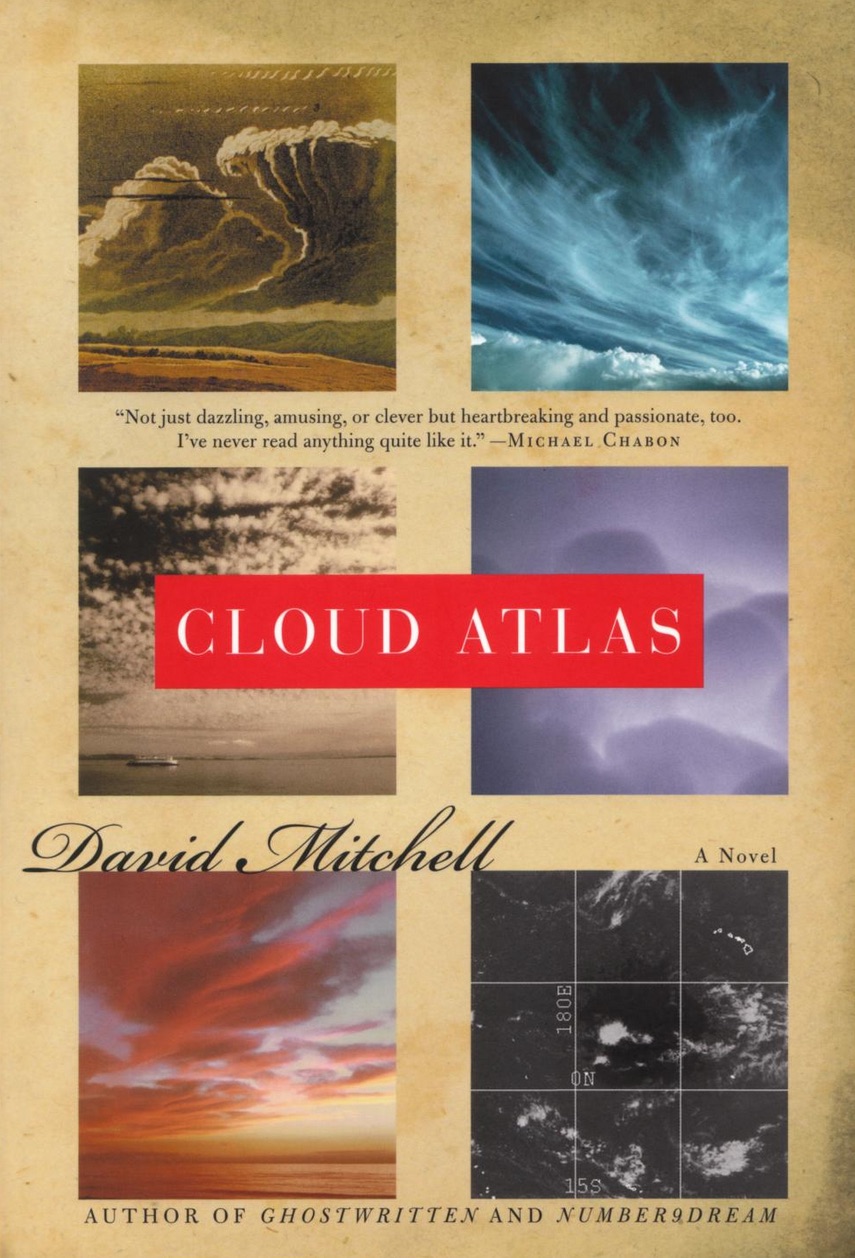
Cloud Atlas

 Cloud Atlas by David Mitchell, 509 pages.
This nested novel is complex and twisting, but I will do my best to summarize it concisely nonetheless. The novel begins with the Pacific voyage of Adam Ewing in 1850, where there is much philosophy on the nature of race and civilization, and where Ewing is treated by his new friend Dr. Henry Goose treats him for a mysterious parasite. The story then jumps to 1931, when  disinherited bisexual composer Robert Frobisher finds his journal in the house of the aging composer who he is working for (and being abused by) in an attempt to break into the musical world. Then in the 1970s reporter Louisa Rey finds Frobisher's letters in the possession of a man murdered for trying to warn the world about an unsafe nuclear reactor, a catastrophe it falls on her to stop. A novelization of Rey's adventures are sent to publisher Timothy Cavendish in more-or-less present day England, which he reads on the run from debtors before being inadvertently locked in an old folks home. The film adaptation of Cavendish's ordeal is illicitly watched by Sonmi-451, a clone in a far future Korea taken over entirely by corporate greed where she has the opportunity to discover herself as a person instead of property for the first time. A recorded interview with Sonmi after her arrest is found by a young man in a post-apocalyptic iron age Hawaii, who's culture reveres Sonmi as a goddess. All of these source materials are interrupted, so all of these stories go unfinished. That is until we reach young Zachry on Hawaii, whose adventures at the end of recorded history reach their conclusion, as the stories finally ripple back through the centuries and all reach their conclusions. 

I picked up this book pretty much immediately after watching the 2012 film by the Wachowskis because I thought it was such a fascinating experiment in structure that I felt like I needed to compare them immediately. And I was not disappointed. Just as I suspected, the film and the novel are different in a lot of ways, but both play masterfully with their structures, allowing format to reinforce themes. And I would say that this is a novel driven by themes more than any other element; I believe I will be thinking about the details for quite a long time. This is an intensely literary novel, but despite that it rarely feels slow or difficult. It is full of action, and the characters are all flawed and compelling. I am also extremely impressed by how well Mitchell captured each of the many genres he wrote in, the style and language shifted dramatically in each story, which I think went a long way towards making each character feel complete in their own story (even if the language shift after the apocalypse was a little hard to parse until I got used to it. Overall I think this book was a masterwork, and I would definitely recommend it to others.


Wednesday, January 27, 2021

The Vanished Birds

The Vanished Birds by Simon Jimenez, 390 pages

Every 15 years, a fleet of ships returns to a rural farming planet to gather goods for the rest of humankind, which is spread through a handful of space stations and city-planets. As the ships use wormholes to travel, the trip takes place every eight months for Nia, captain of one of the ships, who sees people age rapidly between visits. When a boy mysteriously appears on the planet, one genius woman sees him not as an oddity, but as the potential key to instantaneous travel. She enlists Nia and her crew to keep the boy safe until such time as her theories prove true.

Told in episodic lovely prose, this story ties together regret, longing, loneliness, love, family, and suffering across time and space. I'd recommend this for fans of literary science fiction rather than diehard fans of the genre, as Jimenez's language deserves to be mulled over rather than torn through. It leaves a lot to consider, well after the last page.