Showing posts with label Palestinian refugees. Show all posts

Tuesday, June 18, 2024

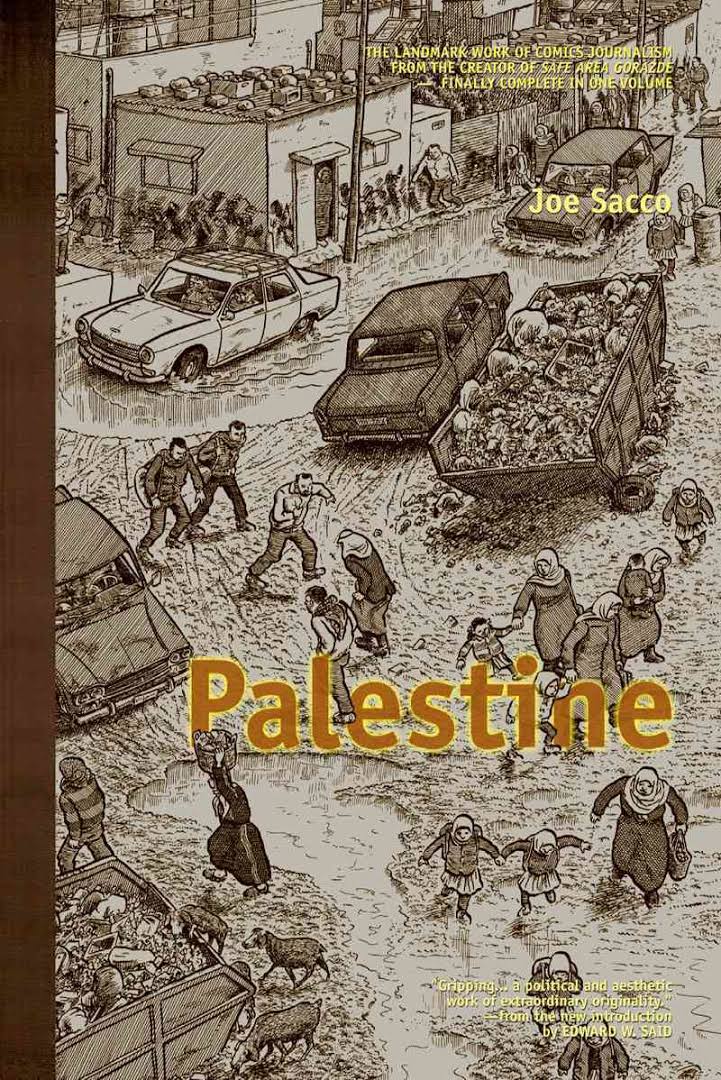
Palestine


Palestine by Joe Sacco (1996) 288 pages

I've had reporter and artist Sacco's The Fixer and Other Stories on my reading list for awhile. Then I saw he wrote this book of graphic journalism called Palestine. It is available on Hoopla. Considering current events I thought this was a great opportunity to learn more about the Palestinian perspective. This was written back in the 1990s. I was in high school and definitely not paying attention to the conflict between Israelis and Palestinians. There are nine chapters. It took some time to get used to the chaos of some of the comic panels. Narration and speech bubbles are at angles or follow an "S" curve. Eventually I did grow to enjoy the style of Sacco's black and white sketches. Joe Sacco (illustrated with prominent round glasses and lips) is there on the ground meeting and interviewing everyone he can. He shares the history with chapter 2 containing columns of text and smaller illustrations compared to the rest of the book. Sacco witnesses and hears dozens of stories about the Occupation, the colonial power of Israel taking land and homes and lives to control and reduce the Arab/Muslim presence of Palestinians. He visits multiple refugee camps. He encounters the red tape of the Israeli military. He experiences the hospitality of tea served in every Palestinian home. He hears prison stories and stories of violence. He hears how the court system works against Palestinians and the Israeli hospitals avoid treating serious injuries of refugees. He discovers the differences of opinion about peace talks from the different Palestinian factions. Chapter 8 contains an especially heartbreaking tragic story from a Palestinian mother. Old folks tell stories of this happening decades ago. Teenagers tell stories of it happening then in the '90s. The news shows it is still happening now. Joe Sacco talks to Israelis, who have come from other Western countries, too. It is a complicated political issue, but identifying which group Sacco sees as the colonizers and which are the oppressed is not hard.

Wednesday, January 15, 2014

My Promised Land: the Triumph and Tragedy of Israel / Ari Shavit 445pages

It's impossible to evaluate this book without considering this year's other historical survey-type book of Israel, Yossi Klein Halevi's Like Dreamers. Shavit takes an earlier starting point, a visit by his great-grandfather to 1897 Palestine which led him move his prosperous Jewish-English family there. In separate chapters, Shavit chronicles major trends in the state's history from the points of view of both key players and ordinary people: "Orange Grove," "Masada," and "The Project" (referring to the development of nuclear weapons capacity in the Negev) are a few. Shavit is a columnist for Haaretz, and one gathers given the access to extremely prominent figures he clearly possesses, one of the country's most prominent journalists. The writing style is journalistic and somewhat personal; in fact, many of the chapters were first published as long magazine pieces in Israel and elsewhere, including in the New Yorker.

Shavit is a subtle thinker who makes a point of straddling lines, taking positions which are not exactly left or right, hawk or dove. His most firm point is that occupation is wrong for moral and practical reasons, but that ending occupation will not bring peace. For Shavit, Israeli security lies neither in expanding the territories with settlements, nor in pursuing a utopian peace. Rather, it consists in a return to the cohesion and commitment of the country's early decades and in a courageous leadership. Very fresh material; the chapter on Iran considers quite recent developments.

While I thoroughly enjoyed Shavit's analyses, as a book-length work I find Klein Halevi's book to be superior. I found myself thinking of the difference between showing and telling: Shavit told us many things about Israel; through the lives of the seven individual paratroopers in Like Dreamers, Klein Halevi showed us more.