Showing posts with label Israel/Palestine conflict. Show all posts

Tuesday, June 18, 2024

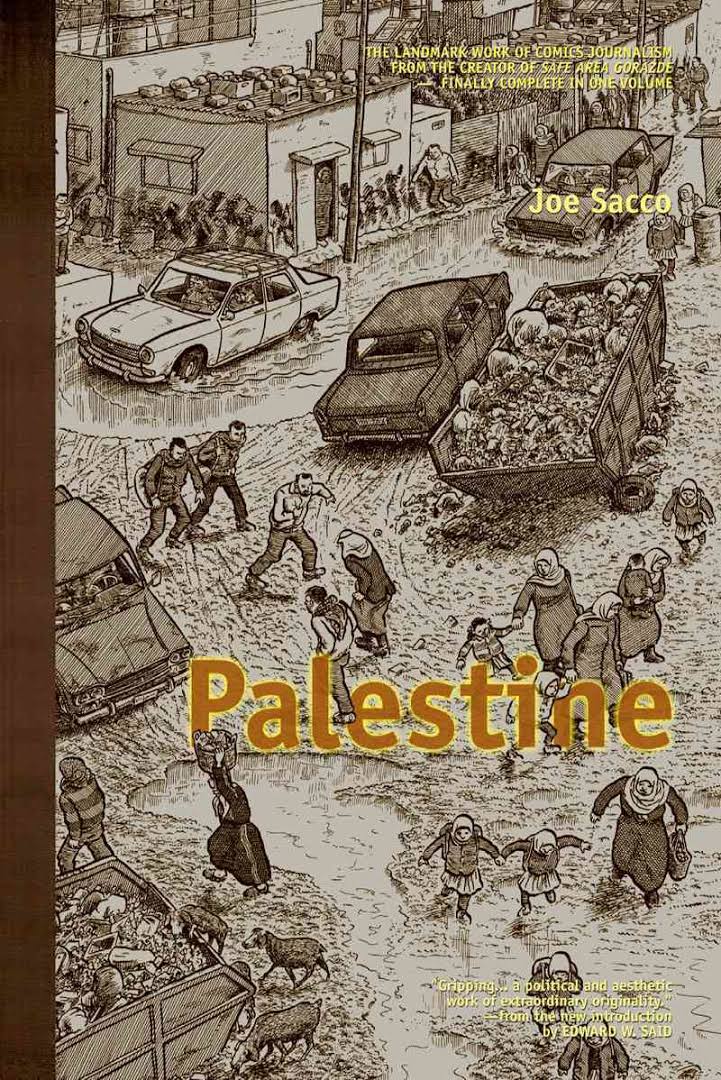
Palestine


Palestine by Joe Sacco (1996) 288 pages

I've had reporter and artist Sacco's The Fixer and Other Stories on my reading list for awhile. Then I saw he wrote this book of graphic journalism called Palestine. It is available on Hoopla. Considering current events I thought this was a great opportunity to learn more about the Palestinian perspective. This was written back in the 1990s. I was in high school and definitely not paying attention to the conflict between Israelis and Palestinians. There are nine chapters. It took some time to get used to the chaos of some of the comic panels. Narration and speech bubbles are at angles or follow an "S" curve. Eventually I did grow to enjoy the style of Sacco's black and white sketches. Joe Sacco (illustrated with prominent round glasses and lips) is there on the ground meeting and interviewing everyone he can. He shares the history with chapter 2 containing columns of text and smaller illustrations compared to the rest of the book. Sacco witnesses and hears dozens of stories about the Occupation, the colonial power of Israel taking land and homes and lives to control and reduce the Arab/Muslim presence of Palestinians. He visits multiple refugee camps. He encounters the red tape of the Israeli military. He experiences the hospitality of tea served in every Palestinian home. He hears prison stories and stories of violence. He hears how the court system works against Palestinians and the Israeli hospitals avoid treating serious injuries of refugees. He discovers the differences of opinion about peace talks from the different Palestinian factions. Chapter 8 contains an especially heartbreaking tragic story from a Palestinian mother. Old folks tell stories of this happening decades ago. Teenagers tell stories of it happening then in the '90s. The news shows it is still happening now. Joe Sacco talks to Israelis, who have come from other Western countries, too. It is a complicated political issue, but identifying which group Sacco sees as the colonizers and which are the oppressed is not hard.

Sunday, December 22, 2019

Letters to My Palestinian Neighbor by Yossi Klein Halevi, 224 pages.
I reread this during the final committee discussions we were having early in 2019. This is a provocative and engaging book about the state of affairs in Israel and the surrounding Palestinian territories from a man who has been a soldier, a reporter, and the co-director of the Muslim Leadership Initiative at the Shalom Hartman Istitute, and who is the author of 2013's Like Dreamers. 
In a series of letters addressed to "Dear Neighbor," Halevi, an American-born Israeli who moved to Israel in the early 1980s, attempts to explain his, the Israeli, side of the story to his Palestinian neighbors, feeling that the inability to hear each other or to acknowledge each other's humanity is a large part of the continuing problem. Halevi presents his arguments for Israel's right to exist and balances this against what he sees as intransigence on the Palestinian side. His letters are unlikely to sway anyone firmly committed in their beliefs, but he does a good job of explaining the timeline, at least as seen through Israeli eyes.

Saturday, June 30, 2018

Letters to My Palestinian Neighbor


Letters to My Palestinian Neighbor by Yossi Klein Halevi, 224 pages.
A provocative and engaging book about the state of affairs in Israel and the surrounding Palestinian territories from a man who has been a soldier, a reporter, and the co-director of the Muslim Leadership Initiative at the Shalom Hartman Istitute, and who is the author of 2013's Like Dreamers. 
In a series of letters addressed to "Dear Neighbor," Halevi, an American-born Israeli who moved to Israel in the early 1980s, attempts to explain his, the Israeli, side of the story to his Palestinian neighbors, feeling that the inability to hear each other or to acknowledge each other's humanity is a large part of the continuing problem. Halevi presents his arguments for Israel's right to exist and balances this against what he sees as intransigence on the Palestinian side. His letters are unlikely to sway anyone firmly committed in their beliefs, but he does a good job of explaining the timeline, at least as seen through Israeli eyes.
Narrated by the author.

Tuesday, May 24, 2016

City of Secrets

City of Secrets by Stewart O'Nan, 194 pages.
O'Nan's sixteenth (?) novel takes place in post-World War II Jerusalem. Brand, a Latvian Jew who feels that he "accidentally" survived the Holocaust, after having been a prisoner of the Russians, then the Nazis, and then Russians again, has made it to Palestine with an assumed identity. He is working for Haganah, a Jewish paramilitary / resistance force has just put aside its differences with other like-minded groups, such as Irgun, to drive the British out of Palestine and form a Jewish state. But Brand is not sure how he feels about all of this. He is haunted by those he lost in the war, and haunted by the sense that he is not the man he used to think he was. When one of the members of his clandestine cell is betrayed, and Brand finds that standing by, doing nothing to save the man (not quite a friend, but almost) who is accused of the betrayal, is sickeningly reminiscent of his time in the camps.
An affecting, sad novel.

Tuesday, December 30, 2014

My Promised Land: The Triumph and Tragedy of Israel

My Promised Land: The Triumph and Tragedy of Israel  by Ari Shavit, 445 pages.
An excellent, even-handed history of Israel from the Zionist movement in the late nineteenth century to the present day.
Shavit interviews Israelis from across the political and social spectrum today, as well as researching and reporting to tell of Israels founding, the wars and  upheavals it has endured in its short history, and attempts to see what the future may hold for Israel and the Middle-East.

The audio is very well read by Paul Boehmer.

Check our Catalog
Downloadable Audio

Tuesday, September 3, 2013

Jerusalem: Chronicles from the Holy City

Jerusalem: Chronicles from the Holy City by Guy DeLisle, 336 pages.
Guy DeLisle, animator, graphic artist and graphic travel writer, moved with his children and wife to Jerusalem while she worked for Medecin sans Frontiere for a year. DelLisle's drawings and text give his version of the state of Israel, its citizens and their relationship to Gaza, the West Bank, and the Palestinians. It's not a cheery story. He describes his encounters with settlers, armed joggers, soldiers at countless checkpoints, and disillusioned NGO workers. Delisle does a wonderful job conveying a sense of place and of the sometimes hopeless situations he encounters.

Check our catalog.

Friday, January 18, 2013

The People of Forever Are Not Afraid / Shani Boianjiu / 338 p.

These are the stories of Yael, Lea, and Avishag, Israeli teens from a small village near the Lebanese border.  The story begins near the end of their last year in high school and takes them through their years of military service.  On the one hand this was fascinating and completely engrossing, a very quick intense read.  In Boianjiu's telling, Israel's young people live lives that are steeped in every kind of horrific violence, from random checkpoint attacks, roving shooters, actual war casualties, to suicide and plain interpersonal cruelty.  And she's very effective at demonstrating nuance and compassion for Israelis and Palestinians alike.  But I have a problem with any novel that's so drenched in physical tragedy (I think of this as the Arundhati Roy syndrome: just one more rape, shooting, murder, whatever - then I'll have something truly dramatic, thinks the author.)  In the case of Boianjiu, it's not that I think she's exaggerating anything.  It's just that one novel can only handle so much blood before it becomes numbing and kind of dull.

Another problem is that while the novel has three main characters, with chapters told from alternating points of view, they seem to have only one voice.  This makes the novel hard to follow, and hollows out the three characters.  Boianjiu is definitely talented (I think this is her first novel) and I will be interested to see what she does next.

Friday, July 15, 2011

Striking Back

Striking Back: The 1972 Munich Olympics Massacre and Israel's Deadly Response by Aaron J. Klein  288 pp.

As it says on the cover, this is the book about the real events that inspired Spielberg's movie Munich. I chose to read it for another reason. As a fan of Daniel Silva's "Gabriel Allon" series of thrillers, I wanted to know more of the real background events that inspired the creation of Silva's character, a Mossad assassin. I was in junior high school when the Black September terrorists attacked the Israeli athletes at the Munich Olympics occurred. What I remembered was that the athletes and some of the terrorists died at the airport. What I did not know was how all attempts to save them were botched by the German officials and police in such a horrendous way or that one of the athletes might have survived if anyone had bothered to see if any of the athletes in a burning helicopter had survived being shot. He died of smoke inhalation, not gunshot wounds. The book documents "Operation Wrath of God",  Israeli's revenge on the Palestinians for the massacre. This operation was charged with seeking out the Palestinian terrorists responsible for planning and carrying out the massacre and assassinating them. Included is the horribly botched case of mistaken identity in Lillehammer, Norway, where Israeli agents gunned down an innocent man in front of his pregnant wife and then were caught by authorities and tried. In some of the Silva novels references to "we don't another Lillehammer affair" pop up and now I know what they mean. In response to some of the assassinations, there were more terrorists attacks. However, the audacity some of the Mossad attacks led to the mythology that they were unstoppable even when they had done nothing. This book is interesting, horrifying, maddening, and depressing. Who are the good guys in the Israeli/Palestinian conflict? I don't think there are any. I'm sure I'll be criticized for saying it, but, in my opinion, both sides are equally to blame.