Showing posts with label politics. Show all posts

Tuesday, November 10, 2026

Eugene V. Debs and Looking Backward

 Eugene V. Debs: A Graphic Biography by Paul Buhle and Steve Max with art by Noah Van Sciver (2019) 128 pages 

A new biography about Eugene V. Debs called American Socialist has just been written by Shawn Gude. I remembered I had a graphic biography of Debs on my reading list. The graphic version has a couple pages of prose giving historical information at the start of each chapter. This provides a nice overview. The graphic biography is more broadly about Socialism's rise and fall in popularity in America than an in depth biography of Debs' life. Debs' central cause was fighting for the labor class and making sure the poor have there basic needs met. He was also anti-war. This much is clear, but I wanted a stronger narrative throughout the book. The final chapter moves past Debs' life and traces his influence on later Socialist movements in America. Maybe the details and complete narrative I crave are present in Gude's new book.

Looking Backward by Edward Bellamy (1888) 222 pages 

I listened to the audiobook on Hoopla. This novel was mentioned as being very popular in Debs' early life. It pushed Americans to imagine a socialist future. A young Mr. West living in the late 1800s is put in a hypnotized sleep and Rip Van Winkle-style wakes up more than a century later. A doctor and his family in the year 2000 finds and wakes up Mr. West. The world and America specifically have become a Socialist Utopia. There is very little plot, but just conversation as the Doctor, or his wife, or his daughter share the political, industrial, educational, social, and economic philosophy of their world. Some aspects of this world resemble the future imagined in Star Trek. Ableism and sexism are still expressed unfortunately, although the author tries to show that there has been progress on these issues. The way the characters speak still feels very 19th century. "It must needs be so." Bellamy does predict a sort of streaming service that allows people to listen to any type of music or the sermons of their preferred preacher from home. The city of Boston is also described with skyscrapers and greenspaces. There is a twist near the end that was not unexpected. The ending was quite powerful as Mr. West takes a more clear-eyed view of the horrors of the social conditions of his late 19th century world. Have we forgotten that Capitalism and Robber barons will never serve the best interests of humanity? Things could be better.

Tuesday, October 20, 2026

The Things We Never Say

The Things We Never Say by Elizabeth Strout (2026), 224 pages

I am not sure what to say about this book. I see what Strout was going for; Artie a middle-aged teacher struggles with his life, current political conditions, and what the future entails, but feel she really missed the mark. The book was almost painful to read as it clunkily tried to tackle big issues without garnering a whole lot of compassion and, really, any interest in the characters. I suspect the book would have been more compelling if Strout had written more and deep-dived some of the story lines. As is, it reads as a person trying to get their anger at the current state of the world out too fast and coming across frustrated and malcontent. I would pass on this if I was you.

Thursday, July 9, 2026

The Treasure of the Sierra Madre and B. Traven

 The Treasure of the Sierra Madre by B. Traven (1935) 313 pages

I listened to the audiobook on Hoopla narrated by three voices. I love the movie version from 1948 and have been curious to check out the source material. The book has a lot more background information, but not about the three main gold prospector characters. Instead, the author paints a picture of Mexico, its bandits, its socio-religious conditions, and other backstories about people craving gold. The plot with Dobbs, Curtin, and Howard is nearly identical to the movie. Howard is the knowledgeable old-timer. Dobbs and Curtin first meet on an oil drilling contract and then go searching for gold in the mountains. Trust and saving each others' lives eventually devolves into paranoid distrust and murderous intentions. Dobbs, in particular, has an epic descent into madness over his greed for gold.


B. Traven: Portrait of a Famous Unknown by Golo (2024) 144 pages

This graphic nonfiction is translated from French. I was curious to learn more about the author of The Treasure of the Sierra Madre. The enigma, B. Traven, remains an enigma. He used many pseudonyms through the years. Golo uses Traven's novels to piece together what his life experiences might have been. It gets into the weeds of German politics between WWI and WWII. One of his novels is about the terrible conditions working shoveling coal on a steam ship, and so, it is thought it is based on his lived experience, a job that allowed him to escape Germany and the rise of Naziism. When he begins living in Mexico I was much more engaged in the life story. He wrote many novels set in Mexico. The art of the graphic novel is fairly busy (especially on the color montage pages), so I didn't find much clarity about the man.

Monday, May 11, 2026

The Moon Is a Harsh Mistress

 The Moon Is a Harsh Mistress by Robert A Heinlein (1966) 302 pages

I listened to the audiobook on Libby. Narrator Lloyd James has the facile ability to handle the many accents of all the characters. I really enjoyed this sci-fi adventure even though it does have some slower sections. Our protagonist is Manny, a computer programmer/repairman with Russian ancestry. Strangely, another book I'm reading includes characters in the future using occasional Russian phrases and calling each other comrade too. In this book Heinlein establishes a quirky Lunar culture in post-prison colony underground cities all around our Moon. Manny befriends a central computer that has become sentient. Manny is a fan of Sherlock Holmes so he names the computer Mycroft or Myc and later refers to kids of all the lunar families as irregulars helping in small ways with the revolution efforts. Myc is curious about the human concept of humor. He is not a mobile android, but Myc reminded me quite a lot of Data from Star Trek: The Next Generation. Myc, the computer, is truly a secret weapon that almost magically makes the revolution against the authoritarian Authority possible. Heinlein was inspired by the American Revolution. With the moon being a former prison colony Australia was also brought to mind. But, with the Russian influence, I couldn't help imagining parallels to the Bolshevik Revolution although Heinlein is not espousing communist views. There is a teacher nicknamed Prof, who is responsible for the political direction of the revolution. The book is known for containing Libertarian views and they mostly come from Prof's voice. Manny, at first, fully trusts Prof, but questions him more as the story goes on. Honestly, Prof becomes a bit insufferable. Diplomatic meetings on Earth and explosive fights in the Lunar cities all make it an exciting  and humorous book.

Tuesday, April 28, 2026

Run: Book One

 Run: Book One by John Lewis and Andrew Aydin with art by Nate Powell and L. Fury (2021) 152 pages

This continues in the same style as John Lewis' graphic trilogy March, which I enjoyed. Well researched and intensely dramatic. Covers the three years John Lewis was chairman of SNCC, but the book is not just concerned with SNCC business. The coverage of events is broadly about the changes in the Civil Rights Movement during the mid-60s.

Monday, April 13, 2026

Challenger

 Challenger: A True Story of Heroism and Disaster on the Edge of Space by Adam Higgenbotham (2024) 563 pages

A friend has planned a Jolabokaflod, or Yule Book Flood, book gift exchange for New Years for the past several years. This is the book that was gifted to me this year. It is very in-depth. I appreciated the brief biographies of ALL the major people involved. The engineering of the solid rocket boosters are covered in great detail since the joints where the sections stack together were the main flaw that led to the explosion. Also Higgenbotham spends a good deal of time examining the chain of command and decision-making process of NASA and their contractors. The decision to launch the shuttles through the 1980s often ignored engineers' advice about risky technological problems. The book goes back to the beginning of the space rocket program and shows a pattern that existed since the Apollo 1 disaster in 1967. Then the book covers the Congressional investigation into the 1986 disaster and loss of life. Hope and human achievement is balanced with scientific facts and figures.

Monday, November 24, 2025

The Madness of Crowds

The Madness of Crowds by Louise Penny (2021), 432 pgs. 

Bodies packed into an old gym, murmuring in anticipation. Sweltering heat in the middle of an unforgiving Quebecois winter. Tensions and temperatures rising in this claustrophobic room. One shove could lead to total chaos. Violence erupted at this speaker's previous events, and Chief Inspector Armand Gamache is here to make sure it does not happen again--despite his personal feelings about the speaker and the event itself. With the pandemic still fresh in the minds of everyone involved, there are many factors that make this situation feel so dangerous, but the main one is the harmful rhetoric about disabled people spewed by the speaker. Gamache knows that no matter what happens at this event, harm has already been done, as the speaker's ideas are becoming more widely discussed. The pandemic lockdown was a pressure-cooker for fear and loneliness, and while reuniting has largely been a salve, the madness of crowds could also now be society's undoing. 

This seventeenth novel in the Three Pines series is a hard read. From the very beginning of this book, I was angry. I was angry that Louise Penny would even have characters debate the repulsive ideas shared by the speaker and her followers. I was angry about the pandemic, and I was angry about the world. As I read on, though, I began to think about my anger and about what Louise Penny was actually trying to say. I worried that the very discussion and debate of the speaker's ideas could legitimize them, and that scared me, but the fact is that those ideas (sadly) are ones that already exist, and perhaps it is important to confront and dispute them before they whip up a mad crowd behind them. Themes of justice, political killings and martyrdom, mercy, and crowd mentality all bring up very real, very relevant fears relating to public health policy and societal discussion post-pandemic. While far from perfect, ultimately, I believe this is one of the best books in the series due to how much it makes you think about important ethical topics. To be clear Louise Penny, Gamache, and I are against eugenics. This one is more than just a murder mystery; it is a mirror. It is a hard read, but a good one. 


Saturday, August 23, 2025

The Raven Scholar

The Raven Scholar by Antonia Hodgson, 672 pages

The reign of King Bersun is coming to its mandated end, and representatives from Orrun's seven societies must vie for their chance to replace him. One of those is Bersun's high scholar, Neema, who is thrown into the position after the original candidate from her society (the Ravens) was murdered just before the competition started. Tasked with both finding the killer and surviving (and maybe even winning?) the battle for the throne, Neema must carefully thread the needle of competing against and investigating her fellow fighters, none of whom are entirely as they seem.

This is a beast of a book, in that it's almost 700 pages of political intrigue and untrustworthy characters. But it's also a great start to a well-imagined fantasy tale, with plenty of fodder for future books. And while there is a bit of a romance in this book, it's refreshing to have it not take center stage, as happens in so many fantasy books these days. I'll happily read the sequel(s) to this one when they come out!

Wednesday, April 30, 2025

How To Stand Up to a Dictator

 How To Stand Up to a Dictator by Maria Ressa, 309 pages.

In this book, Nobel peace prize winner and journalist Maria Ressa examines the forces that are giving power to authoritarianism and taking it away from journalists. Ressa traces her life from the Philippines, to growing up in America, then moving back to the Philippines to work as a journalist where she helped establish CNN in South East Asia and eventually founded her own online news organization, Rappler. Rappler was hugely successful, but drew fire from the government when they refused to stop covering the crimes of the Duterte regime, leading to Ressa being charged in enough criminal cases to go to jail for life if she is convicted. Ressa also shines a spotlight on the ways that social media actively aids the creep of authoritarianism and the misinformation and polarization of populations. 

This is a book that feels very relevant to the current moment. As Maria Ressa points out in her book, problems the Philippines experiences are often seen in other parts of the world a few years later. Ressa draws on a wide variety of experiences to issue a warning that is very easy to understand. It is just a little unfortunate that a lot of the book reminds me quite a bit of an extended college admissions essay. I do still think it is an important book, and it would be absolutely indispensable to anyone interested in the effect of social media on politics. 

Friday, March 28, 2025

Another selection of graphic novels read in Mar.

 Are You My Mother? A Comic Drama by Alison Bechdel (2012) 290 pages


Unfortunately, I liked this one, the third I've read by Bechdel, the least. She has a hard time deciding how to start this book about her relationship with her mother, with what memory. She spends more time describing her psycho-analysis therapy sessions than showing us memories with her mother. There are a lot of big psychology concepts about parents and children, objects and subjects, plus quoting Virginia Woolf. I could not understand it all. I enjoyed her memories of life with her mother, some of it was relatable. I think the biggest flaw was the structure. I could not find the thread of the story as she jumps around from writing Fun Home to writing this book, from going on a promotional tour for Fun Home to moving away to college memories, from teenage memories to childhood memories, from one therapist to another, from one girlfriend to another, and from her mother as a widow in recent years to back when she was newly a widow and still doing theater. Dream analysis and certain phone conversations with her mother sometimes are revealing, but too often don't connect. Oh, and the ebook of this on Hoopla had the margin cut off too high across the bottom. Some text was cut off.

Berlin by Jason Lutes (2018) 580 pages


Epic! Three books bound into one. I loved this historical fiction about the Weimar Republic, the years between WWI and WWII in the title city. The characters are so well developed. Such a wide range of perspectives like in life. Such diversity like in life. There is a trans character, so this could count if you are participating in a trans rights readathon through trans visibility day on March 31. So timely with the politics currently happening in America. The nightmare of the rise of Fascism and their efforts to eliminate dissent and diversity has happened before and we must learn from history. Jason Lutes has crafted a story and art that is incredibly full of life!


Bad Dream: A Dreamer Story by Nicole Maines with art by Rye Hickman (2024) 205 pages


My wife and I enjoyed streaming the CW's Supergirl series. When I saw that the actress who played Dreamer, Nicole Maines, was writing a comics origin story of her trans superhero character, I was excited to read it. I've also read Jadzia Axelrod's Galaxy: The Prettiest Star graphic novel with a handful of land of Oz references, and a couple characters from that crossover in this story. This is promoted as a DC YA crossover. Rye Hickman's art has a YA feel, not too gritty, brightly colored with plenty of pink and blue, and not too realistic. Nia's dreams, especially before she embraces her Dreamer powers, which includes this entire prequel adventure before the events of the TV series, are topsy-turvy and hard to interpret. While some would accuse it of woke-ness, as if that is a bad thing, there are plot points exploring the way alien refugees are treated and how families sometimes disown their queer children. T
his would also count if you are participating in a trans rights readathon through trans visibility day on March 31.

Tuesday, October 15, 2024

The Humanity Archive

The Humanity Archive: Recovering the Soul of Black History from a Whitewashed American Myth by Jermaine Fowler (2023) 416 pages

I listened to the audiobook on Hoopla narrated by the author. The book was recommended by a friend. I was unfamiliar with the author's podcast that is also called "The Humanity Archive." I love that the author loves libraries. Fowler has read much about history and picks out gems of stories featuring Black experience from across the breadth of history. In America, in particular, many of these examples have been forgotten or actively whitewashed. Fowler is an excellent storyteller. There are both traumatic stories and stories of excellence. Both injustices and uplift are important for building empathy with our fellow humans.
 

Tuesday, June 18, 2024

Palestine


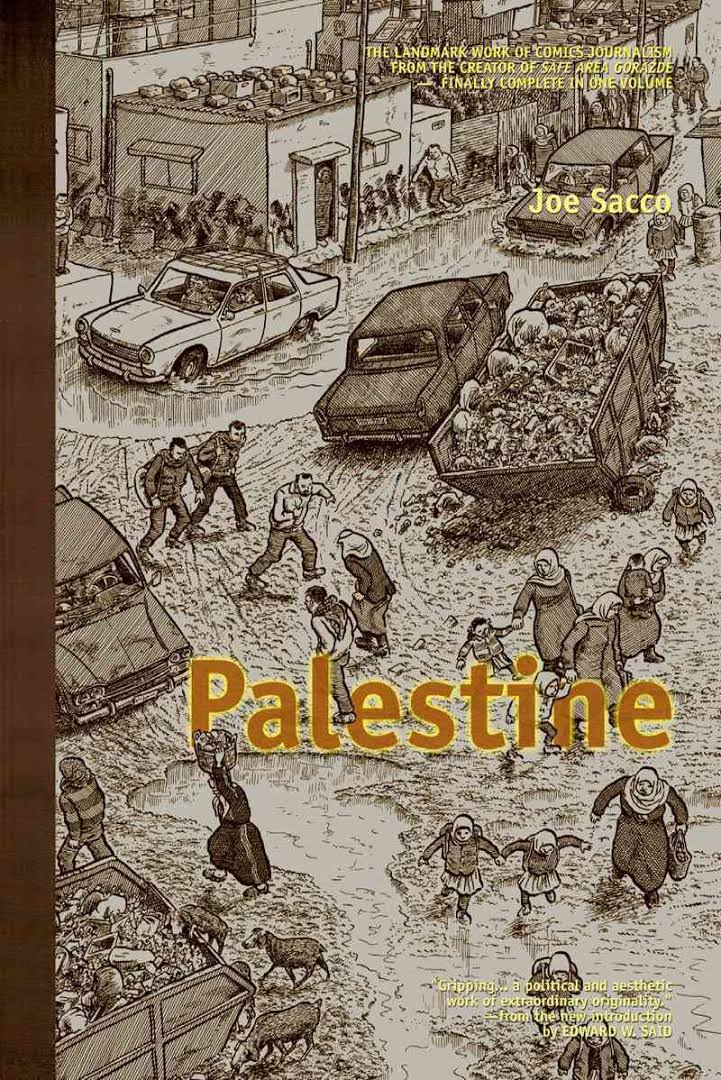
Palestine by Joe Sacco (1996) 288 pages

I've had reporter and artist Sacco's The Fixer and Other Stories on my reading list for awhile. Then I saw he wrote this book of graphic journalism called Palestine. It is available on Hoopla. Considering current events I thought this was a great opportunity to learn more about the Palestinian perspective. This was written back in the 1990s. I was in high school and definitely not paying attention to the conflict between Israelis and Palestinians. There are nine chapters. It took some time to get used to the chaos of some of the comic panels. Narration and speech bubbles are at angles or follow an "S" curve. Eventually I did grow to enjoy the style of Sacco's black and white sketches. Joe Sacco (illustrated with prominent round glasses and lips) is there on the ground meeting and interviewing everyone he can. He shares the history with chapter 2 containing columns of text and smaller illustrations compared to the rest of the book. Sacco witnesses and hears dozens of stories about the Occupation, the colonial power of Israel taking land and homes and lives to control and reduce the Arab/Muslim presence of Palestinians. He visits multiple refugee camps. He encounters the red tape of the Israeli military. He experiences the hospitality of tea served in every Palestinian home. He hears prison stories and stories of violence. He hears how the court system works against Palestinians and the Israeli hospitals avoid treating serious injuries of refugees. He discovers the differences of opinion about peace talks from the different Palestinian factions. Chapter 8 contains an especially heartbreaking tragic story from a Palestinian mother. Old folks tell stories of this happening decades ago. Teenagers tell stories of it happening then in the '90s. The news shows it is still happening now. Joe Sacco talks to Israelis, who have come from other Western countries, too. It is a complicated political issue, but identifying which group Sacco sees as the colonizers and which are the oppressed is not hard.

Tuesday, May 28, 2024

Lost Ark Dreaming

Lost Ark Dreaming by Suyi Davies Okungbowa, 178 pages

As the rising ocean temperature caused the Atlantic to swallow up more and more coastline in Lagos, thousands of Nigerians moved into The Fingers, five skyscrapers poking up out of the ocean itself. A few hundred years later, and the tallest, Pinnacle, is the only one left, and its residents are strictly separated by the Uppers, the Midders, and the Lowers, the latter of whom live on the levels that are literally underwater. When a Lower level experiences a wall breach, two Midders are sent down to investigate and make sure that nothing (either water or dangerous sea creatures) come through. However, they soon find themselves making decisions and learning things they never would have thought possible.

This is Okungbowa's first dive into science fiction, and oh, it's so good. His story is sculpted in equal parts by Nigerian politics, climate change, and creation mythology, which combine to make a short but thought-provoking tale reminiscent of Rivers Solomon's The Deep and An Unkindness of Ghosts (which are very very different, but somehow both apply here). It's well worth a read.

Monday, April 8, 2024

The Great Wave

 The Great Wave by Michiko Kakutani (2024) 238 pp

Polemic alert! But not in a bad way. The obvious premise— all things are changing — hence the extended sub-title: The Era of Radical Disruption and the Rise of the Outsider.  And to illustrate, the author produces a whirlwind overview of well-trod ground. This is preaching to the crowd writ large.

Well written and wide ranging, this work summarizes a potpourri of historical trends, current events, and prognostications. The primary weakness here is the mile-wide, inch-deep approach. For instance, a three-page overview of the gilded age fails to illuminate the complexities, intricacies and ramifications of the era - broad strokes instead of a careful brush.

The author is a well-respected journalist but this is not a scholarly tome, and although she fills the last forty pages of the book with notes/sources — mostly news articles, opinion pieces, and the occasional think-tank report — this is not a place to look for academic insights.

Criticism aside, as a person in the Biden/Trump demographic, I was pleased, enchanted and surprised by the interweaving of historical contextual references to the positive and strong accomplishments being made by today’s activists.


Thursday, January 4, 2024

Saint Death's Daughter

Saint Death's Daughter by C.S.E. Cooney, 477 pages

Miscellaneous Stones (Lanie) is the youngest member of the Stones family, which has long served Liriat's ruling family as executioners and assassins. Lanie, however, has an allergy to any sort of unnatural physical harm, as sympathy wounds appear on her any time she's near someone getting stabbed, poisoned, beaten senseless with fists, etc. Makes it a bit hard for her to spend any time with her family (which makes Wednesday Adams seem like a cuddly lovable puppy), and to her psychopathic sister Nita, Lanie is an excellent target for bullying. Thankfully, Lanie is also a necromancer, so she's able to spend her time instead with ghosts, revenants (like the Stones family's longtime servant, Goody), and all the skeleton creatures she can animate. But when Nita comes home from schooling abroad with a shapeshifting man in her thrall and a royal assignment to murder the wizards of a rival country, Lanie finds herself spending more time than she'd like with Nita, Nita's now-husband Mak, and her niece Datura, constantly fearful that Nita's work and violent inclinations will bring on Lanie's demise and the destruction of everything their family built.

This was an enjoyable read, though my summary above only really hits on a small bit of the plot. A blurb on the back notes "every time I thought I knew what kind of book it was, it changed," and really, I couldn't agree more. Cooney obviously had a lot of really excellent ideas for worldbuilding and characters, but at times, I felt like this could have been expanded into a few books that gave more insight into those characters and places instead of cramming them all into one place. It's particularly perplexing, as this is intended to be a series, so some of those elements certainly could have waited until later on. That said, I loved the idea of a gentle, bookish, vegetarian necromancer, as well as so many of the other characters. Unsure about whether I'll read more though, given Cooney's love of footnotes (which slowed down the reading a LOT).

(P.S. Just learned that this won the 2023 World Fantasy Award for best novel. Clearly, my misgivings are my own.)

Friday, November 17, 2023

The Bill of Obligations

 The Bill of Obligations: The Ten Good Habits of Good Citizens, by Richard Haas, 217 pgs. 

Democracy? More like demo-crazy, am I right? Thanks to authoritarian-leaning groups making bold power-grabs recently, I've learned a lot more about the state and history of democracy in the last few years than in my entire lifetime. While there's a deluge of political books these days, this one stands apart as it highlights some of the commonalities we share as countrymen and offers suggestions for maintaining those qualities, thus strengthening our mutual bonds as citizens and the country's writ large. None of the suggestions here are very partisan, rather they're very basic and commonsense measures that a majority of people can agree with. Haas served in the Pentagon and State Department under Republican and Democratic presidents and knows what makes good policy, both foreign and domestic. The obligations range from being informed and getting involved, to promoting the common good and improving our civics curriculums. I could definitely see an abridged version of this for teens being a good introduction to Civics 101. Highly recommended and a quick read for anyone feeling anxious about the country's future. 


Thursday, June 29, 2023

Red, White & Royal

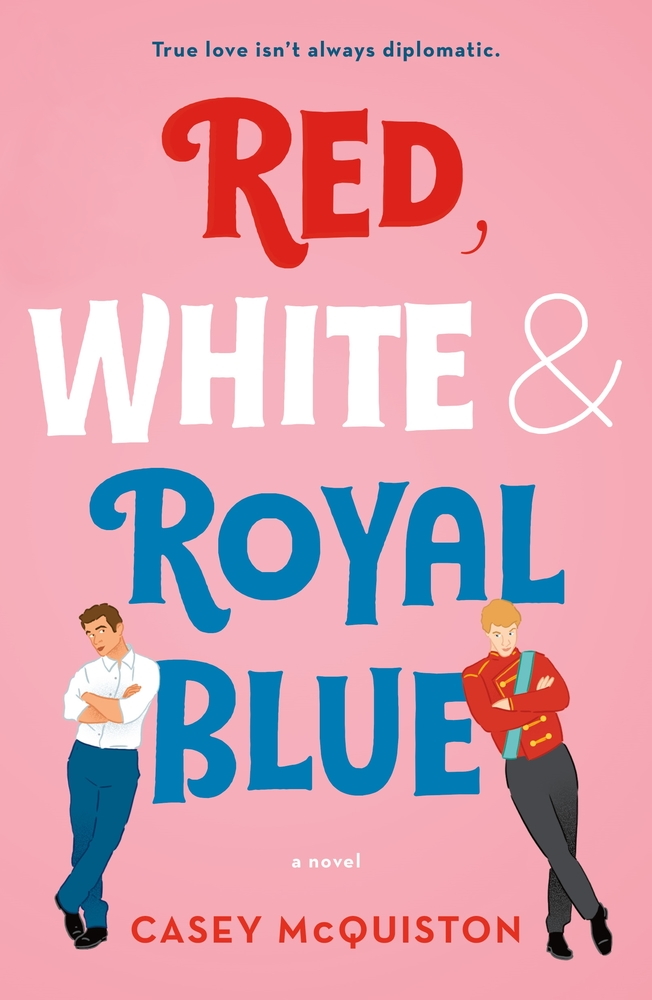
Red, White & Royal Blue by Casey McQuiston, 423 pages.

Alex Claremont-Diaz hates Prince Henry of England and his stupid face and boring personality. After he makes headlines when the president's son is seen in an altercation with the prince at his brother's wedding they have to convince the press that it was all a misunderstanding and actually they're best friends in order to save both families a scandal. Unfortunately (fortunately?) the act isn't an act for very long, as Alex realizes that most of Henry's public persona is in fact a persona, and soon the two are talking more honestly than they talk to anyone else. This turns into something more romantic before too long (shocking), but since their relationship would literally cause an international incident, everything has to be very clandestine. Is this a long term solution? Probably not! The question becomes how much will they each give up for this relationship.

I liked this book, I found the characters compelling. Like all of McQuiston's books I find the supporting characters to be one of the most compelling parts. This wasn't my favorite of the author's books, but I still found it sweet and fun, a perfectly enjoyable book.

Friday, February 17, 2023

Let's Not Do That Again

Let's Not Do That Again by Grant Ginder, 336 pages

Nancy Harrison is a longtime New York Congresswoman running for the Senate, just weeks away from Election Day, when her daughter, Greta, is photographed destroying property during a political demonstration in Paris. Nancy sends her long-suffering son, Nick, to France to retrieve his sister, while she focuses on managing the scandal back home. But as Nancy's campaign team starts to investigate Greta's actions and friends, the situation becomes much more complex.

I love dysfunctional family stories (they make mine seem so normal!), and Ginder has a gift for telling dysfunctional family stories, which should make this a home run for me. For the most part, I loved not knowing how straight-laced Nancy and loose cannon Greta would interact, as well as how mediator Nick would deal with these two stubborn women. But then something happens about 3/4 of the way through the book that took the story past the point of believability and unfortunately, it never came back. I won't spoil it here, as some may have a completely different take than I do, but the ending just didn't work for me. If anyone else reads it though, I'd love to chat about it!

Saturday, December 31, 2022

The World We Make

The World We Make by N.K. Jemisin, 357 pages

This second half of Jemisin's Great Cities duology (after The City We Became, which you REALLY need to read before picking up this one) finds the living avatars of New York and its boroughs struggling with being a newly alive city, one with a supernatural Lovecraftian horror still looming over Staten Island and threatening to destroy the newborn New York. In a less supernatural horror, a fearmongering mayoral candidate who aims to "Make New York Great Again" is stirring up fascists, and threatening to destroy what really makes New York great: it's diversity, creativity, and individuality.

Jemisin writes in an afterword that she intended this to be a trilogy, but when she started it, she didn't see COVID-19 on the horizon (but who did?), nor did she realize how close to home this series would hit. So two books is where this ends. But you know what? While it does hit disturbingly close to home, it's also an excellent duology, and this is a fitting end. I enjoyed it, and I loved that it had all of the Lovecraftian horror while fighting all of Lovecraft's hatred. A great duology, and I can't wait to read what Jemisin writes next.

Monday, August 1, 2022

Splendid City

Splendid City by Karen Heuler, 275 pages

Eleanor is a young woman, unsure of what to do with her life until a group of witches takes her under their wing. But no sooner does she become part of their coven than she turns her creepy and cocky coworker Stan into a cat. Sentenced to live with her major mistake (no, they can't figure out how to change him back, though that hasn't stopped him from drinking beer, eating tacos, and shooting people who annoy him), Eleanor must also travel to the new country of Liberty (formerly Texas) to investigate the disappearance of a witch there.

If you can't tell from the description, this was a really odd book. It somehow manages to be completely unbelievable (people really can't tell that the talking cat who keeps chirruping at birds is actually a cat and not just a hairy guy?) and way too believable (the politicians, the media, the surveillance of the Liberty populace). I would have liked it to veer into one of the two absurdities; as it was, I just felt too unsettled to really get into the story. But I guess that's what I get for choosing a book by its (admittedly cool) cover.