Showing posts with label 1960s America. Show all posts

Tuesday, April 28, 2026

Run: Book One

 Run: Book One by John Lewis and Andrew Aydin with art by Nate Powell and L. Fury (2021) 152 pages

This continues in the same style as John Lewis' graphic trilogy March, which I enjoyed. Well researched and intensely dramatic. Covers the three years John Lewis was chairman of SNCC, but the book is not just concerned with SNCC business. The coverage of events is broadly about the changes in the Civil Rights Movement during the mid-60s.

Wednesday, April 24, 2024

The Vinyl Underground

The Vinyl Underground by Rob Rufus (2020) 328 pages

I listened to the audiobook on Hoopla narrated by Nick Mondelli. It is 1968 and Ronnie is still grieving the death of his brother over in Vietnam the year before. He's now a senior and questioning his future plans. Does he still want to pursue his brother's dream of being a radio DJ in California, or go to college to pursue his own path? Will either of those even be an option if he is drafted? Ronnie's brother had sent him a series of letters each with a recommended song on a 45rpm. He privately cherished these letters and his brother's stash of great albums. With his best friend Milo, their new neighbor Hana, who is half-Japanese, and a fellow star wrestler Louis, who has already failed his first senior-year to defer being called in the draft, Ronnie forms the Vinyl Underground. They form the record club to share righteous songs and chat about school and the war while drinking and smoking weed. They also plan how to dodge the draft. Ronnie finds it is better to work through his grief when he shares his brother's letters and recommended songs. Hana's family is new to town and faces a lot of racism. A bully at school constantly accuses her of being a spy for the Vietnamese. There is a scene of a sickening attack on Hana that is racially motivated. Milo wants to be a filmmaker and has recorded the attack, but the police doubt the identity of the assailant. This sets in motion the boys planning a super secret prank at the school prom. I loved the name-dropping of musicians from this decade. I could hear most of them in my head. I loved the exploration of courage in the face of pro-war forces and those who protest the war machine.
 

Sunday, December 31, 2017

The Hue and Cry at Our House: A Year Remembered

The Hue and Cry at Our House: A Year Remembered by Benjamin Taylor, 183 pages.

Benjamin tells of growing up in Texas during the late 1950s and early 1960s and recounts what a large effect the Kennedy assassination had upon him and his family.

Friday, February 12, 2016

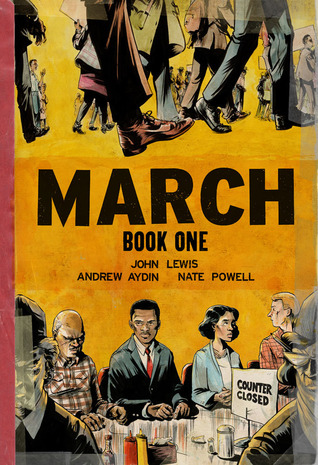
March: Books 1 and 2

March: Book 1, 128 pages, and March: Book 2, 189 pages, both by John Lewis, Andrew Aydin, and with art by Nate Powell

March recounts the life of Congressman John Lewis, one of the Big Six leaders of the civil rights movement and the only person still alive who spoke at the March on Washington. Using the inauguration of Barack Obama in 2009 as a framing device, Lewis tells about his childhood as a sharecropper's son, his desire to be a preacher, and the experiences that led to his role in the lunch counter sit-ins and other civil disobedience movements in the 1960s. Book 1 primarily deals with those early demonstrations, while Book 2 sees him remembering the Freedom Rides into the deep south to challenge the non-enforcement of interstate bus desegregation and the events that led to the March on Washington in 1963.

You might think that a comic book would be ill-suited to tell a story like this. You would be wrong, of course, but there is also a historic precedent for this. In 1957, a comic about Martin Luther King, Jr. and the Montgomery bus boycott was published. John Lewis read this comic book as a young man and was inspired, and it was his hope that by publishing his story in comic format, he might do the same for others. Both volumes are fantastic, especially with Nate Powell's wonderful art. Rendered in black and white, he manages to capture what many of us have seen on TV (either live or in documentaries), and make it more than just a carbon copy of newsreel footage. For example, you can see and feel the dread of the Freedom Riders pulling into a town and being forced to wait on the bus while the mob grows outside, knowing they face violence as soon as they are allowed to get off. March is an incredibly important read, especially in light of the Black Lives Matter movement, and I can't wait until book 3 comes out.

Monday, December 30, 2013

Brewster / Mark Slouka 281p.

Jon Mosher, son of Holocaust survivors, grows up and attends high school in a small town in 1960s upstate New York called Brewster. He carries a personal loss within him which connects him with Ray Cappiciano, a seeming tough guy whose personal tragedy is even more vivd in the form of his horribly abusive ex-cop father. Jon discovers track as a means of escaping his unhappy home, while Ray falls in love, but their friendship may not be enough to see them through to happily-ever-after.

This was a reasonably suspenseful story, and a nice portrayal of friendship. Slouka's portrayal of Ray's violent father is insightful and smart. But if you're going to write about adolescent angst in a forgotten corner of upstate New York, you'll have to run fast to escape the shadow of Richard Russo's Empire Falls, and I'm obliged to report that Slouka's writing lacks that escape velocity. And there was just way too much Oliver Stone-ish Boomer cliche. Vietnam, John Fogerty's Fortunate Son, grass-smoking free lovers, Woodstock...blech. I suppose it's possible to write something fresh about this era, but it didn't happen here.