Showing posts with label medical research. Show all posts

Tuesday, June 27, 2023

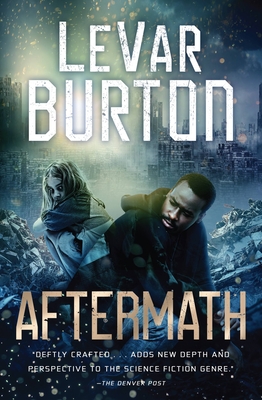
Aftermath


Aftermath by LeVar Burton (1997) 320 pages

The author, who is the same actor from Roots, Star Trek: TNG, and host of Reading Rainbow, wrote this in the '90s. In a way, he predicted a future America that would elect its first African American President in 2012, but within three short months the President was assassinated. Then a civil war over race in America collapses our society. This reminded me a bit of Stephen King's The Stand, which I've only read in graphic novel form, but this book has fewer characters. There are really four separate stories for three quarters of the book. Renee is a scientist who has invented a neuro-enhancer, and she is able to mentally call out for help when a rival scientist steals her invention and imprisons her. I wish the four characters' stories wove together sooner and that combining their skills to save Renee took more planning. As it is, it all wraps up in less than 50 pages and it doesn't seem like there is a great reason for each of the characters to be there. Still I mostly enjoyed the journey.

Sunday, February 14, 2016

The Portable Veblen

The Portable Veblen by Elizabeth McKenzie, 430 pages

Dr. Paul Vreeland grew up on a commune that was constantly being raided by a neverending cycle of hippie friends of his parents and DEA agents. Yet he's now an upwardly-mobile neurologist with a new device in testing phases at a VA hospital. His fiancee, Veblen, is a temp in a doctor's office,  voluntarily translates texts into Norwegian, and has a deep knowledge of the economist Thorstein Veblen, who inspired her name. If the two can sort through their family issues, as well as their vastly differing opinions on squirrels, they're getting married in the spring. And, at times in this book, that seems like an awfully big "if."

This book is hilarious in the weirdest ways. Veblen's long conversations with a squirrel, their experiences meeting each other's families, heck, even some of Paul's interactions in the VA hospital... they're all just so awkward and weird and fantastic. I particularly love McKenzie's goofy descriptions: she describes the diamond on Veblen's engagement ring as "a diamond so large it would be a pill to avoid for those who easily gag." It's tough to hit the right balance between weird and overbearing when it comes to family dysfunction, and McKenzie hits the sweet spot. Well worth a read, particularly if you like squirrels.

You Don't Look Like Anyone I Know

You Don't Look Like Anyone I Know by Heather Sellers, 356 pages

Heather Sellers is a successful English professor, with a complicated family life: her mom is likely a paranoid schizophrenic, her dad is definitely an alcoholic and likely has other mental issues as well, and her marriage is a strained one, as she and her husband don't see eye-to-eye on anything, from politics to what they want in a house. But Sellers' life is most complicated by face-blindness, her inability to recognize people's faces, no matter how well she knows them. This book covers Sellers' version of a coming-out story, the challenge of convincingly explaining her condition to her colleagues and friends, and the mountains of emotional baggage she had to unpack along the way.

This is a true story, and it's amazing how long Sellers went in life before being diagnosed with prosoagnosia, a rare neurological condition that makes it nearly impossible to recognize someone by their facial features (unless those features are REALLY distinctive; in describing the testing that was done to determine her diagnosis, she mentions that she was able to recognize a picture of Julia Roberts (sans hair and ears) by her toothy smile). This is a fascinating story, and well worth the read. I'm glad Sellers chose to share it.

Monday, December 14, 2015

Saving Gotham

Saving Gotham: a billionaire mayor, activist doctors, and the fight for eight million lives / Tom Farley 310 pgs.

The New York City health department under the leadership of Thomas Frieden became very active in trying to have positive effects on the health of its residents.  One of the first big "wins" was making restaurants and bars smoke free.  Bar owners thought this measure would put them out of business but in the end, business went up.  Turns out there are a lot more people who were avoiding smoky bars than going to smoke in bars.  By lowering smoking rates, the health department could project the number of lives saved.  Backed by Mayor Bloomberg, the department continued to make positive health related changes via regulations and laws.  The argument being, if a known infectious disease killed as many people as tobacco, obesity and high blood pressure, the health commissioner would lose his job.  Why NOT try to improve those things and improve the health of the populous.

I enjoyed this book and learned a lot more about public health verse the way we usually think of medical care...one doctor treating one patient at at time.

check our catalog

Tuesday, October 27, 2015

The Great Influenza: The Epic Story of the Deadliest Plague in History

The Great Influenza: The Epic Story of the Deadliest Plague in History by John M. Barry, 546 pages.
Barry does have an epic going here. He starts with some facts about the Great War and the flu, and then he doubles back and gives us the history of medicine up to that point. He then presents a fascinating section on William Welch and the other medical luminaries from the late 19th and early 20th centuries who were changing the way medical science was researched and the way in which medical care was given. Barry does a wonderful job of bringing these researchers and practitioners to life. As he takes us into the early stages of the epidemic, we also make acquaintance with the political movers and shakers of the time, so many of whom seemed to go out of their respective ways to make things worse when the "plague" hit. A really fascinating book, with so much detail, but with so much of the story still barely covered. Modern research indicates that as many as 100 million people died during the course of the pandemic, and most of those deaths took place far from the United States (though the Spanish Flu started here). Untold millions died in India, China, Russia (already wracked by revolution), and in parts of the world whose inhabitants rarely encountered flu. These regions are mentioned, but are not the focus of the book.
There is a fair amount of repetition in the text. I listened to a good deal of this book on audio, so that actually helped a bit with all the names, places, and numbers. Probably a better book to read so that you can keep the vast cast straight. A landmark book, ably read by Scott Brick.

Saturday, May 11, 2013

The Immortal Life of Henrietta Lacks

The Immortal Life of Henrietta Lacks by Rebecca Skloot  369 pp.

This is the incredible, upsetting, maddening, heartwarming, and very interesting story of how one woman's cancer cells survived and reproduced for over 50 years, long after she had died. The so-called HeLa cells became the most important tool in the search for cures for a variety of diseases. But little was known about the woman, her life, and her family until Skloot began her research. In fact, many believed the cells belonged to a woman named Helen Lane. What emerged is a story of an impoverished family with many problems who didn't know anything about the importance of Henrietta's cells. When they did learn that a part of her still lived and was being experimented on, they were not educated enough to really understand what was being done or why they had never been told. The book raises the issues of medical ethics, who owns tissue removed from patients, and who can profit from it.

Sunday, November 25, 2012

The Emperor of all maladies: a biography of cancer

The emperor of all maladies: a biography of cancer by Siddhartha Mukherjee  571 pgs.

It took me awhile to read this book, not because it isn't well written or compelling but at times it is difficult to realize how far we have to go with this cancer thing.  Of course it has come very far since the days of discovery.  The struggles and breakthroughs in research are all here.  Of course there are untold others who tried different research angles and made no headway.  I guess that is what was so overwhelming about this book, it really makes you think and also makes you reflect on the gift of good health.

check our catalog

Thursday, September 29, 2011

Stiff

Stiff: The Curious Life of Human Cadavers by Mary Roach  303 pp.

This book preceded Roach's book Bonk. Instead of sex research, it is about dead bodies. It's not about how the bodies got that way but rather what happens to them afterward. Included are the various ways donated cadavers are used for scientific and medical purposes, a "body farm" where human decomposition is studied, cannibalism, the myriad of ways bodies can be embalmed, cremated, composted, or preserved, and a look at the process that creates the "Body Worlds" exhibits. Roach did extensive research, traveling internationally to observe different research and techniques and to interview the people who do the "hands on" work with dead bodies. She is not afraid to observe the grotesque, disturbing, and often smelly firsthand. Nor does she shirk from asking the difficult questions. Throughout the book, the subject is handled in a respectful manner, even when humorous comments are included. I'm glad she disproved the "human buttocks in the Chinese dumplings" story or I might have to give up some of my favorite foods. And the idea of freeze-drying and composting just might change my mind about being cremated when the time comes.

Wednesday, September 21, 2011

Bonk

Bonk: The Curious Coupling of Science and Sex by Mary Roach  319 pp.

This book is a hoot! Roach has researched the history of sex research from as far back as she could find documentation to the present (including the work of St. Louis' own Masters & Johnson). What she has 'uncovered' is a collection of odd, interesting, sometimes frightening, frequently bizarre, and often laugh out loud funny studies, findings, and inventions. Ever thorough in her research, Roach interviewed sex researchers, observed scientific testing, participated in some research with her husband (yes, that kind), and found out more than you ever want to know about Norwegian hog insemination methods. The book is occasionally repetitive but never boring. The hypotheses and methods of some of the researchers will have you shaking your head. Some of the inventions will make you either cringe or want to buy one for yourself. Even more surprising is the fact that some of these researchers found willing subjects to study. Roach's humorous side comments had me laughing out loud. After reading this you will never look at the Pyrex in your kitchen the same way again.