Very, very, very dreadful: The influenza pandemic of 1918 / Albert Marrin, 198 pgs.
Who doesn't like a good pandemic story now and again. Especially now as we are enjoying our own pandemic. This 1918 story actually sounds more horrible. That flu took no time racing through the world, knocking down young adults faster than anyone else. The death toll is shocking. Of course some comparisons can be made to today but hopefully we are better off today after some strides in science and research.
We are competitive library employees who are using this blog for our reading contest against each other and Missouri libraries up to the challenge.
Showing posts with label flu epidemic. Show all posts
Tuesday, June 30, 2020
Wednesday, September 26, 2018
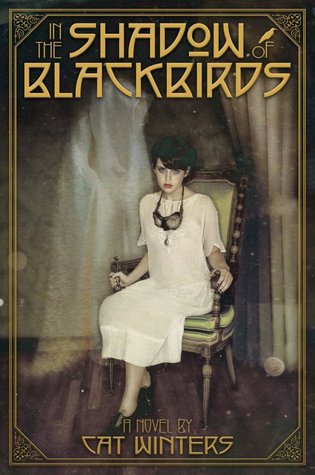
In the Shadow of Blackbirds
In the Shadow of Blackbirds by Cat Winters, 404 pages


16-year-old Mary Shelly Black’s life is falling apart. The year is 1918 and between WWI and the Spanish flu, death breathes down everyone’s neck. Furthermore, her father has been arrested under the Sedition Act and she is forced to move to a new city to live with her overprotective aunt. The one silver lining to this is that she will once again be close to her childhood best friend, Stephen. It is only once she arrives in town that she finds out he has enlisted and will be leaving within the week. A telegram arrives shortly thereafter announcing that he has died a hero’s death on the battlefield. When Stephen appears to her and she herself has a near death experience, she is forced to re-think her entire worldview. She now must help him understand what has happened - and solve her own mysteries - in order for him to rest.
Winters brings this book to life through archival photos and descriptions so evocative, you can practically smell it (I will never look at an onion the same way again). I recommend this for anyone who likes strong female protagonists, historical fiction, or books about resiliency in the face of disaster.
Tuesday, October 27, 2015
The Great Influenza: The Epic Story of the Deadliest Plague in History
The Great Influenza: The Epic Story of the Deadliest Plague in History by John M. Barry, 546 pages.
Barry does have an epic going here. He starts with some facts about the Great War and the flu, and then he doubles back and gives us the history of medicine up to that point. He then presents a fascinating section on William Welch and the other medical luminaries from the late 19th and early 20th centuries who were changing the way medical science was researched and the way in which medical care was given. Barry does a wonderful job of bringing these researchers and practitioners to life. As he takes us into the early stages of the epidemic, we also make acquaintance with the political movers and shakers of the time, so many of whom seemed to go out of their respective ways to make things worse when the "plague" hit. A really fascinating book, with so much detail, but with so much of the story still barely covered. Modern research indicates that as many as 100 million people died during the course of the pandemic, and most of those deaths took place far from the United States (though the Spanish Flu started here). Untold millions died in India, China, Russia (already wracked by revolution), and in parts of the world whose inhabitants rarely encountered flu. These regions are mentioned, but are not the focus of the book.
There is a fair amount of repetition in the text. I listened to a good deal of this book on audio, so that actually helped a bit with all the names, places, and numbers. Probably a better book to read so that you can keep the vast cast straight. A landmark book, ably read by Scott Brick.
Barry does have an epic going here. He starts with some facts about the Great War and the flu, and then he doubles back and gives us the history of medicine up to that point. He then presents a fascinating section on William Welch and the other medical luminaries from the late 19th and early 20th centuries who were changing the way medical science was researched and the way in which medical care was given. Barry does a wonderful job of bringing these researchers and practitioners to life. As he takes us into the early stages of the epidemic, we also make acquaintance with the political movers and shakers of the time, so many of whom seemed to go out of their respective ways to make things worse when the "plague" hit. A really fascinating book, with so much detail, but with so much of the story still barely covered. Modern research indicates that as many as 100 million people died during the course of the pandemic, and most of those deaths took place far from the United States (though the Spanish Flu started here). Untold millions died in India, China, Russia (already wracked by revolution), and in parts of the world whose inhabitants rarely encountered flu. These regions are mentioned, but are not the focus of the book.There is a fair amount of repetition in the text. I listened to a good deal of this book on audio, so that actually helped a bit with all the names, places, and numbers. Probably a better book to read so that you can keep the vast cast straight. A landmark book, ably read by Scott Brick.
Wednesday, February 18, 2015
Station Eleven
Station Eleven / Emily St. John Mandel 333 pgs.
The Georgian flu kills in 48 hours and by all evidence has wiped out 99.9% of the population. This is the story of some survivors who are all tangentially related through a relationship with an actor who has a heart attack right before the world ends.
This book is well written and interesting but I personally can't get past the timeline of certain events. Pretty much all modern conveniences stop after about 90 days and the book goes on to tell of 20 years after the pandemic. At that point, there is evidence of one town who has electric lights again. Seriously? Does no electrician or engineer survive? I personally have no skills that would be useful in this situation but I could read a book and learn. Instead these people get into these small communities and live off the land in tents. We are talking about TWENTY YEARS...I think someone would have gotten it together a little faster. What about solar and wind power? I'm not expecting manufacturing to rebound but I think you could come up with a few more improvements. Ok, off the soap box. Everyone else here really liked this book. And I did like it but found it frustrating.
check our catalog
Labels:
christa,
flu epidemic,
post-apocalyptic,
survival,
survivors,
tournament of books
Tuesday, December 30, 2014
The Boston Girl
The Boston Girl: a novel by Anita Diamant 322 pp.
Eighty-five year old Addie Baum answers the question put to her by her granddaughter: "How did you get to be the woman you are today." With a lot of humor and honesty she relates her life from about age 15 through her marriage. As the daughter of Jewish immigrants growing up in the tenements of Boston in the early 20th century she lived a hard life with until her eyes were opened to the world around her by joining a club for young women. Soon she learns to stand up for herself against her unhappy, domineering mother, survives man trouble, World War I, and the flu epidemic, to become a true "Boston Girl", working and supporting herself with the help and encouragement of other strong, modern women. It's a touching picture of a time when the roles of women began to change drastically and Addie revels in it. I listened to the audiobook read by actress Linda Lavin (tv's "Alice") and she gives Addie the perfect voice. This book is as enjoyable as The Red Tent but in an entirely different way.
Monday, December 16, 2013
In the Shadow of Blackbirds
In the Shadow of Blackbirds, by Cat Winters, 387 pagesFleeing her home in Portland, OR as her father is arrested for treason, Mary Shelley Black runs to her aunt's house in San Diego. Not only is she escaping the sight of her father's imprisonment, but she hopes to escape the Spanish flu. It's 1918, and boys half the world away fight each other, only to come home broken, both physically and mentally. At home, as families are broken by war and sickness, Spiritualism becomes all the rage, especially in the realm of photography, with photographers hoping to catch concrete proof of an afterlife. Mary Shelley, with her inquistive and curious nature (her mother was a doctor, after all), refuses to believe in it - science hasn't proven it, and it's far too easy to doctor photos to make them look like spirits have shown up. But after her best friend (who had the potential of becoming more than her best friend), Stephen, is killed in action, Mary Shelley manages to get herself struck by lightning. And then she dies. She forces her way back into her body, but she quickly finds herself haunted by Stephen, who visits her at night, talking of blackbirds and poison. Something clearly isn't right, and naturally, Mary Shelley puts her quizzical mind to work to find out what really happened to Stephen in an effort to put his spirit to rest.
I loved this book. LOVED. Mary Shelley is a fantastic heroine, especially due to her odd-for-her-time interest in science and engineering. The mystery around Stephen's death is perfectly twisty and satisfying in its conclusion. The inclusion of the historical elements of World War I and the flu epidemic that followed the end of it helped heighten the atmosphere surrounding Mary Shelley's haunting, helping to create a sense that the world as she knew it was ending, not only for her personally, but for everyone. In short:
I'll try not to the throw the book at you, but I can't make any promises. Definitely check it out if you enjoyed some of the topics that were in Libba Bray's The Diviners.
(Read as part of the Young Adult Library Services Association's (YALSA) Hub Challenge.)
Subscribe to:
Posts (Atom)

