There are some works included in this literary canon by people of Afro, Latino, and Asian descent. Some graphic adaptations of classic works are more successful than others. I'll try to keep this blog entry short by offering only a few highlights or critiques for each volume.
Volume 1
I had previously read three excerpts from Fred Van Lente and Ryan Dunlavey's graphic Action Philosophers!. It was a pleasure to revisit these entries. I especially liked the adaptation of Lucretius's "On the Nature of Things." There was also a great adaptation of a Noh play by Hagoromo. The adaptation of the classic Chinese novel Journey to the West was fun. And I enjoyed the satire of Swift's Gulliver's Travels and "A Modest Proposal."
Volume 2
There were too few actual graphics for adaptations of three Grimm fairy tales, three Hans Christian Andersen fairy tales, and five Edgar Allan Poe short stories/poems. There was an intriguing adaptation of The Mortal Immortal, something Mary Shelley wrote other than Frankenstein. This volume of 19th century literature has a mix of very short and very long works. Many were visualized too minimally. Edgar Allan Poe and Lewis Carroll are perhaps over-represented. Still I loved the visuals merged with the rhyme for Lewis Carroll's Jabberwocky.
Volume 3
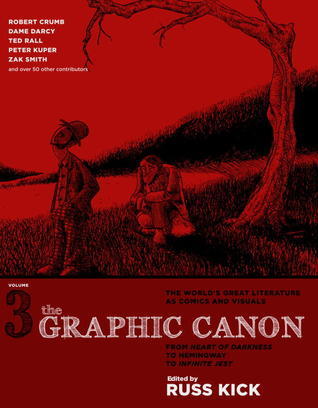
I caught two outright errors presented in the biographical introductions to two author's works in this volume. What others might the editor have missed? It is amusing mixing Kafka's The Metamorphosis with Charles Schulz's Peanuts. The poem "Dulce et Decorum Est" by Wildred Owen is given haunting graphics of the horror of WWI. There are excerpts of two graphic adaptations of James Joyce's Ulysses, yet it still remains difficult to fully understand. Hemingway's article "Living on $1,000 a Year in Paris" nicely illustrates the 1920s. "Letters to a Young Poet" by Rainer Maria Rilke offers radical graphic design of text with no images, but is still touching. A Robert Crumb adaptation of Sartre is frustratingly left in French with only a summary of the plot translated in the intro. "The Voice of the Hamster" by a teenaged Thomas Pynchon was very funny. I counted a full fifteen entries that gave a single page to convey a work. This is too minimal. A picture may be worth a thousand words, but not tens of thousands of specific words contained in most novels. These minimalist entries did not draw me into wanting to read the original works.


