Showing posts with label class differences. Show all posts

Friday, February 6, 2026

The Great Gatsby

The Great Gatsby by F. Scott Fitzgerald (1925), 180 pgs. 

A mysterious party host; a decadent mansion with crowds of lavish guests overflowing into the lawn; champagne and rumors spilling; distant views of the working class below. Welcome to the Roaring Twenties in New York City.
When Nick Carraway moves into the much smaller home next-door to Jay Gatsby's mansion, he gets an up-close view of extravagant wealth. Mr. Gatsby throws a fancy party every weekend, each one more over the top than the last. Nick is only an observer of these events until one day he receives an invitation, and suddenly he is a part of Gatsby's world--a world of affairs and adventures which is sure to end in disaster. 

This was my first time reading this classic, and I had a good time! The prose was a bit difficult for me to understand at times--I definitely had to re-read a few parts to get what was going on--but it is a very interesting story to imagine. The themes of class and gender roles during the 1920s are quite interesting to unpack, but this is definitely a story written from a well-off white male perspective.


Thursday, January 19, 2023

Eat The Rich

 Eat the Rich by Sarah Gailey (illus. Pius Bak and Roman Titov), 128 pages.

Joey is nervous about visiting her boyfriend Astor's very rich family in Crestfall Bluffs for the summer. It turns out she was very right to be nervous, but very wrong about why. The wealthy of Crestfall Bluffs are cannibals, and they eat their staff. And if Joey's not "the right kind of girl" they just might eat her too. 

This was a cool premise, but unfortunately the book didn't really work for me. There was to much of the plot that was hard to swallow (pardon the pun), and it didn't feel like this comic had anything really interesting to say. It was also really gross, but that was pretty much expected in a comic about cannibalism.


Monday, June 21, 2021

Rules of Civility


 Rules of Civility / Amor Towles, read by Rebecca Lowman, 335 pp.

In 1938 New York, Katey Kontent works in the typing pool of a Manhattan law firm while making the most of New York nightlife with the other residents of the boardinghouse she dwells in.  When she meets a charming and successful young banker, her life course is altered.

On one hand this is Katey's coming of age story, set in lavish period detail.  It's also an explicit examination of wealth and its meanings, and how much we should allow materialism to influence our choices, which strikes me as thematically similar to Towles' second novel, A Gentleman in Moscow.  

Thursday, June 17, 2021

The Children's Train


The Children's Train: a Novel / Viola Ardone, trans. by Clarissa Botsford, 295 pp.

Based on true events in postwar Italy which saw the transport of Italian children from the impoverished south to families in the wealthier north for temporary or permanent foster care arrangements.  This is the story of Amerigo, a young boy from Naples whose mother is loving but distant and whose father is absent, perhaps in America.  Amerigo doesn't go to school, seldom wears shoes, and is always more or less hungry.  An Italian communist group organizes his journey to a comfortable family in Modena, where he learns to play the violin and excels at school.  His problems arise when it is time to go home and he realizes he no longer knows where he belongs.

Interesting historical fiction which didn't quite grip emotionally.

Friday, January 24, 2020

Crazy Rich Asians

Crazy Rich Asians / Kevin Kwan, read by Lynn Chen, 527 pgs.

Nick and Rachel are two professors in love.  He invites her to meet his family in Singapore but does not prepare her for the realities of his family.  They are old money.  Lots of money.  The lifestyle they lead is so out of bounds of what Rachel knows, she is thrown for a loop.  And Nick is seen as a very eligible bachelor so there is scheming and gossip and craziness following them everywhere.  I thought this was going to be a light read, a fun romance but it was really so much more.  Aside from the scheming and fun description of excess, I enjoyed that there were a lot of characters with different perspectives and that the "romance" part was not always the center of the story.  Don't get me wrong, the focus on BUYING and having expensive things is a little nuts but there is more to it than that.  Would have liked more focus on Rachel's field but  this does depict her on vacation. Lynn Chen did a great job with the audio.

Tuesday, December 11, 2018

The secrets between us

The secrets between us / Thrity Umrigar, read by Sneha Mathon, 357 pgs.

Bhima is poor and illiterate.  Her husband and son left her.  Her daughter and son-in-law have died of AIDS. Only her granddaughter Maya remains and Bhima's goal is to put Maya through college so she can have a better life.  Bhima befriends Parvati, a widow in even more dire straights.  Together they start a business and face the changes that are overtaking Mumbai.  This is a wonderful story of strength, friendship and resilience.  The audio book is perfectly done by Sneha Mathon who conveys a sense of place and class differences through her excellent reading.

Thursday, August 17, 2017

David Copperfield

David Copperfield by Charles Dickens  891 pp.

I completed this year's Summer Big Book and have to say I liked it better than some past year's selections. In general I like Dickens' writing and, while this isn't my favorite of his novels (A Tale of Two Cities holds that place), it's better than some. There are places that the story bogs down and, in general, it is not a particularly remarkable plot. It is the characters that bring this book to life. Dickens' detailed descriptions of the characters, their mannerisms, and ways of speaking bring the story to life. The evil Uriah Heep, the generous but unlucky Micawber, the immature and flighty Dora, the cruel and controlling Murdstones, the unscrupulous Steerforth, and others are described so well there is no doubt of their personal attributes and attitudes.   The story of a young boy growing into manhood through good times and bad is a timeless one and much of what David Copperfield lives through could easily be translated into modern times. I have to admit that the part of the book I disliked the most involved David's marriage to Dora. She drove me crazy. I listened to the audio book version which was excellently narrated by Richard Armitage.

Monday, May 8, 2017

White trash

White trash: the 400-year untold history of class in America by Nancy Isenberg, 468 pgs.

Is America really the land of opportunity?  Can anyone make it here?  Isenberg tells the history of class going back to the earliest immigrants.  The land of opportunity was also a convenient place to send criminals and other miscreants.  Even then, the poor were looked upon as lazy, misbehaving deviants...and undoubtedly some were...just like the upper class.  Fast forward 400 years and we have a continuation on the theme.

It would nice to read something like this and see a history of great progress but I guess nobody would write that book if there wasn't an issue.

Monday, October 17, 2016

The Summer Before the War

The Summer Before the War by Helen Simonson  479 pp.

While this story begins before the start of World War I, it encompasses a large part of the war also, so I am rather perplexed by the title. In 1914, young, well educated, and essentially penniless Beatrice Nash arrives in the East Sussex town of Rye to become an outrageous oddity, a woman Latin teacher at the local school. Such a thing has not been experienced in this small town with an overactive gossip machine. Beatrice just wants to teach her students and spend her free time writing. Soon the gossips have much more interesting fodder in the Belgian refugees that are brought in after Germany invades their country.  Beatrice develops an interest in the son of her sponsor, a young man who is an aspiring surgeon, currently enamored of his mentor's daughter. What begins as a light story of small town residents and class differences and prejudice turns darker with the advent of the war. Not a family, rich or poor, is left unscathed by the conflict. This novel is a well written and highly detailed tale of an important part of England's history.

Sunday, April 24, 2016

Mothering Sunday: a Romance / Graham Swift, 177pp.

A brief and strangely powerful story shows us one important afternoon in the life of Jane Fairchild, 22-years-old in 1924 and housemaid to a wealthy family. More importantly, she is the secret lover of Paul, the scion of an even wealthier neighboring family. Their tryst on this unseasonably warm March Sunday, a holiday which was the forerunner of the modern Mother's Day, sets the course for Jane's future in unexpected ways. Deeply sensual but not gratuitous, and unlike anything I've read in recent years. Recommended.

Thursday, October 22, 2015

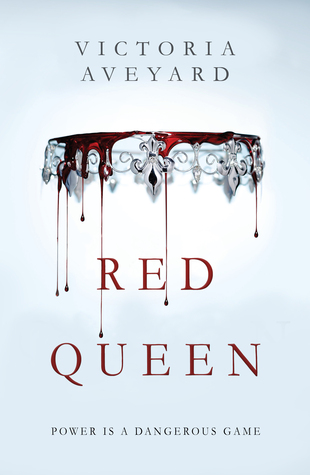
Red Queen

Red Queen by Victoria Aveyard, 383 pages

Mare's world isn't just stratified by the haves and have nots, but by the color of blood. If you have silver blood, then you have all the wealth, prosperity, and power in world - both the power to rule, but also physical power in the form of a special ability. But if your blood is red, then your life is not much more than a fight to survive. Mare is a Red. Her three older brothers have all been sent to the frontlines of Norta's never-ending war, and unless a miracle happens, she will likely be next. After a series of unfortunate events, she finds herself where she thought she would never be - with a job, working for the Silvers attending the Queenstrial. As the favored silver daughters demonstrate their abilities for the king and queen, hoping to be picked for betrothal to Cal, the crown prince, an accident happens, and Mare finds herself plummeting to an early death by electrified shield. Except she doesn't die. It's determined that she is something new and different and scary for the silvers in power - a Red with silver abilities, specifically the ability to manipulate and use electricity. And so she is thrust into the world of the silvers, hiding in plain sight, so to speak, as the betrothed of the younger prince, Maven. But when she's contacted by the Red Guard, a group of guerrilla fighters determined to take down the system oppressing them, she decides to work for them and help them further their cause. But trust in a world of secrets, lies, and machinations is a fragile thing to maintain.

Red Queen is a hard book for me to judge, and if the reviews on Goodreads are any indication, I'm not the only one. While reading it, I found myself greatly enjoying it, but when I wasn't reading it, it was largely forgettable. Part of the reason why probably has to do with the fact that it seems to mash together elements of several other popular YA series (Bardugo's Grisha trilogy and The Hunger Games for sure come to mind) with the more unique elements of the world Aveyard is creating. It has a weird almost love square at play between Mare and the other male main characters her age that was sometimes intriguing, but not enough to get me to root hard for anyone. I figured out the reveal at the end fairly early, but the twist took me surprisingly longer to figure out. It definitely benefits from Aveyard's skills as a scriptwriter. Despite the feeling of having read much of this before, she kept the plot moving perfectly, so it should adapt to the big screen without much of a challenge. So basically I enjoyed it, but there wasn't much there to make it a stand-out for me. Pick it up if you're a die-hard YA fan like me, but otherwise, you're not missing much.

Wednesday, October 29, 2014

On Immunity: an Inoculation / Eula Biss 205 p.

A book as unusual as it is important.  Biss is the author of, among other things, Notes from No Man's Land: American Essays, which earned a host of accolades and was chosen as Washington University's 2013 First Year Reading Program title for its elegant examination of race and identity in America.  Here Biss takes immunization as a focal point for a discussion of, well, many things: individual rights versus the needs of the group, the boundaries we place on our own bodies, notions of cleanliness and purity, sickness and health.  She is at once provocative and mild, clearly seeking to draw readers into a conversation rather than pushing them away from a hard, bright line.

While Biss writes with delicacy, in the end she is clear about her pro-immunization position.  One senses in her desire not to demonize those who disagree with her a strong wish not to alienate herself from them.  She casts herself over and over as an upper-middle class mother with all the hyper-vigilant concerns that characterize that tribe.  At times she goes overboard here, in statements such as ,"I remember feeling agony when my son drank water for the first time."  Agony?  Either she is grossly exaggerating for the sake of appearing 'balanced' or she is...well, let's just hope she's exaggerating.