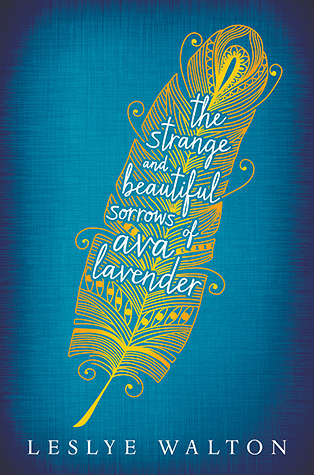
The Strange and Beautiful Sorrows of Ava Lavender by Leslye Walton, 301 pages
A 2015 Morris Award Finalist
The Roux women's lives have been defined by loves and loves lost. Emilenne, who immigrates with her family from France to Manhatine (Manhattan, naturally) on her larger-than-life father's belief that their lives will be better, loved three times to disastrous results before settling, moving to Seattle, and giving birth to Viviane. Viviane grew up in her mother's bakery, somewhat of an outcast, her only friend being Jack Griffith. As they grew up together, friends became lovers, until Jack went away to college and came back engaged. One last tryst left Viviane pregnant and heartbroken, and it seemed that this history of love and loss somewhat manifested in her twins: Ava, born with wings and initially heralded as an angel, and mute and remote Henry, who didn't speak a word until Trouver the puppy tumbled into their lives. Closed up in a grand house, Ava never wanted for much - she had her mother, her brother, her grandmother, Gabe, who boarded with the Lavenders when Viviane was a teenager and immediately fell in love with her, and best friend Cardigan who lived next door - until she was a teenager and Nathaniel Sorrows moved to town.
This book is beautiful. I'm sort of upset it's YA, because if it were about 100 pages longer and advertised as being for adults, we would be talking about it with the same bated breath as Anthony Doerr and other literary fiction bestsellers. It's a fantastic piece of magical realism (almost too much so at times), full of the different ways love can mean and be expressed. Walton's prose is excellent, full of what my tenth grade English teacher would call beautiful sentences, and her wordplay in naming characters (Jack's wife is named Laura Lovelorn, for example) is fun. It's an excellent debut novel, and I'm looking forward to what she writes next.
(Read as part of YALSA's Morris/Nonfiction Challenge.)
We are competitive library employees who are using this blog for our reading contest against each other and Missouri libraries up to the challenge.
Saturday, January 17, 2015
Friday, January 16, 2015
Sharp Objects
Sharp Objects by Gillian Flynn, 254 pagesCamille Preaker is a crime reporter in Chicago, but is sent back to her hometown in the Missouri boot heel to cover a possible serial kidnapper and murderer. Staying with her cold mother, nondescript stepfather, and unnerving 13-year-old sister in the sterile home where she grew up makes Camille slip back into the discomfort of her youth as she attempts to separate rumor from fact.
Flynn (Gone Girl, Dark Places) is not known for creating likeable characters, but in this, her debut novel, she succeeds in making Camille sympathetic, while still messed up beyond belief. I'll admit that, pretty early on, I could see where this story might end up; that said, I had no idea exactly how we'd reach that point, and there were enough twists and tension to make the journey fascinating (albeit in a slightly stomach-turning way). IMO, this is Flynn's best book. Well worth a read.
Labels:
bad mothers,
dark fiction,
Kara,
kidnapping,
murdered children
Thursday, January 15, 2015
The Golden Age Shtetl: a New History of Jewish Life in East Europe / Yohanan Petrovsky-Shtern 431p.
Most everyone has seen a version of Fiddler on the Roof, set in the fictional shtetl of Anatevka. Petrovsky-Shtern wants to remind us that Anatevka represents the dying days of the many shtetls (or shtetlach) throughout the Pale of Settlement, or western Russia. The shtetl had a golden age, from approximately 1780 to 1840, when the shtetl territories had only recently been conquered from Poland, and before the rise of a more backward-looking Russification. Petrovsky-Shtern has done a truly amazing amount of research and assembled an in-depth view of aspects of shtetl life, from trade, home construction, married life, religion, and literacy. Not exciting but entirely readable; this almost could be considered a stand-alone reference volume. Coherent and extremely impressive.
Exit Berlin: How One Woman Saved Her Family from Nazi Germany / Charlotte Bonelli 293 pp.
Bonelli is an archivist who researched the letters of Luzie Hecht, a longtime employee of the American Jewish Committee, and in so doing uncovered an important wartime story. Luzie was a 27-year-old Berliner, from a comfortable but not wealthy Jewish family. In 1938, having for months seen her employment prospects dim in Germany, she left Berlin with the assistance of a wealthy American cousin, Arnold Hatch. (Hecht, anglicized) Over the next several years, she maintained copious correspondence with a host of relatives and friends in Germany, her file being distinctive because she kept copies of her own letters as well as those she received. She made strenuous efforts to assist and advise this wide circle who was left behind, with no financial means of her own.
I sort of fell in love with Luzie while reading her letters. Although she succeeded in directing her immediate family to New York via an 18-month stay in Shanghai, most of her remaining correspondents would perish. This was no fault of Luzie's, of course. She was a penniless immigrant in New York who had only her distant relative in Albany to rely on. It was her role as cheerleader to all those left behind, so evident in her letters, that was quite moving. I can only imagine how important her many letters were to those who received them. Bonelli's arrangement and explication was far less interesting than the letters themselves; still I am grateful for her work in bringing them to light.
Labels:
Berlin,
Holocaust,
immigrants,
Kathleen,
letter writing,
New York,
Shanghai
Tuesday, January 13, 2015
The Strange Library
The strange library / Haruki Murakami
After being invited to the special reading room, a young boy is taken prisoner by an old man who wants him to memorize books and eventually eat his brain. The boy's guardian is the sheep man who is dressed in sheep skin but abused and controlled by the old man. A beautiful translucent girl who visits his cell encourages the boy to escape and says she will join him. They make a break for it but are confronted by the old man. I won't spoil the ending but will marvel at another interesting edition by Murakami.
check our catalog
Trieste / Dasa Drndic 359 pp.
Drndic describes this novel as documentary fiction. Using poetry, encyclopedia entries, photos, and archival lists, she assembles a faintly traced fictional story based on the true story of a German-Italian-Slovenian-Jewish woman who spends most of her life on the Adriatic coast near Trieste, a city in present-day Italy which, like Haya, has a Babel-like heritage. Haya has an affair with an SS officer and later gives birth to his son. At five months of age the boy is kidnapped to increase the ranks of Aryan-ish boys for the Lebensborn. [From Wikipedia: Lebensborn e.V. (literally: "Fount of Life") was an SS-initiated, state-supported, registered association in Nazi Germany with the goal of raising the birth rate of "Aryan" children via extramarital relations of persons classified as "racially pure and healthy" based on Nazi racial hygiene and health ideology.]
So. As confusing as the above is, it's crystal clear compared to Drndic's impressionistic approach to storytelling. Which is not to say that it's not a brilliant piece of work, at least in part. It demands a tremendous effort on the part of the reader, though, and in the end, the story itself is thin. She's done something worthy, and certainly interesting, but it's hard to evaluate a work which is nearly a scrapbook. Laundry lists of atrocities are not, in themselves, novels, at least I don't think so. And ending a 'novel' with a page of text from The Waste Land seems wrong, somehow.
Nevertheless, I appreciate Drndic's reveal of the specific world of Italian Jews which is a story less told (at least in English) than some others.
Labels:
Holocaust,
Italian Jews,
Kathleen,
math teachers,
refugees,
World War II
Monday, January 12, 2015
Anne of the Island
Anne of the Island by L.M. Montgomery, 244 pagesThis is the third book in Montgomery's classic Anne of Green Gables series, and focuses on Anne's college years. It's just as sweet as the previous two, and just as idyllic. I'd not read the series before, and I'm enjoying these titles, which are an excellent palate cleanser between watching Game of Thrones and reading some Gillian Flynn.
Sunday, January 11, 2015
Being Mortal
Being Mortal: Medicine and what matters in the end / Atul Gawande 282 pgs.
Atul Gawande writes a brilliant book about the end of life and how we are (mis)handling it. He discusses nursing homes, assisted living, the role of doctors, the role of patient, and so much more. I found the way he boiled down the indignities of aging great to explain the ideas of what we want for our elderly parents in contrast to what the elderly actually want. It is kind of eye opening to realize how "assisted living" is marketed.
In the end, we all just want to be happy. We want things that are important to us to be respected and made doable if at all possible. I'm not sure this book will get rid of all the oddness that surrounds death and aging in our culture but it sure did help me.
check our catalog
Saturday, January 10, 2015
The Monuments Men
The Monuments Men: Allied Heroes, Nazi Thieves, and the Greatest Treasure Hunt in History by Robert Edsel with Bret Witter, 473 pagesDuring World War II, the Nazis stole and hoarded thousands of priceless artworks and cultural treasures. While some were lost or destroyed during the years of the war, an astonishingly high number of these pieces survived, thanks to the work of an American and English collaborative unit, the Monuments, Fine Arts and Archives section, also known as the Monuments Men.
Edsel's book gives a thorough examination of these unsung heroes in their earliest days, when only a handful of Monuments Men were working, without supplies and often on their own in combat situations, were attempting to save some of the most treasured artworks and cultural sites in Europe. It's a fascinating tale; though if this book has any fault, it's that Edsel crams too much information in. Any one of the original Monuments Men and their allies (particularly the astounding Rose Valland) could easily be the subject of his or her own book, yet Edsel's determination to shoehorn in all the original Monuments Men makes the story a bit muddled. That said, it's still worth a read, as this is a history that needs telling.
Labels:
art,
art history,
art theft,
Kara,
Nazis,
non-fiction,
WWII,
WWII aftermath
Thursday, January 8, 2015
What if?
What if?: Serious scientific answers to absurd hypothetical questions / Randall Munroe 303 pg.
Have you got unanswered questions? I think we all do. If those questions are science related, you can ask them to Randall Munroe, the author of the webcomic xkcd and he might try to answer it. Now he has put some of the questions and their answers into a book. If, for example, you have been wondering what would happen if you started rising at 1 foot per second, how would you die? Would you freeze, suffocate or something else? This book has a whole chapter covering this topic. The answers you get here are as interesting as the questions. Who else would spend the time researching such thing? Munroe is a gem and has a lot of librarian in him.
check our catalog
Labels:
answers you have been looking for,
christa,
research,
science
Subscribe to:
Posts (Atom)