We are competitive library employees who are using this blog for our reading contest against each other and Missouri libraries up to the challenge.
Wednesday, October 28, 2026
Easy Crafts for the Insane: A Mostly Funny Memoir of Mental Illness and Making Things by Kelly Williams Brown
The author experiences a truly astounding amount of misfortune in a short amount of time, including hospitalization for mental health, and details how humor and crafting helped her cope.
I feel like there are a lot of books of this type, attempting to "put the fun back in dysfunctional", but I found this to be way better than the myriad of such memoirs circulating. The author's style is easy, and she does take responsibility and learn and grow from these difficulties. This book was not just an exhausting endless tragedy with no point (a la Tara Westover) nor was it more cringy than necessary ( lookin' at you, Jenny Lawson). I appreciated that she limited her stories to those she had a reason to tell, and that for the audiobook she omitted most of the craft instrucitons. It really did have some solid crafting advice, too!
The Half-God of Rainfall

The Half-God of Rainfall by Inua Ellams, 96 pages.
When Demi cries, the storms come; when he shoots a basketball, he does not miss. Demi's father is Zeus, and his mother an unwilling mortal Nigerian woman. Demi's great passion is basketball, and when the worshipful admiration of his fans begins to draw the ire of the gods, he and his mother Modupe flee to America. But even there they can't escape the pettiness of the gods, and so must choose to stand against them.
Ellams is a poet, and although this novella is written in prose, you can still definitely tell that is his background. I found the prose powerful, and thought this short book used every page very efficiently.
The Death of Jane Lawrence

The Death of Jane Lawrence by Caitlin Starling, 362 pages.
Jane marries Dr. Augustine Lawrence out of convenience, and if he has an odd condition or two that's no more than she had when she proposed the strange arrangement. Augustine says he must spend every night at his family's crumbling estate, and she must never sleep there. This arrangement is almost immediately broken, and Jane is quickly pulled into the strange and terrifying mysteries of Lindridge Hall, where she learns that her husband is not what he seems, and neither is the world.
This was a delightfully unsettling gothic novel. The synopsis listed Crimson Peak as one of its big inspirations, and there is a lot of that here, especially in atmosphere. However, Starling also engages very consciously with the genre, and plays on expectations about classic gothic novels to subvert them. I was very impressed by this book, even if the end lost me a little. I would still recommend it wholeheartedly, especially for fall.
Throw Away the Key
Throw Away the Key by Jason M. Hough, 320 pages
Lars Bergman was once part of the CIA's "surreptitious entry team," the group assigned to sneak in and steal, plant, or replace documents or other things during spy operations. But now, he's semi-retired, putting his skills to use as the main locksmith at CIA's headquarters. When a woman near the top of the CIA hierarchy dies and leaves hints that only Lars would understand in her office safe, he begins to suspect that her death is tied to a failed operation from decades earlier.
This is simultaneously a throwback to old-school Cold War spy thrillers and a nesting doll of heists. I loved the twists and turns, as well as the details about locks and how to pick them. Yeah, there are a lot of spy tropes here, but they're done so well. A wonderful escapist novel that you can just sink into. I recommend it for fans of Alma Katsu's CIA thrillers.
Tuesday, October 27, 2026
These Walls Remember
These Walls Remember by Del Sandeen, 352 pages
When sisters Mickie and Delilah inherited their great aunt's house, they also received their relative's increasingly unhinged artwork from the asylum where she spent her final days. Among the drawings, a note: DO NOT GO INTO THE ATTIC. Yet as Mickie prepares to flip the house for quick sale, Delilah is drawn toward the locked attic door and soon finds herself ascending the stairs. Meanwhile, Mickie starts hearing about mysterious disappearances linked to the house, going back to it's origins in the late 1800s. Before long, there is something pulling at both sisters, begging them to stay at the house.
I'll be honest — I read this book about a month ago and completely forgot about it until I saw it on my list of books to blog about. It wasn't until I looked up the plot summary that bits started to come back to me. So while it was a creepy read while I was reading it, it obviously has no staying power, at least not for me. Which is a shame, because it did offer up a nice Southern gothic haunted house vibe with plenty of generational trauma thrown in. The walls may remember, but I certainly don't.
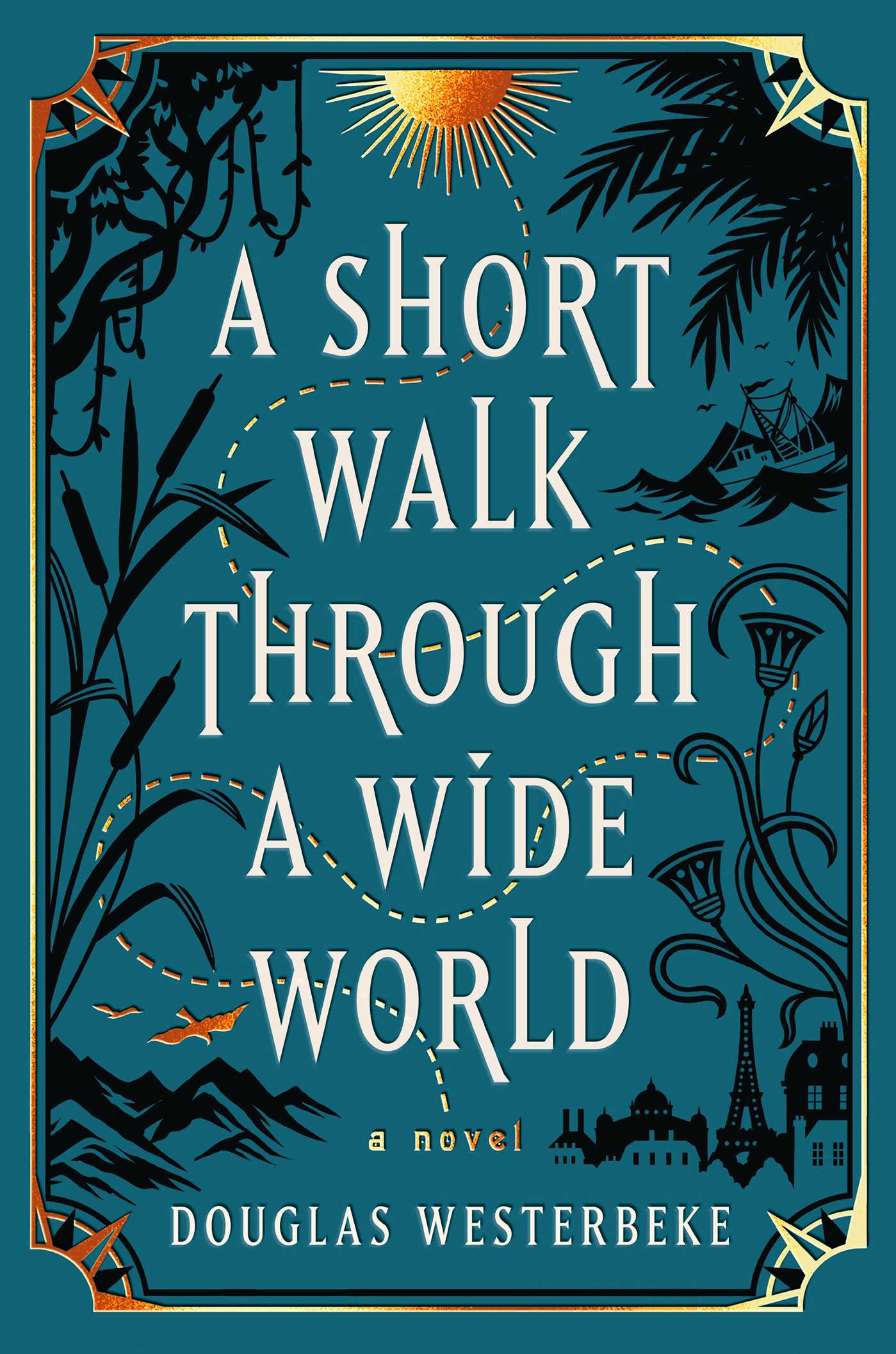
A Short Walk Through a Wide World

A Short Walk Through a Wide World by Douglas Westerbeke, 400 pages.
As a child in Paris, Aubry Tourvel was struck with a strange illness. If she stays to long in one place she starts to bleed, then die. The only thing that holds her illness at bay is travel, so she begins to walk. Over the decades her wanderings take her from the greatest cities to the most remote locations. The only thing that is constant is that she can't stay, and she can't come back anyplace she has been before. Over the decades the world starts to change, as she passes from the 19th century to the 20th. Aubry sees countless wonders, but she sees most of them alone, as she longs to share her strange life with someone, and finally find a place to call home.
I enjoyed this book a lot. It had a lot of really great set pieces, and Westerbeke did a good job building vibrant, interesting characters even if they were only part of the book briefly. The nested, non-linear stories did a really great job conveying the endlessness of Aubry's travels, as well as the vibrancy of her experiences. My biggest complaint was that the book couldn't seem to decide whether the "why" of Aubry's illness mattered, and I think I would have preferred it go entirely unexplained over the half measures taken towards the end (along with a totally unnecessary bootstrap paradox). Despite a couple of hiccups, I think this is really impressive for a debut novel, and did quite enjoy it.
Daggerbound
Daggerbound by T. Kingfisher, 448 pages
Learned Edmund is no longer excited by his career as a religious scholar after discovering that his job mainly consists of schlepping artifacts from one temple to another. He's determined that this job will be his last, though he doesn't anticipate being set upon by bandits and grabbing the relic with his bare hands, releasing an warrior cursed to live in the dagger forever. The Dervish, as the immortal and devastatingly handsome warrior calls himself, must serve the bearer of the dagger whether he wants to or not. But as much as he wants to hate his new wielder, the Dervish just can't help but like Edmund for his dorky kindness.
While that first paragraph makes this sound like a romance novel, I'd argue that it's more of a found-family cozy fantasy, as Edmund and the Dervish manage to pick up strays and reforge old friendships throughout their journey to break the Dervish's curse. It's sweet and cozy and a fun story, no matter where you put it on the shelf though.
The Savage, Noble Death of Babs Dionne
The Savage, Noble Death of Babs Dionne, by Ron Currie (2025), 368 pages
Babs is the matriarch of a
Franco-American all-woman crime syndicate in Little Canada (Waterville, Maine).
She is a proud French-Canadian American and Catholic. She is determined to keep
those identities strong in her rural Maine town. To help her are her
drug-addicted daughters and a cadre of like-minded local women. Her stronghold
has been noticed by another narcotics gang and things come to a head with devastating(?)
consequences.
This sounded interesting on
paper and was a good read, but it could have been a great read. It was nearly
impossible to connect with any of the characters and they had few redeeming
qualities and the author did not give us enough backstory to sympathize with
their current situation. I still don't understand why Babs was so determined to
cling to her heritage when we are never given an opportunity to understand why
it is so important to her. While French-Canadians were definitely not treated
fairly and that was painful as a child, her family did not seem particularly interested
in maintaining their cultural background. Babs, while trying to mother the
community, seemed to be a pretty terrible mother to her actual children, yet
they had a weird loyalty to her. Perhaps if Currie and delved more into Babs
rise as the gang leader, it would have been easier to connect to the story as a
whole.
Friday, October 23, 2026
Brooms
Brooms by Jasmine Walls and Teo Duvall, 248 pages.
In a 1930s Mississippi slightly more magical than our own, illegal broom races fill the skies deep in the woods. These races are a vibrant gathering place for the people too marginalized for the national races, and an opportunity to win the money to change lives. Billie Mae is the leader of the Night Storms, and is determined to make enough money to get to one of the states where Black folks can legally practice magic. Sisters Mattie and Emma are trying to earn enough money to avoid getting sent to a residential school, a place where their cousin went and came back without her magic. Other members of the Night Storms have their own reasons to race, and as time runs out and the law draws closer, their desperation sends them to the most dangerous race of all.
This was a really neat book! It draws on a lot of real history and extrapolates from there to make a world the feels real and believable. The art was expressive, and I think it did a good job helping to tell the story. A pretty cool historical fantasy graphic novel, definitely worth checking out.
Wednesday, October 21, 2026
Up on Cove Mountain: Adventure, Tragedy, and a Quest for Meaning on the Appalachian Trail
Up on Cove Mountain: Adventure, Tragedy, and a Quest for Meaning on the Appalachian Trail by Early Swift (2026), 368 pages
I
seem to be on a kick of reading novels where middle-aged men revisit an
adventure from their youth. Between Mississippi Solo, Walking with Sam and Up
on Cove Mountain, I have found the latter to be the most interesting. BUT, if I
was likely to actually undertake one of the three treks, it would definitely be
the Camino de Santiago (then the Mississippi River with the Appalachian Trail a
far third). Why? Because Swift does an excellent job of conveying just how hard
and long the trail is. I cannot imagine doing it twice, with the second time
being 66 years-old. Swift notes how the trail has changed over 34 years and how
climate change has affected the availability of resources (especially water)
for hikers. I learned a lot about how people hike the trail, trail culture, and
what it means to thru-hike. I thought it meant you did the hike in one long
fell-swoop. Apparently, it is not uncommon to leave the trail and come back
many times and, as long as you complete it within a year, you are considered a
thru-hiker. Swift also touches upon a tragedy that happened during his first
thru-hike: the murder of a young couple on the trail. He had interacted a few
times with this couple and their murder shocked him and the otherwise insular
AT community. While this is an interesting sub-plot, the majority of the book
is devoted to what it means to hike the trail and the self-discovery it brings
along the way.